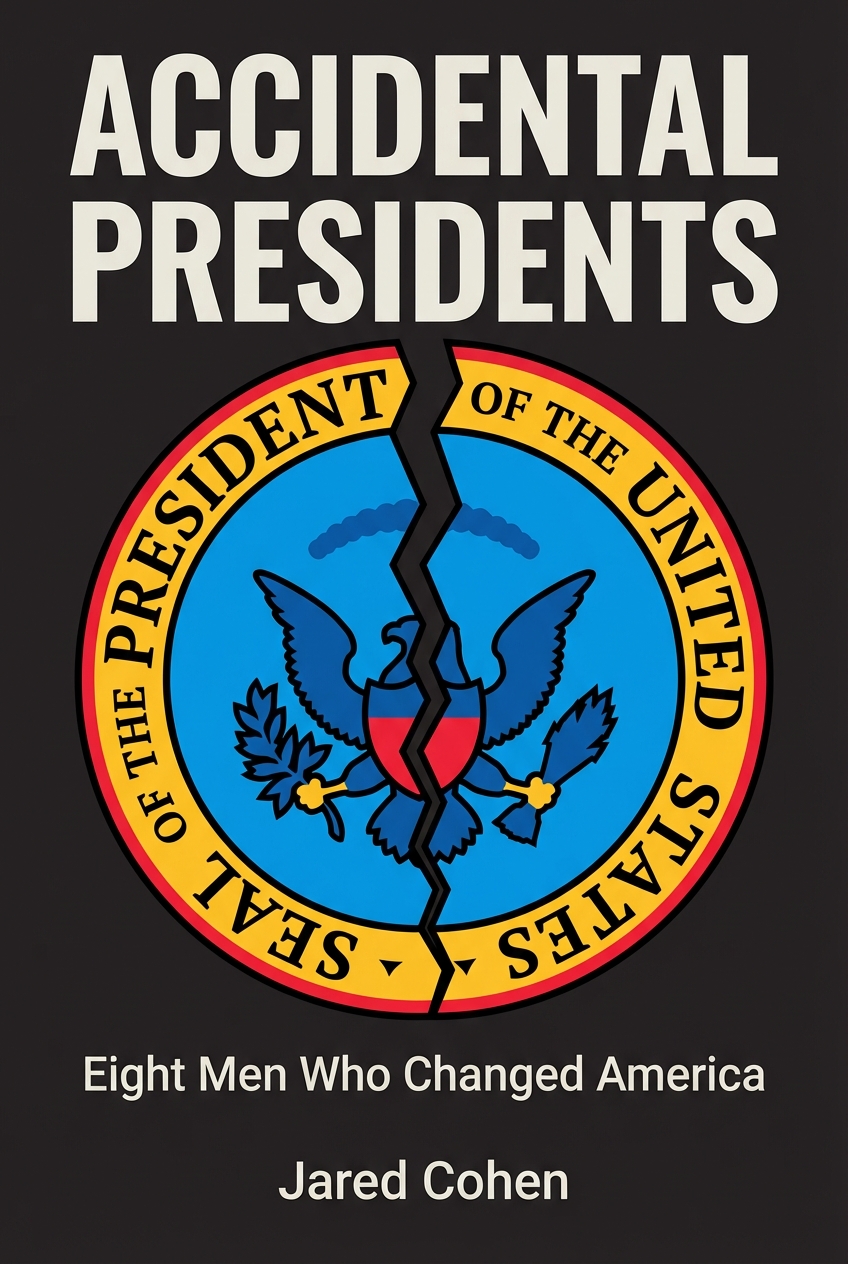
Accidental Presidents
Eight Men Who Changed America
What's it about
What if history's biggest turning points weren't planned? Discover how eight men who were never supposed to be president unexpectedly took power and radically reshaped the nation, proving that a single heartbeat can change the course of America forever. You'll learn how these "accidental presidents" navigated immense crises, from civil rights to the Cold War, often with no mandate from the people. Uncover the behind-the-scenes drama, the critical decisions they faced, and the surprising leadership lessons that reveal how unforeseen circumstances can forge greatness.
Meet the author
Jared Cohen is the founder and CEO of Jigsaw at Google, a technology incubator that builds products to address major global security challenges. His extensive background working in policy planning at the U.S. State Department under two secretaries of state provided him with a unique vantage point on executive power. This direct experience with the highest levels of government and its vulnerabilities gave him the essential insight to explore how unexpected successions have profoundly shaped American history in Accidental Presidents.
The Script
The Secret Service has a codename for it: 'The Deats.' It’s the meticulously rehearsed, yet never-spoken-of, procedure for when a President of the United States dies in office. While one team of agents surrounds the fallen leader, another, smaller team immediately peels away, forming a new protective bubble around a person who, just moments before, was largely a political afterthought. In that instant, without an election, without a campaign, and often without any real preparation, the line of succession snaps taut. The vice president is no longer the vice president. The entire political, military, and economic trajectory of the most powerful nation on earth now rests on the shoulders of someone the public didn't choose for the top job—and who likely never expected to hold it.
This high-stakes transfer of power is a recurring hinge point in American history. It's the moment when a person’s hidden character is thrust into the global spotlight under the most extreme pressure imaginable. This very scenario—the sudden, dramatic elevation of the second-in-command—is what fascinated Jared Cohen. As a historian and former policy advisor who has worked inside the halls of power, Cohen saw these moments as profound stress tests of both an individual and the nation. He realized that to understand America, we must understand the men who were never meant to lead it but did. This book is the result of his deep dive into the stories of these nine 'accidental presidents,' exploring how their unforeseen ascensions changed the course of history.
Module 1: The Vice Presidency as a Political Blind Spot
The vice presidency is often treated as a political bargaining chip. It's a tool for party unity or electoral advantage. This creates a dangerous dynamic. The person one heartbeat away from the presidency is often chosen for reasons that have nothing to do with their ability to lead.
The book shows vice presidential candidates are often selected to appease rival factions, not for their qualifications. This practice is a marriage of political convenience. A candidate needs to win a specific state or satisfy a powerful constituency. So, they add someone to the ticket who can deliver that support. Take the 1880 election. Republican nominee James Garfield was a reformer. He was pressured to accept Chester A. Arthur, a man deeply tied to New York's corrupt political machine, as his running mate. The choice was purely tactical. It secured New York's support. But it placed a symbol of the "spoils system" a step away from the presidency.
Similarly, Abraham Lincoln dropped his first vice president in 1864. He replaced him with Andrew Johnson, a Southern Democrat. This was a strategic move to project national unity during the Civil War. It was meant to attract voters who supported the war but were not Republicans. This calculation proved catastrophic. Johnson's presidency after Lincoln's death became a disaster for Reconstruction.
And here's the thing. This is a persistent problem. Lyndon B. Johnson was added to John F. Kennedy's ticket in 1960. His job was to deliver the state of Texas. The two men were political rivals, not ideological partners. The choice was about electoral math. This leads to a crucial insight. The system incentivizes candidates to overlook a running mate's fitness for office. The office of vice president is seen as powerless. Political bosses and campaign managers ask, "What harm can they do?" The answer, as history shows, is immense. This casual approach to succession leaves the nation vulnerable. It gambles the country's future on the life of one person.