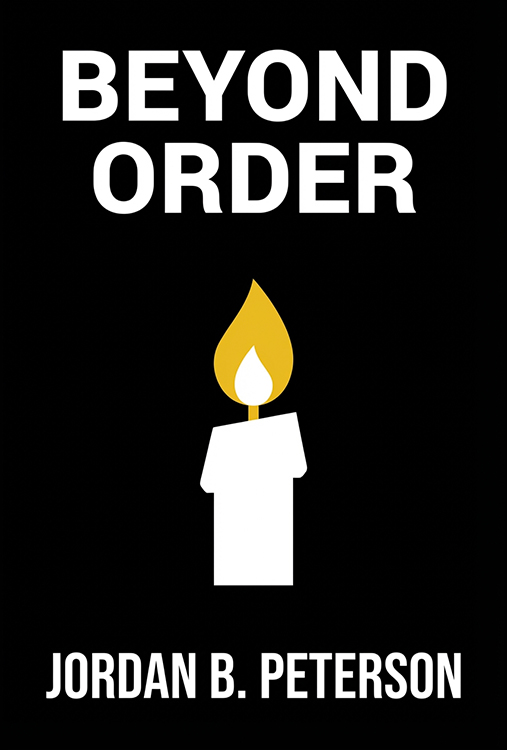
Beyond Order: 12 More Rules for Life
What's it about
How do we find balance and meaning when surrounded by chaos and uncertainty? This book offers a compelling argument for embracing both structure and possibility as we navigate the complexities of modern life. Building on his previous work, Peterson provides 12 new, profound principles to help you cope with the inevitable chaos you will encounter. It’s a guide to strengthening your character and finding the courage to face life’s challenges.
Meet the author
Dr. Jordan B. Peterson is a clinical psychologist, cultural critic, and professor emeritus at the University of Toronto, who has become one of the world’s most influential public intellectuals. Drawing on his deep knowledge of psychology, mythology, and philosophy, he offers powerful insights into human nature and the pursuit of a meaningful life. His work challenges readers to take personal responsibility and aim for a higher purpose.
The Script
Imagine an architect, years into their masterwork. They unroll the final blueprint on a vast table. Every line is perfect, every angle calculated, every room placed for maximum efficiency. It's a city on paper, a testament to pure, unadulterated order. There are no winding, inefficient alleyways, no chaotic public squares—only clean grids and predictable pathways. Construction begins, and the vision becomes reality. The structures are flawless, the streets are immaculate, the systems run like clockwork. But as people move in, a strange silence descends. The perfect parks remain perfectly empty. The logical plazas inspire no spontaneous gatherings. The architect achieved everything they set out to do—they eliminated all chaos, all unpredictability. In doing so, they created a beautiful, functional, and utterly sterile cage. They built a perfect machine for living, but forgot to leave any room for life itself. This is the terrifying paradise of too much order, the place where the map becomes more important than the territory. What do you do when the walls you built for safety become your prison?
This paradox—the need for structure and the danger of its excess—is the central challenge explored in the work we are about to examine.
Background
Jordan B. Peterson is a Canadian clinical psychologist, cultural critic, and professor emeritus at the University of Toronto. He first gained widespread attention for his online lectures on psychology, mythology, and religion, but became a global phenomenon with his 2018 bestseller, 12 Rules for Life: An Antidote to Chaos. That book provided a framework for taking on personal responsibility to counteract the chaos of existence. Beyond Order: 12 More Rules for Life serves as its necessary counterpart. Written in the aftermath of immense personal and familial health crises, the book explores the other side of the coin: the danger that arises when structure becomes too rigid and belief becomes too dogmatic. Peterson argues that while order is essential, we must also cultivate the courage to step beyond its boundaries, to confront the unknown, and to find the revitalizing meaning that can only be discovered in the territory just beyond our maps.
Module 1: The Essential Dance with Chaos
We spend our lives trying to build stable systems. We create routines, build companies with clear hierarchies, and establish social norms. This is the realm of Order. But what happens when that order becomes too rigid, too stifling? Peterson argues that a meaningful life requires a delicate balance. It means standing with one foot firmly planted in what is known and secure, while cautiously extending the other into the unknown, the realm of Chaos.
The first step in this dance is to do not carelessly denigrate social institutions or creative achievement. These structures, from the family unit to corporate hierarchies, are the hard-won results of generations solving recurring problems. They provide the stability we need to function. Peterson uses the example of a resentful young waiter who decided to stop criticizing his job and instead embrace its structure. By working diligently within the system, he was promoted three times in six months, discovering opportunity where he previously saw only oppression. This doesn't mean institutions are perfect. It means they serve a vital purpose, and to tear them down without a viable alternative is to invite chaos.
However, order can become a prison. When we try to eliminate all uncertainty, we create a totalitarian environment that stifles growth and adaptation. This is where we must learn to voluntarily confront the unknown to create new, habitable territory. Chaos is the source of all new things. It’s the unexpected project, the market disruption, the difficult conversation. Peterson points to artists as the pioneers of this process. They are the ones who move into the roughest parts of a city, transforming dangerous, chaotic spaces into vibrant, ordered communities through their creative work. They venture into the unknown and bring back something of value. The heroic path isn't about avoiding the dragon of chaos; it's about confronting it to claim the treasure it guards.
This leads to the central practice of a well-lived life: find the balance point between order and chaos. Too much order leads to stagnation. Too much chaos leads to disintegration. The ideal state is to live on the edge between them. This is where life is most meaningful and engaging. It's the state of flow, where you are challenged just enough to grow but not so much that you are overwhelmed. It requires respecting the traditions that give us stability while having the courage to update them when they become obsolete.