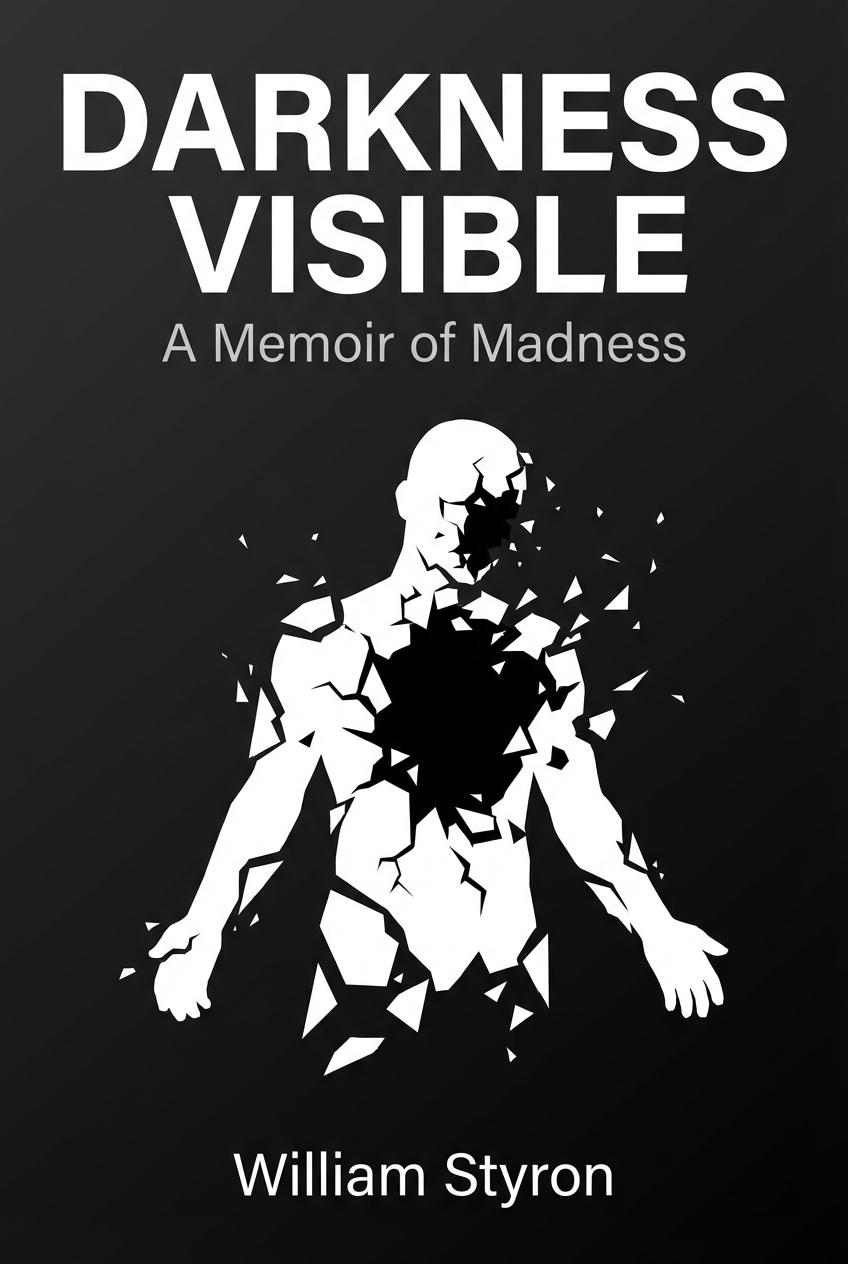
Darkness Visible
A Memoir of Madness
What's it about
Ever wondered what it’s like inside the mind of someone battling severe depression? This powerful memoir takes you on an unflinching journey into the abyss of mental illness, offering a rare and honest look at a struggle that often remains hidden in the shadows. You'll discover the terrifying reality of a mind turning against itself and gain profound insights into the nature of despair, the inadequacy of language to describe it, and the slow, arduous path toward recovery. Uncover the courage it takes to confront the darkness and find the light.
Meet the author
William Styron was a Pulitzer Prize-winning novelist whose unflinching literary explorations of the human condition earned him international acclaim and a place among America's greatest writers. After a debilitating bout of depression in his sixties, he felt compelled to break the silence surrounding the illness, documenting his harrowing descent and eventual recovery. His resulting memoir, Darkness Visible, became a landmark work, offering a powerful and profoundly human account of an experience he described as a "howling tempest in the brain."
The Script
Imagine a ship's radio operator, deep in the night, his headphones filled with static. Suddenly, a faint signal cuts through, a distress call from another vessel. But the words are distorted, scrambled by a storm he can't see. He hears desperation, but the specific nature of the catastrophe—fire, flooding, mutiny—is lost in the noise. He knows a ship is sinking, but he cannot grasp the mechanics of its demise. He can only relay the raw fact of the crisis, a second-hand witness to an agony he can't fully comprehend. This is the profound isolation of trying to understand a suffering that defies language, a pain that has no common vocabulary.
This chasm between knowing a person is in pain and understanding that pain is what novelist William Styron confronted in 1985. After receiving a prestigious literary prize in Paris, he was expected to feel triumphant. Instead, he found himself slipping into a vortex of despair so profound it felt like a 'veritable howling tempest in the brain.' He realized the words we use for sadness—unhappiness, grief, melancholy—were like trying to describe a hurricane with the word 'breeze.' They were utterly inadequate. This memoir, Darkness Visible, was born from that harrowing journey. It is a dispatch from inside the storm, an attempt by a master of language to finally find the words for a suffering that had rendered him speechless.
Module 1: The Anatomy of an Invisible Illness
Depression is often misunderstood. It's confused with sadness or a bad mood. Styron argues this is a profound and dangerous error. He begins by dismantling our common vocabulary for mental suffering. The word "depression" itself, he claims, is a weak, clinical term. It’s a word we use for potholes and economic downturns. It fails to capture the violent, storm-like nature of the illness. He suggests the older term, "melancholia," was far more evocative. But since we are stuck with "depression," his mission is to show us what it truly means.
He makes it clear that severe depression is an experience fundamentally incomprehensible to the healthy mind. Before his own descent, Styron, a well-read and curious man, admits he was a "total ignoramus" on the subject. He, like many, had subconsciously avoided learning about it. It felt too close to the "psychic bone." This reveals a core truth of the illness: it creates a chasm of understanding. Sufferers cannot adequately describe their torment, and healthy individuals cannot imagine such an alien form of anguish. Styron tries using analogies like drowning or suffocation, but even he admits these fall short.
This leads to his next point. Depression is a full-body assault with severe physical and cognitive symptoms. Styron’s own experience was a cascade of failures. His sleep patterns became anarchic. He suffered from brutal insomnia at night and, even more cruelly, in the afternoons when his misery was most intense. His mind, once his greatest asset, began to betray him. He experienced crippling confusion and memory lapses. In Paris to accept a major literary award, he completely forgot a formal luncheon in his honor, a social catastrophe that deepened his shame. This was accompanied by a rising tide of self-loathing. He even subconsciously lost the prize check, an act he later saw as his mind repudiating any sense of worth.
Here’s where it gets more complicated. Styron shows that depression is a complex illness with no single, identifiable cause. People often look for a simple reason for suicide or a depressive collapse. They might blame a failed business, a bad review, or a recent loss. Styron argues this is a fallacy. He points to the suicides of figures like Abbie Hoffman and Primo Levi. Observers tried to pinpoint a single trigger. But countless people endure similar hardships without succumbing to the illness. The real causes are a tangled web of abnormal brain chemistry, genetics, and life events. Styron himself considers several triggers for his own episode. The abrupt, involuntary end to his lifelong habit of drinking alcohol. The milestone of turning sixty. But he also looks deeper, to the early death of his mother and a genetic predisposition inherited from his father. The truth is, there is no simple answer.