Everything Is F*cked: A Book About Hope
What's it about
In an age where we have more than ever, why do so many of us feel a sense of hopelessness? This book offers a counterintuitive and brutally honest look at our modern anxieties, arguing that our pursuit of happiness is actually making things worse. You’ll explore the surprising nature of hope and learn how to live with more honesty and resilience in a world that often feels chaotic. It’s a thought-provoking challenge to our core beliefs about what makes a good life.
Meet the author
Mark Manson is a #1 New York Times bestselling author and blogger known for his no-nonsense, “anti-self-help” approach to personal development. With a massive global following, he challenges conventional wisdom with a mix of academic research and profanely blunt humor. He speaks to a generation that is tired of empty positivity and is seeking more authentic ways to navigate life.
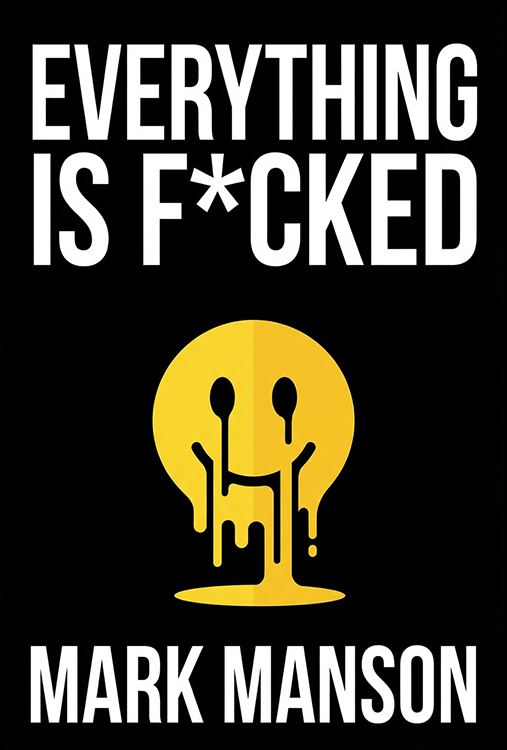
The Script
We are a culture obsessed with hope. We're told to look on the bright side, to believe in a better tomorrow, to never, ever give up. But what if that's the worst advice you could ever receive? What if hope isn't the cure, but the disease? Consider this: our relentless pursuit of a pain-free, perfectly happy future is the very thing creating our present-day anxiety. Every time we pin our well-being on some future outcome—a promotion, a relationship, a political victory—we mortgage our present for a future that may never come. We've built a society that runs on cheap, disposable hope, and it's left us feeling empty and fragile. This isn't a call for nihilism or despair. It's a call to question the very foundation of our emotional lives. Because to build a life of genuine meaning and resilience, you must first confront the uncomfortable truth that sometimes, the most mature and healthy thing you can do is to let go of hope itself.
This provocative idea comes from an author who has made a career of challenging our most comfortable beliefs.
Background
Mark Manson is not your typical self-help author. He started as a blogger, gaining a massive following for his brutally honest, no-nonsense approach to life's biggest questions. His writing style, often described as a philosophical discussion with a foul-mouthed but brilliant friend, cuts through the feel-good platitudes that dominate the genre. His first major book, 'The Subtle Art of Not Giving a Fck,' became a global phenomenon by arguing that the key to a good life is not eliminating problems, but choosing better problems to have. Manson's work is born from a deep-seated frustration with the culture of toxic positivity and unearned self-esteem. He draws on a wide range of philosophical traditions, from Stoicism to existentialism, but translates these complex ideas into actionable, modern-day advice. With 'Everything Is Fcked,' he continues his mission to challenge our most cherished beliefs about happiness, meaning, and what it truly takes to live a worthwhile life.
Module 1: The Hope Paradox
We often think of hope as the ultimate virtue, the light in the darkness. But Manson presents a more complicated picture. Hope, he argues, is not a passive feeling of optimism; it's an engine that requires fuel. That fuel is the belief that something is broken and needs fixing. This creates a strange and unsettling dynamic.
The narrative begins with a simple observation: despite incredible material progress, psychological distress is on the rise. Hope is a transaction with the future that requires a problem to solve. This means that to feel hopeful, we must first believe that our present is deficient. Hope doesn't just get us through bad times; it needs bad times to exist. It motivates us to build a better future, but it simultaneously forces us to devalue the present. This can create a perpetual cycle of dissatisfaction, where our minds are always searching for the next problem to fix in order to maintain a sense of purpose.
This leads to a fascinating psychological quirk. Our perception of problems expands to meet a psychological baseline. Manson introduces a concept he calls the Blue Dot Effect, based on a study where participants were asked to identify blue dots on a screen. As researchers showed them fewer blue dots, the participants didn't report seeing fewer; instead, they started identifying purple dots as blue. Their definition of "blue" expanded to fit their expectation. Similarly, as our lives become safer and more comfortable, we don't stop seeing threats. We simply redefine what constitutes a threat. Minor social slights become sources of trauma, and disagreements become existential dangers. Our minds are calibrated to find a certain number of problems, regardless of our objective reality.
This reveals a fundamental truth about our existence. Pain is the universal constant of consciousness; we cannot eliminate it, we can only change its form. Life is an unending series of problems. When you solve your health problems, you create new problems, like figuring out what to do with your newfound energy. When you solve your financial problems, you create new ones, like how to manage your wealth responsibly. The goal, therefore, is not a life without pain. That’s impossible. The goal is a life with better, more meaningful pain. The quality of your life is determined by the quality of the problems you choose to solve.