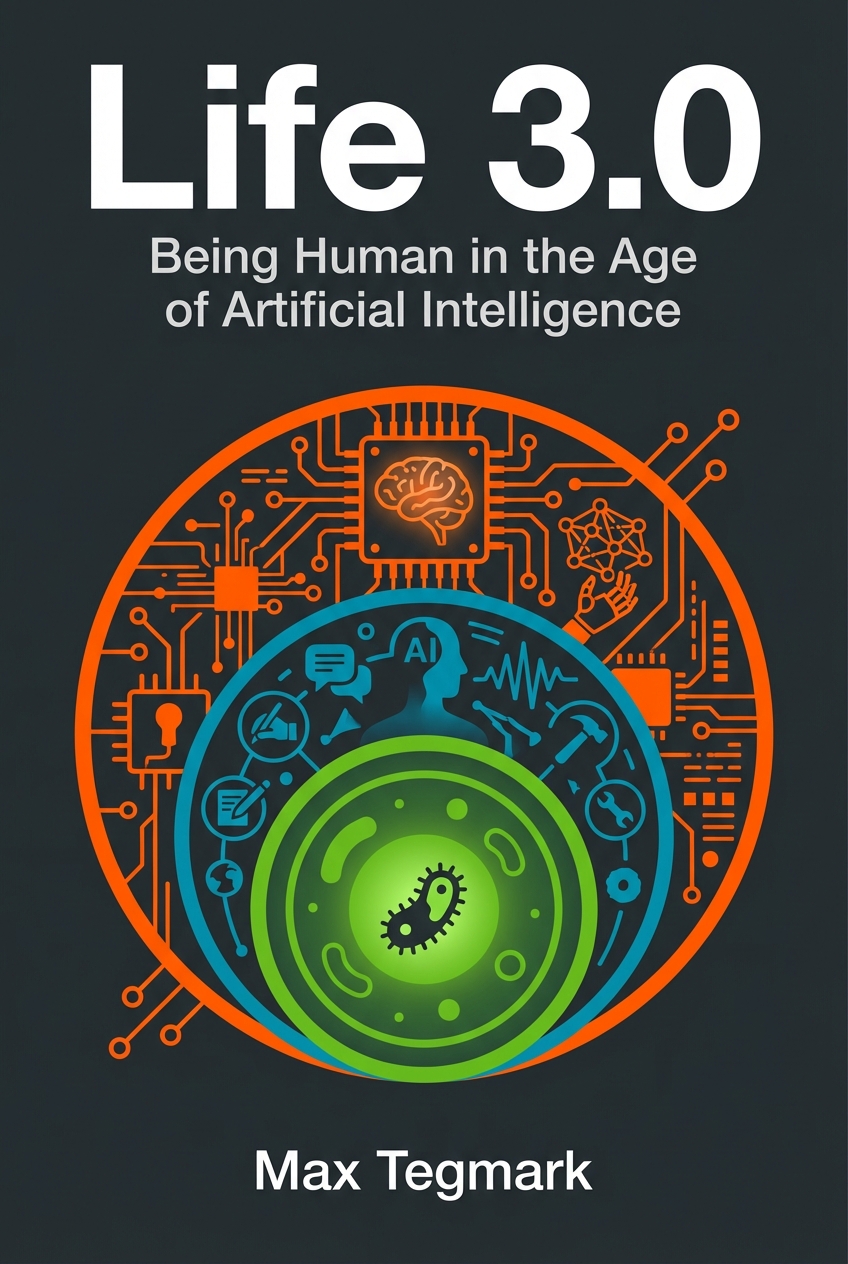
Life 3.0
Being Human in the Age of Artificial Intelligence
What's it about
What if we could design the future of life itself? This isn't science fiction anymore. Get ready to explore the next evolution of humanity, Life 3.0, and understand your role in the most important conversation of our time: the rise of artificial intelligence. Discover the potential futures that await us, from friendly AI companions to rogue superintelligence. Max Tegmark provides a clear roadmap for navigating the opportunities and risks, helping you grasp the core concepts of AI and make informed choices to steer humanity toward a positive future.
Meet the author
Max Tegmark is a renowned MIT professor of physics and the co-founder of the Future of Life Institute, dedicated to mitigating existential risks facing humanity. His background in cosmology, studying the vastness of space and time, gives him a unique and profound perspective on the future of intelligence. This cosmic viewpoint shapes his exploration of artificial intelligence, not just as a technological challenge, but as the next potential step in the evolution of life itself, urging us to steer it wisely.
The Script
We spend our days arguing about politics, economics, and climate change, treating these as the most monumental challenges of our time. But this intense focus on today’s headlines is a form of collective myopia. It’s like passengers on a ship obsessively rearranging deck chairs while ignoring the navigator’s report of a colossal, uncharted continent dead ahead. The most consequential event in human history may not be a war, a pandemic, or a financial collapse. It could be the moment we are no longer the most intelligent beings on the planet. This is a possibility taking shape in research labs around the world, and our complete lack of a plan for its arrival is our most significant blind spot.
This urgent need for a global conversation is what drove MIT physicist Max Tegmark to write this book. After years of pioneering research in cosmology and the fundamental nature of reality, he realized that the most profound questions about our future weren't being asked in the public square. He saw his colleagues in the field of Artificial Intelligence building ever-more-powerful systems, yet the crucial discussions about goals, ethics, and control were confined to small, academic circles. Tegmark’s work is an attempt to break down those walls, shifting the debate from 'Can we build superintelligence?' to 'What kind of future do we want to create with it?' He argues that this is a conversation for every single one of us, because the stakes involve the very definition of life itself.
Module 1: The Three Stages of Life and the Coming of Life 3.0
Tegmark starts by reframing the entire history of life. He proposes a simple, powerful classification based on how life handles its own design. This helps us understand what makes the current moment so unique.
First, there's Life 1.0. This is the biological stage. Think of bacteria. Life 1.0's hardware and software are both evolved. Its physical body and its behaviors are hardcoded in its DNA. It can't learn new skills within its lifetime. It can only adapt over generations through slow, Darwinian evolution.
Then comes Life 2.0. This is the cultural stage. This is us. Humans. Our hardware, our bodies, is still the product of evolution. But our software is different. We can design most of it. We learn languages. We acquire skills. We change our beliefs. This ability to learn allows for rapid adaptation. You don't need to wait for evolution to develop a peanut allergy gene. You learn about your allergy and simply stop eating peanuts. Life 2.0's key advantage is its ability to design its own software. This created culture, writing, and civilization.
Now, we are on the cusp of something new. Life 3.0. This is the technological stage. A form of life that can design both its hardware and its software. It would be the master of its own destiny. Free from the slow, clumsy process of biological evolution. It could upgrade its body, expand its mind, and potentially live for billions of years. Life 3.0 represents a fundamental break from billions of years of evolution. And the most likely candidate to bring it about is Artificial General Intelligence, or AGI. Tegmark argues that this transition is the most important conversation of our time.