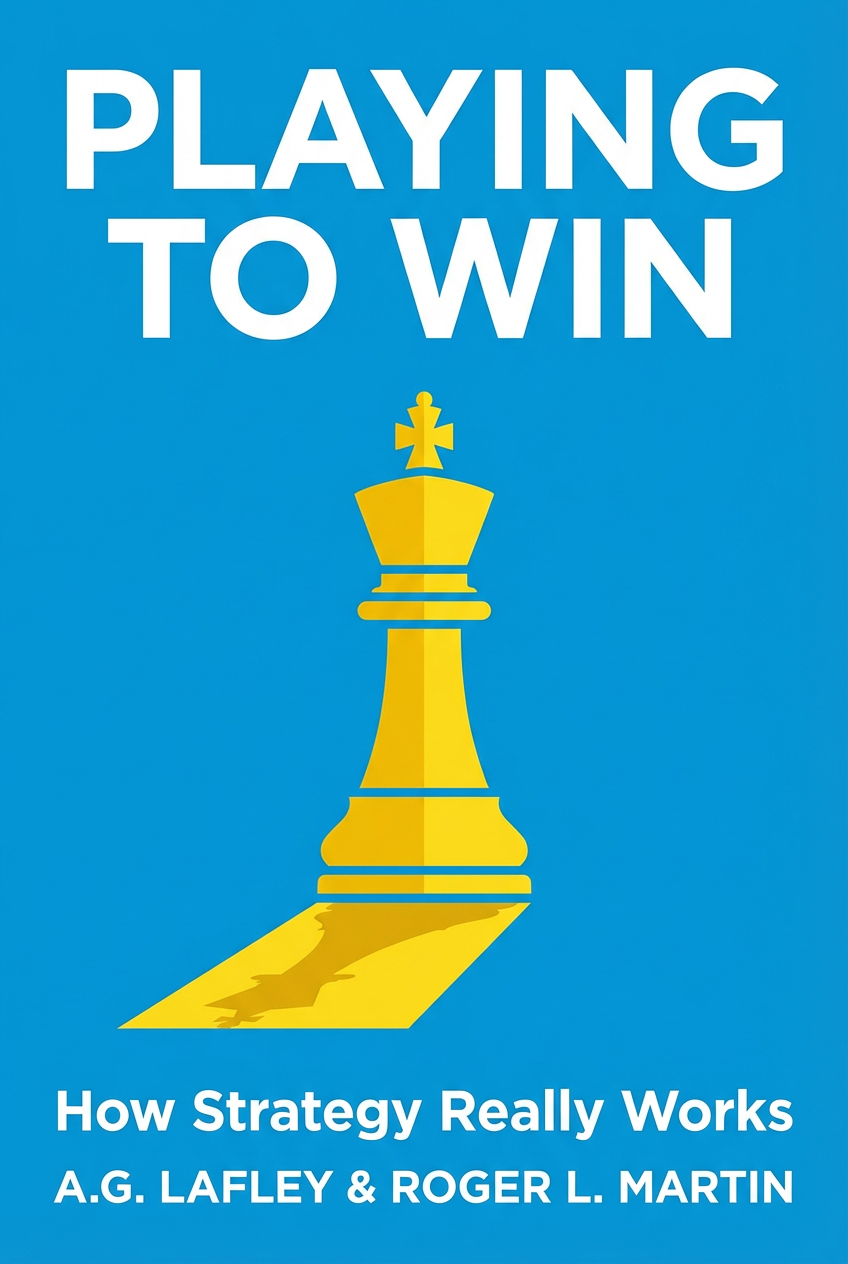
Playing to Win
How Strategy Really Works
What's it about
Is your company's strategy more of a wish list than a winning playbook? Discover the five essential choices that transform vague ambitions into decisive market victories. This is the proven framework that turned P&G into a global powerhouse, and it can work for you. You'll learn the simple but powerful five-question cascade that forces clarity on where to play and how to win. Move beyond abstract ideas and learn to build the core capabilities and management systems that make your strategic choices a reality, creating a sustainable competitive advantage.
Meet the author
A.G. Lafley, the legendary CEO who doubled Procter & Gamble’s sales, and Roger L. Martin, his trusted strategic advisor, reveal the framework behind their historic success. Their partnership forged a powerful, practical approach that moved strategy from abstract ideas to a repeatable five-step process for winning in the market. This book distills the hard-won lessons from their time transforming one of the world’s most iconic companies, making elite corporate strategy accessible to leaders at every level.
The Script
In 2014, Taylor Swift was the undisputed queen of country music, a guaranteed stadium-filler with a fiercely loyal audience. The safest move was to release another successful country album. Instead, she announced 1989, a full-throated, unapologetic pop record, and moved to New York City. This was a deliberate, high-stakes declaration. She abandoned a market she already owned to fight for a completely different one. It was a masterclass in strategic choice. She defined exactly where she wanted to play—the global pop arena—and precisely how she would win, with a specific synth-heavy sound, a new visual identity, and a narrative of personal reinvention. By refusing to hedge her bets or try to be both a country and a pop star, she achieved a new level of global dominance. That absolute clarity, the courage to choose one path and not others, is the difference between success and a dynasty.
That same kind of make-or-break clarity is what separates iconic brands from the ones that fade into the background. For years, the sprawling portfolio at Procter & Gamble faced a version of this dilemma every day. With hundreds of products in dozens of countries, the temptation was to compete everywhere, pleasing everyone, and truly winning nowhere. When A.G. Lafley took the helm as CEO, he saw a company rich in resources but poor in focus, with brands that were drifting by trying to be too many things to too many people. He partnered with acclaimed strategic advisor Roger L. Martin to forge a practical, repeatable method for making these tough choices under pressure. They developed a deceptively simple set of questions that forced every team, from Olay to Pampers, to define their winning aspiration and the specific choices required to achieve it. This book is the direct result of that high-stakes corporate turnaround—the distilled, battle-tested playbook they created to help any organization stop just participating in the market and start winning it.
Module 1: Strategy Is a Set of Choices, Not a Wish List
Let's get straight to the core idea. Many leaders mistake strategy for other things. They think it's a vision statement. Or a detailed plan. Or just optimizing what they already do. The authors argue these are dangerous misconceptions. They lead to mediocrity. They avoid the one thing that truly defines a winning strategy: choice.
This brings us to the first insight. Strategy is an integrated set of choices. A vision might be inspiring. A plan might feel productive. But neither forces you to confront trade-offs. A real strategy deliberately positions your company to create a sustainable advantage over the competition. It’s about choosing a unique path. Think about the airline industry. Legacy carriers spent years optimizing their existing hub-and-spoke models. They made their existing plans more efficient. Southwest Airlines made a different choice. It chose a point-to-point model. It chose to fly one type of plane. It chose to serve secondary airports. These were not just operational tweaks. They were integrated strategic choices that created a dominant, hard-to-copy advantage.
Here's where it gets tough. Winning requires making tough decisions about what to do and what not to do. True strategy is as much about what you don't do as what you do. Every "yes" to a market, a customer, or a feature implies a "no" to others. Most companies hate saying no. They want to keep their options open. Keeping options open is a recipe for being average everywhere and excellent nowhere. P&G, for example, had to make the hard choice to exit its once-promising food businesses, like Folgers coffee and Pringles chips. Why? Because those businesses couldn't benefit from P&G's core capabilities in the same way its beauty and home-care brands could. Winning in one area required saying no to another.
So, how do you make these choices in a structured way? The authors provide a powerful framework. They argue that a winning strategy answers five cascading questions. This "strategic choice cascade" is the engine of the entire book. The questions are:
- What is our winning aspiration?
- Where will we play?
- How will we win?
- What capabilities must be in place?
- What management systems are required?
These questions form a deeply integrated logic flow. The choices you make at the top constrain and inform the choices below. And the choices at the bottom can force you to reconsider the ones at the top. The rest of our discussion will unpack this cascade, piece by piece.
We have established that strategy is about making choices. Now, let’s explore the first two choices in that cascade.