Stranger in a Strange Land
What's it about
Ever wonder if society's rules are holding you back from your true potential? Imagine shedding the conventions of culture, money, and love to discover a more profound way of living. This summary unlocks the journey of a man raised by Martians who challenges everything we believe about being human. You'll learn how to "grok" the world around you—to understand things so deeply they become a part of you. Discover how challenging social norms can lead to personal liberation and a richer, more connected existence, all through the eyes of the ultimate outsider who just might save humanity.
Meet the author
Often called the "dean of science fiction writers," Robert A. Heinlein is one of the most influential and controversial authors in the genre, winning an unprecedented four Hugo Awards for Best Novel. A former naval officer and aeronautical engineer, his technical background and forward-thinking social commentary deeply informed his work. This unique blend of experience allowed him to explore complex themes of individuality, freedom, and societal norms, cementing his legacy as a master storyteller who challenged readers to question everything.
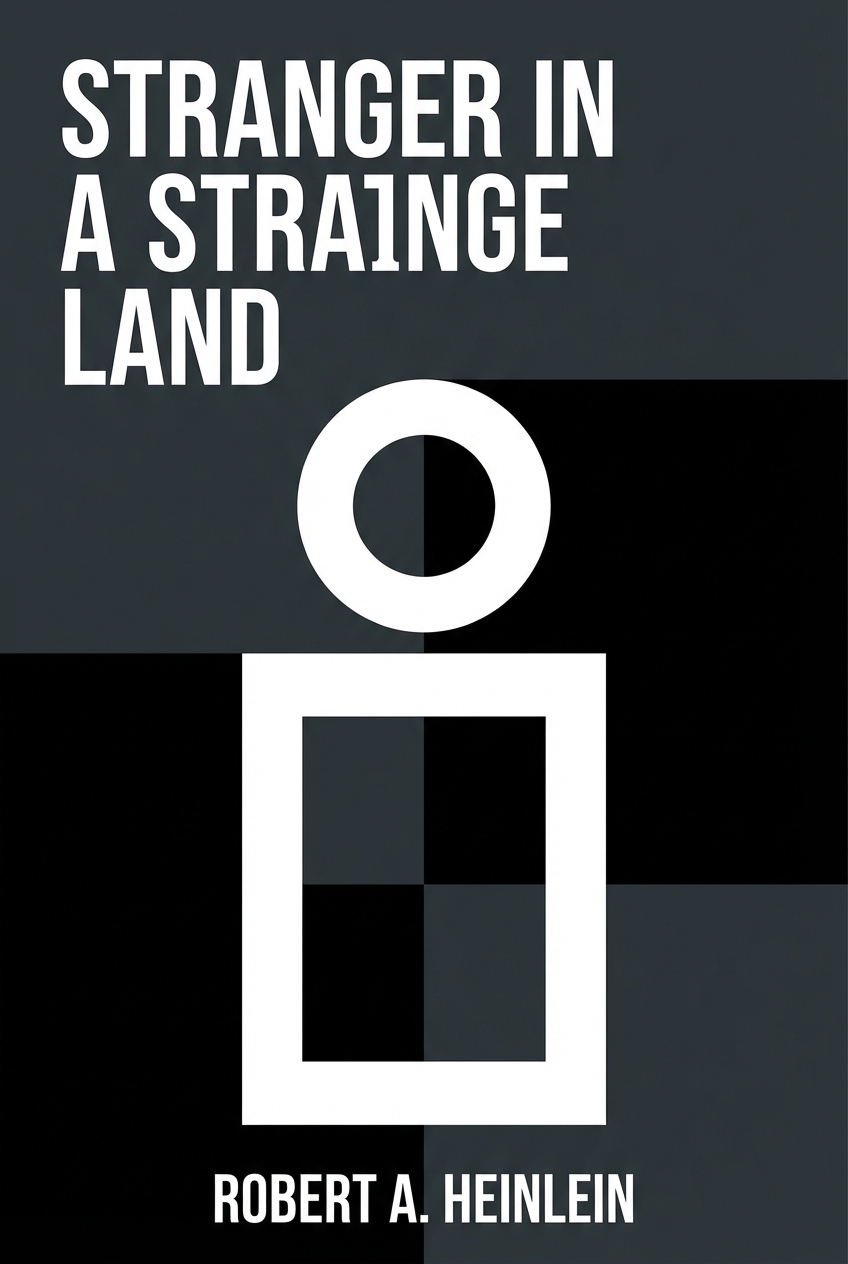
The Script
We believe society’s rules exist to protect us, to create order from chaos. But what if the opposite were true? What if the most cherished social contracts—from property and marriage to our definitions of politeness and reverence—are cages? What if these structures, designed to ensure our survival, actively prevent us from becoming fully human? This is an exploration of a more radical idea: that our deepest capacity for love, empathy, and understanding can only be unlocked by dismantling the very social architecture we’ve been taught to revere. It suggests that true civilization is about transcending rules entirely.
This provocative thought experiment was born from a period of intense creative frustration for its author, Robert A. Heinlein. After finishing a grueling novel, he found himself blocked, unable to write. The concept for "Stranger in a Strange Land"—initially just a title and a vague premise about a human raised by Martians—had been simmering for over a decade. He decided to confront it head-on, viewing the story as a vehicle to challenge every sacred cow of mid-century American life. A former naval officer and engineer who became one of the titans of science fiction's Golden Age, Heinlein used this narrative to explore the ultimate outsider's perspective, questioning the fundamental assumptions about culture, religion, and relationships that most people never think to question.
Module 1: The Alien Lens on Human Systems
This first module explores how an outsider’s perspective can expose the absurdity of our own systems. The protagonist is Valentine Michael Smith. He is a human, but he was raised entirely by Martians. When he arrives on Earth, he is a true alien. He doesn't understand our gravity, our language, or our social cues.
Smith’s journey begins in a state of profound alienation. The story uses his confusion to reveal flaws in our own world. For instance, our social interactions are governed by unwritten rules that seem bizarre to an outsider. When a nurse asks Smith, "How do you feel?" he can't answer. The question is meaningless to him. He thinks in Martian concepts, not English idioms. This highlights how much of our communication relies on shared, unstated context. Smith’s innocence also exposes our hidden motives. When he first meets Nurse Jill Boardman, he asks her to undress. He has no sexual intent. He simply wants to understand what a "woman" is. His pure curiosity contrasts sharply with human social conditioning around gender and sexuality.
This leads to another key point. Institutions often prioritize control and exploitation over genuine care. The government immediately sees Smith as a resource. He is a "treasure trove of scientific information." He is also the legal owner of Mars, making him unimaginably wealthy. Secretary General Douglas tries to manipulate Smith into signing away his rights. He uses a fake double for public appearances. This is done to maintain a carefully crafted illusion of control. The government hides Smith for its own gain, not his protection. It treats him as a political problem to be managed.
From this foundation, we see how the media amplifies these dynamics. Public curiosity can be weaponized to turn a person into a commodity. The press and public are desperate for a glimpse of the "Man from Mars." An orderly tries to trick Smith into signing an exclusive media deal. The government feels pressure to put him on display like a zoo animal. His identity is reduced to a spectacle. His humanity is secondary to his entertainment value. This reveals a chilling truth. Our society often consumes unique individuals rather than trying to understand them.
So what happens next? Smith finds protectors. People who see his vulnerability. True guardianship requires defying the system to protect the individual. Captain van Tromp, the commander of the mission that brought Smith to Earth, fights to give him time to acclimate. Dr. Nelson prioritizes Smith’s health over rapid scientific study. Later, Nurse Jill Boardman risks her career to help him escape. These characters show that ethical action often means pushing back against institutional pressure. They choose compassion over compliance. They focus on the person, not the asset.