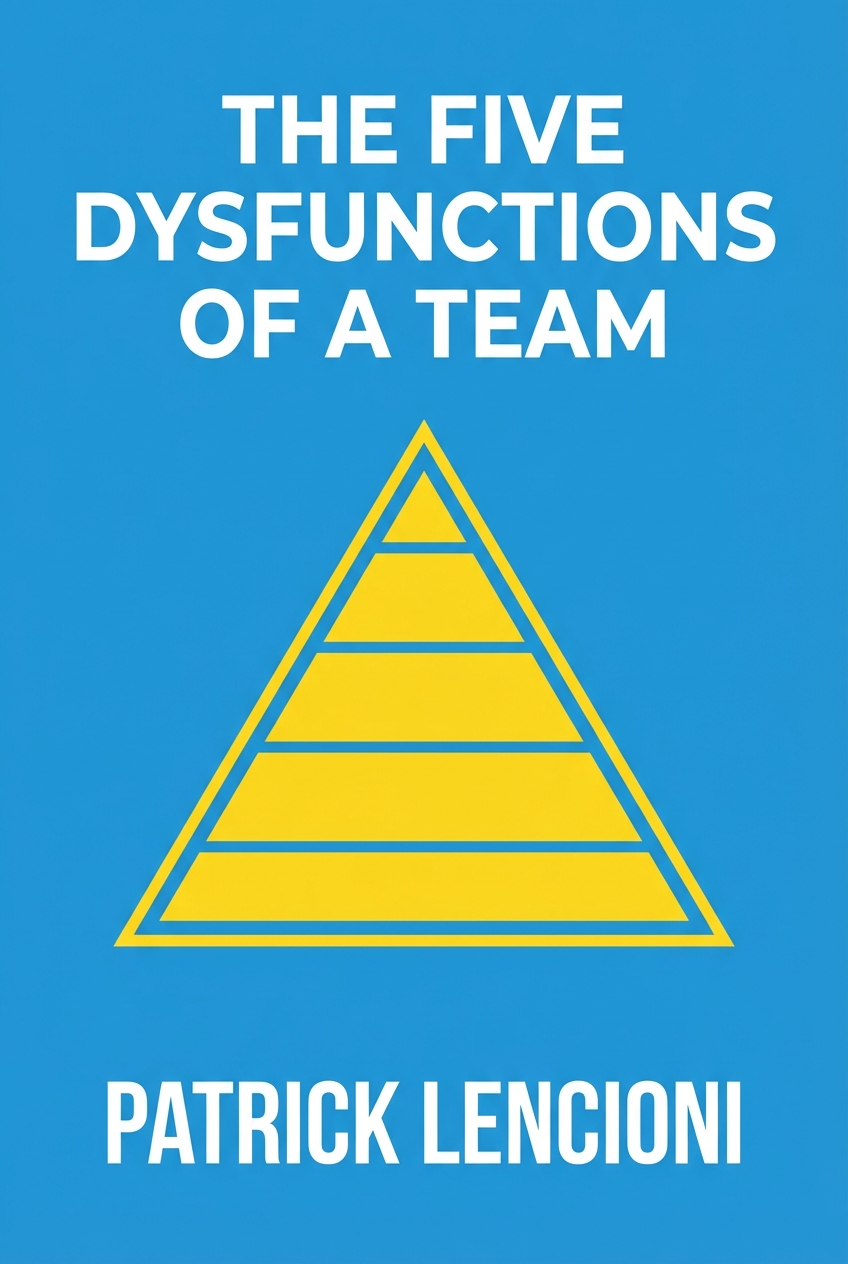
The Five Dysfunctions of a Team
What's it about
Ready to transform your team from a group of individuals into a powerhouse? This summary unlocks the simple yet profound framework for overcoming the five common behaviors that sabotage even the most talented teams and prevent them from winning. You'll dive into a compelling leadership fable that reveals how a lack of trust creates a domino effect of dysfunction. Learn the actionable strategies to master healthy conflict, gain unwavering commitment, and build a culture of peer-to-peer accountability focused on collective results.
Meet the author
Patrick Lencioni is the founder of The Table Group and a pioneer of the organizational health movement, whose bestselling books have sold millions of copies worldwide. Drawing from decades of experience consulting with CEOs and their executive teams, Lencioni crafts his insights into compelling and accessible business fables. His models are born not from theory, but from real-world observations of what truly makes teams cohesive and effective, providing a clear and actionable path for leaders to follow.
The Script
The concert hall lights dim, silencing the rustle of programs and polite coughs. On stage sits the celebrated chamber orchestra, a collection of virtuosos, each a master of their instrument. The conductor raises the baton, and the first notes of a complex symphony fill the air—crisp, technically perfect, and utterly lifeless. Something is wrong. It’s a subtle but profound disconnect. The lead violinist’s solo, while brilliant, seems to compete with the cello’s resonant bassline rather than converse with it. The woodwinds feel a fraction of a second behind, playing their part correctly but without connection to the pulsing rhythm of the strings.
The conductor’s gestures grow more urgent, but the music remains fractured. It’s a group of soloists sharing a stage, not a unified ensemble breathing life into a single piece of art. The audience can feel it. The performance is hollow, a technically flawless execution that lacks a soul. The problem isn’t a lack of talent—the stage is overflowing with it. The failure is happening in the invisible spaces between the musicians, in the shared trust and collective purpose that has clearly evaporated. They are playing the notes, but they are not making music together.
This kind of collapse, where a team of brilliant individuals produces a mediocre result, is precisely the phenomenon that fascinated consultant Patrick Lencioni. For years, he sat in the boardrooms of some of the world's most successful companies, from tech startups to Fortune 500 giants, and witnessed the same discordant performance. He saw executive teams filled with top-tier talent who talked past each other, avoided difficult conversations, and prioritized their own departmental goals over the company's collective success. The symptoms were universal: meetings were unproductive, decisions were ambiguous, and morale was low, despite having all the right people in the room. Lencioni realized the root cause lay in a set of fundamental human behaviors that were sabotaging their work. Frustrated by abstract theories, he chose to capture these dynamics in a simple, compelling fable. He wrote "The Five Dysfunctions of a Team" to make these invisible, corrosive forces visible, giving leaders a clear and practical way to diagnose and address the human friction that holds even the most talented teams back.
Module 1: The Foundation - Absence of Trust
Let's start at the bottom of the pyramid. The first and most fundamental dysfunction is the Absence of Trust.
Lencioni defines trust in a specific way: it's the confidence that your peers' intentions are good. It means you can be completely vulnerable without fear. You can admit mistakes. You can ask for help. You can voice a half-baked idea. At DecisionTech, this trust was nonexistent. The executives were guarded. They managed their words carefully. Backstabbing was, as Lencioni writes, "an art." They spent more energy on self-preservation than on solving problems. This is the hallmark of a team without trust.
So, how do you build it? The author argues that vulnerability-based trust is the foundation of a high-performing team. It's the bedrock upon which everything else is built. Without it, honest communication is impossible. Team members conceal their weaknesses. They hesitate to ask for help or offer constructive feedback. They hold grudges. This creates a toxic environment where politics thrive.
To fix this, Lencioni suggests a clear path. Leaders must model vulnerability first. A leader cannot expect their team to be open if they aren't willing to be open themselves. In the story, the new CEO, Kathryn, starts her first off-site by admitting her own weaknesses. She shares that she's not a tech genius and needs help with public relations. This act of humility sets the tone. It gives others permission to be imperfect. When Nick, the COO, follows by admitting he can come across as arrogant, the team doesn't attack him. They support him. This is the first crack in the wall of dysfunction.
Building on that idea, Lencioni shows that simple, structured exercises can accelerate trust-building. You don't need to sit in a circle singing campfire songs. One of the most effective tools Kathryn uses is the Personal Histories Exercise. Each team member answers a few non-intrusive questions about their background. Things like where they grew up, how many siblings they have, and their first job. The activity is low-risk, but the impact is immediate. The team members start to see each other as human beings, not just job titles. They discover shared experiences and unique perspectives. This small act of sharing builds empathy and begins to break down the barriers that prevent real connection.