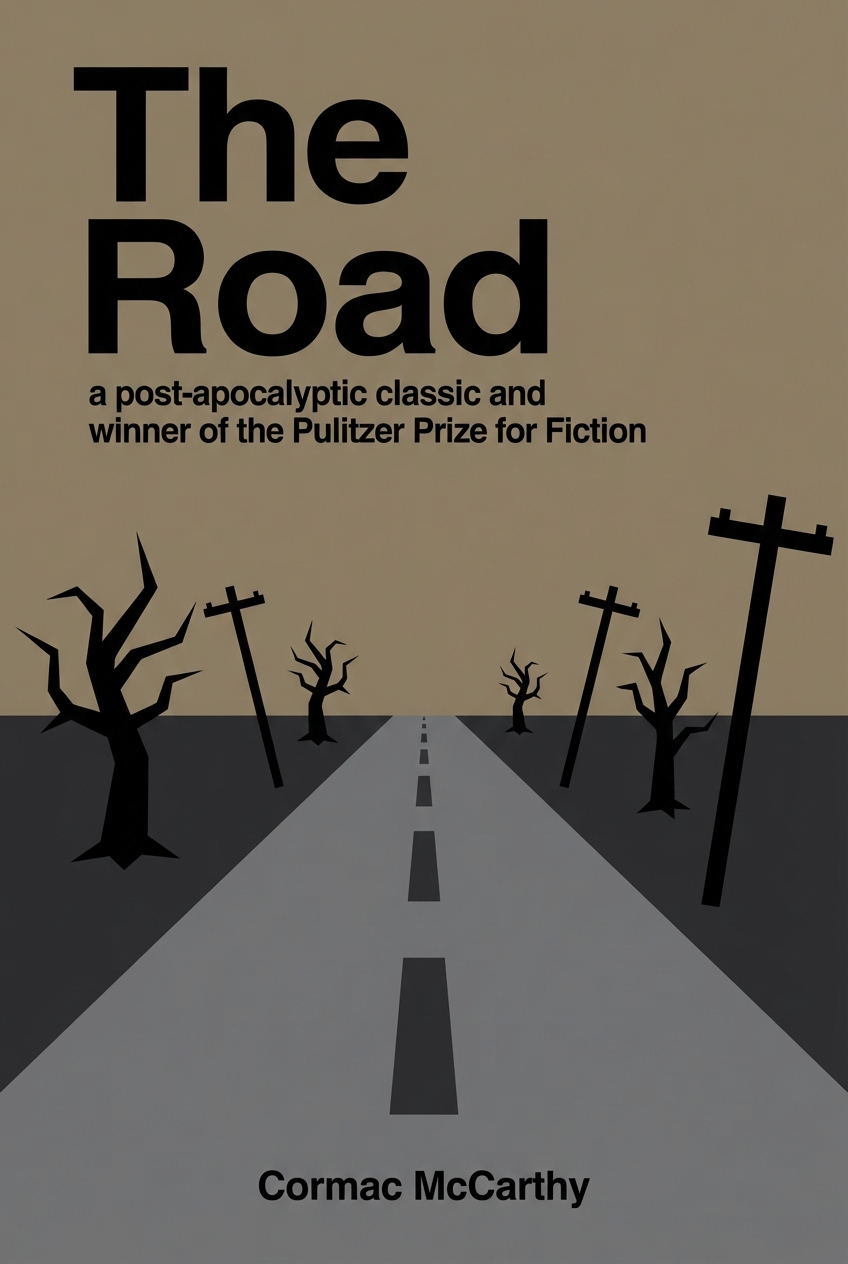
The Road
a post-apocalyptic classic and winner of the Pulitzer Prize for Fiction
What's it about
How far would you go to protect the one you love in a world with no hope? This Pulitzer Prize-winning classic challenges you to explore the depths of human resilience and the powerful bond between a father and son against the bleakest of backdrops. Journey with them through a desolate, ash-covered America as they scavenge for survival and fend off nameless horrors. You'll discover what it truly means to carry the fire—to maintain goodness and humanity when everything around you has crumbled into depravity and despair.
Meet the author
Cormac McCarthy was an American novelist and winner of the Pulitzer Prize, celebrated as one of the greatest writers of his generation for his stark, uncompromising prose. A famously private figure, he dedicated his life to the craft of writing, exploring themes of good and evil, fate, and the raw struggles of human existence. His distinctive, minimalist style and biblical undertones create the hauntingly powerful and desolate world of The Road, reflecting his deep contemplation on civilization's fragility.
The Script
A man wakes in the night, his hand instinctively reaching for the child sleeping beside him. It’s a familiar gesture, a silent inventory in the crushing dark. Is he safe? Is he breathing? For this man and his son, these are the only questions that matter. They are travelers on a journey with no destination, moving through a landscape scoured clean of life, color, and memory. Every sunrise reveals the same uniform gray. Every encounter with another human is a life-or-death calculation. Their entire world has been reduced to the contents of a shopping cart and the pistol they carry with its two remaining rounds. In this stripped-down existence, love is an action—a constant, brutal, and exhausting vigilance against the encroaching dark.
This relentless focus on the bond between a father and son, tested at the very edge of extinction, came from a late-night conversation. Author Cormac McCarthy was in a hotel room in El Paso, Texas, with his own young son. Looking out the window at the quiet city lights while his son slept, he started to imagine what the same city might look like a hundred years in the future, covered in fire and ash. The thought terrified him, but it also sparked a question: what would it take to survive in such a world, and what would it mean to protect a child within it? McCarthy, already a celebrated and famously private novelist known for his unsparing prose and explorations of violence and morality, decided to write down that vision. The result was a novel dedicated to his son, John Francis, that distills human existence down to its most elemental and powerful connection.
Module 1: The Strategy of Radical Focus
In a world of infinite distraction, we talk a lot about focus. But McCarthy shows us what focus looks like in a world of absolute scarcity. The man and the boy have one objective. Go south. That’s it. Their entire existence is stripped down to this single, directional imperative.
This journey is their strategy. And it’s built on a ruthless prioritization that most of us would find impossible. Your survival depends on what you are willing to ignore. The man and the boy pass by countless things. They pass by the remnants of the old world. They pass by other people. They even pass by a man struck by lightning, still twitching on the road. The boy wants to help. But the man is resolute. He says, "We cant help him. There’s nothing to be done for him." This is a calculated decision based on their reality. They have finite resources. A few cans of food. A single pistol with two rounds. Every calorie spent on a stranger is a calorie taken from his son.
This brings us to a critical insight for anyone leading a team or a company. Define your "south" and let it simplify every decision. The man's "south" is the coast, a place he hopes will be warmer. It might be a false hope. He even admits it might be empty. But having a destination, a singular goal, provides a framework for every choice. Is this action moving us south? Yes? We do it. No? We don't. It’s a brutal but effective filter. In your world, "south" might be shipping a product, hitting a revenue target, or surviving a market downturn. The principle is the same. When you know your ultimate destination, the small, distracting choices become much easier to make.
So how does this translate into action? You must audit your commitments with the same ruthlessness as the man audits his supplies. He constantly checks their cart, their food, their gear. He knows exactly what they have and what they need. Anything extra is a liability. Anything that doesn't serve the mission is dead weight. For a leader, this means auditing your time, your team's projects, and your company's initiatives. Ask the hard question: Is this moving us south? If the answer is no, you have to have the courage to cut it loose. Even if it's a good idea. Even if it feels urgent. The man's focus is on surviving the only path they have.