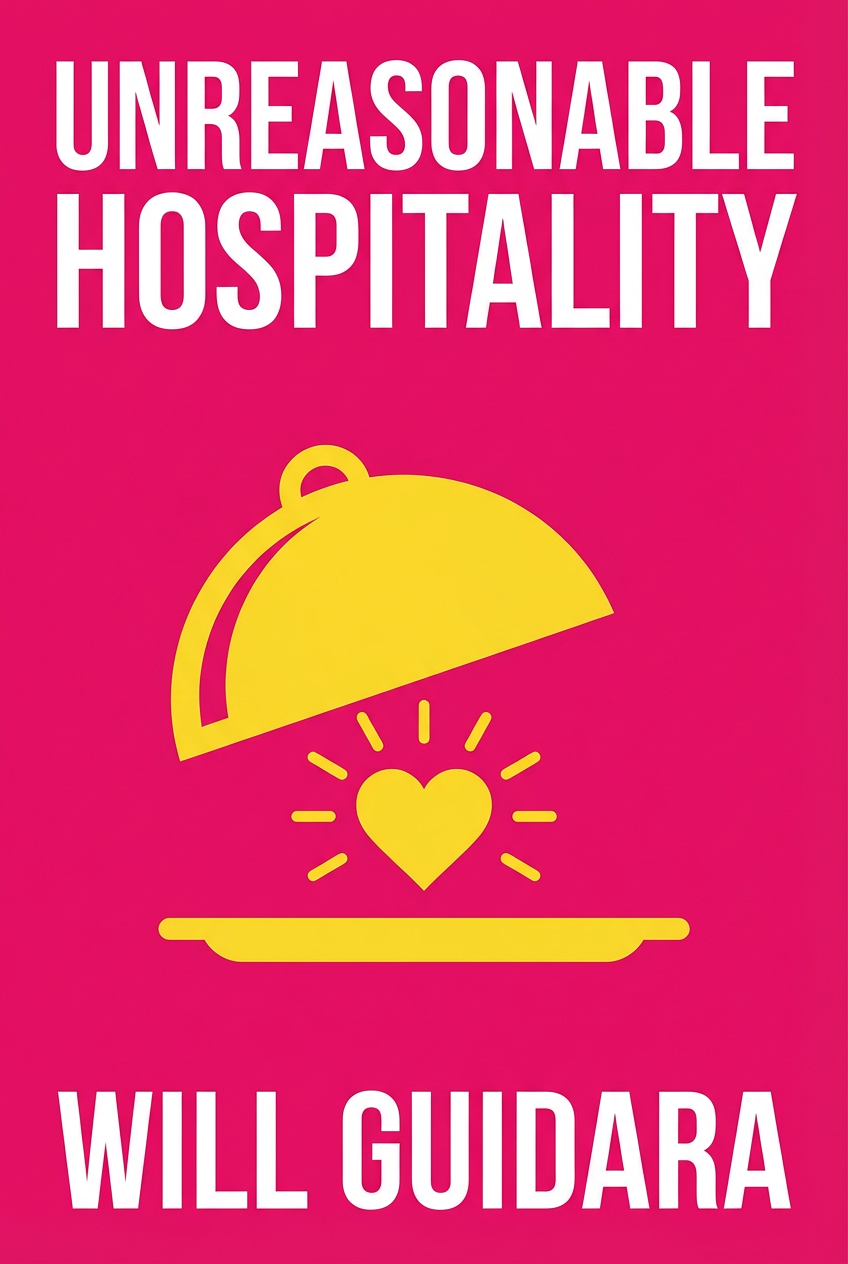
Unreasonable Hospitality
The Remarkable Power of Giving People More Than They Expect
What's it about
Ready to transform your business from merely good to truly unforgettable? Discover how giving people more than they expect isn't just a nice gesture—it's your ultimate competitive advantage for building a world-class team and creating legendary customer loyalty. You'll learn the exact principles Will Guidara used to turn a New York restaurant into the best in the world. Get his playbook on empowering your team to be "dreamweavers," turning mundane interactions into magical moments, and making generosity your most powerful and profitable business strategy.
Meet the author
Will Guidara is the former co-owner of Eleven Madison Park, the New York City restaurant he transformed into the number one restaurant in the world. This remarkable achievement was built on his core philosophy of "unreasonable hospitality"—a relentless dedication to creating legendary, personalized experiences for every guest. He proved that giving people more than they expect is the secret to transforming not just a business, but an entire industry, and now shares these powerful lessons on creating magic.
The Script
The cellist sat on a simple stool in the stone plaza, the deep, resonant notes of a Bach suite cutting through the afternoon air. Most people hurried past, their minds on deadlines and destinations, the music a pleasant but forgettable texture in their day. Some slowed, dropping a few coins into the open case—a polite, transactional exchange for a moment of artistry. The performance was technically flawless, a demonstration of years of disciplined practice offered to the largely indifferent city. The cellist was doing the job, and doing it well. But then the final, lingering note faded, and in the brief silence before the city’s noise rushed back in, the musician saw him: a small child, no older than four, standing utterly transfixed. He was experiencing the music with a wide-eyed wonder that adults had long since misplaced. The transaction was over. The cellist had earned the coins. But the opportunity for connection was just beginning.
Leaning forward with a conspiratorial smile, the musician began a new song, not for the crowd, but for an audience of one. The notes were simpler now, instantly recognizable: a slow, impossibly gentle version of 'Twinkle, Twinkle, Little Star.' The child's face lit up with pure, unedited joy. For ninety seconds, the bustling plaza and its hurried inhabitants ceased to exist. It was a private concert, a secret shared between two people. It was a moment that cost the musician almost nothing but created a memory that would last a lifetime. It was the difference between competence and magic.
That intentional, human shift is the core of unreasonable hospitality. It’s the space between providing an excellent product and creating an unforgettable feeling, the gap between the 99 percent of a job done perfectly and the final one percent that makes an experience legendary. This very distinction became a guiding obsession for Will Guidara. When he took the helm as the general manager of a struggling New York brasserie called Eleven Madison Park, he knew that remarkable food and polished service weren’t enough to stand out in a city of giants. They made the restaurant good, but not memorable; a place you might recommend, but not one you’d rave about. He and his team embarked on a mission to redefine what a restaurant could be by focusing on the people eating from them. They began a relentless, creative pursuit of moments just like the cellist’s—crafting one-of-a-kind, story-worthy experiences for their guests, from tracking down a specific brand of soda from a guest's childhood to filling the dining room with sand to recreate a beach vacation for a couple who'd missed theirs. This book is the chronicle of how that seemingly inefficient, wildly impractical philosophy transformed a good restaurant into the best in the world, detailing the principles and practices they developed to make magic a repeatable, scalable process.
Module 1: Redefining the Game: From Service to Unreasonable Hospitality
We've covered the origin story. Now, let's explore the core philosophy that drove Eleven Madison Park's transformation.
It all starts with a fundamental distinction. Service and hospitality are not the same thing. Service is delivering a product correctly; hospitality is connecting emotionally. Service is black and white. The right food arrives at the right table. It’s competent. It’s efficient. It’s expected. Hospitality, on the other hand, is color. It’s the feeling a person gets when they know they are seen and valued. Guidara learned this as a child at the Four Seasons. He barely remembers the food. He vividly remembers how the staff made him feel important. That emotional residue is the entire point. In any business, a flawless transaction is just service. A memorable connection is hospitality.
This distinction leads to a powerful question. If everyone else is focused on being reasonable, what happens if you choose to be unreasonable? That's where the next insight comes in. To achieve transformative impact, you must pursue an unreasonable standard of care. Guidara and his partner didn't just want to be better. They wanted to redefine the category. They looked at innovators like Steve Jobs and Serena Williams. These figures didn't just improve their fields. They changed them by being unreasonable in their pursuit of excellence. The team at Eleven Madison Park decided to apply that same relentless, obsessive passion to the guest experience. This became their mission. They called it "Unreasonable Hospitality."
Building on that idea, you must ground this mission in a clear sense of purpose. It can't just be a slogan. Every decision, from the grandest strategy to the smallest detail, must be driven by intention. Guidara learned this from his father, who managed a demanding career while providing devoted care for his wife with multiple sclerosis. His father’s life was a masterclass in intentionality. Every action had a purpose. Guidara applied this to his own career. At thirteen, he decided he would open a restaurant in New York. Every job, from Baskin-Robbins to fine dining, was an intentional step toward that goal. This is about creating a filter for your choices. When your intention is clear, decisions become simpler. You know what to say yes to. More importantly, you know what to say no to.
So what's the takeaway? The author argues that in today's service-based economy, hospitality is a massive differentiator. People are lonelier than ever. They crave genuine connection and a sense of belonging. Providing hospitality addresses a fundamental human need. This is why leaders from tech and finance attended Guidara's Welcome Conference. They recognized that making people feel valued is a critical driver of talent retention, customer loyalty, and ultimately, profitability. It’s a principle for any organization that wants to thrive.