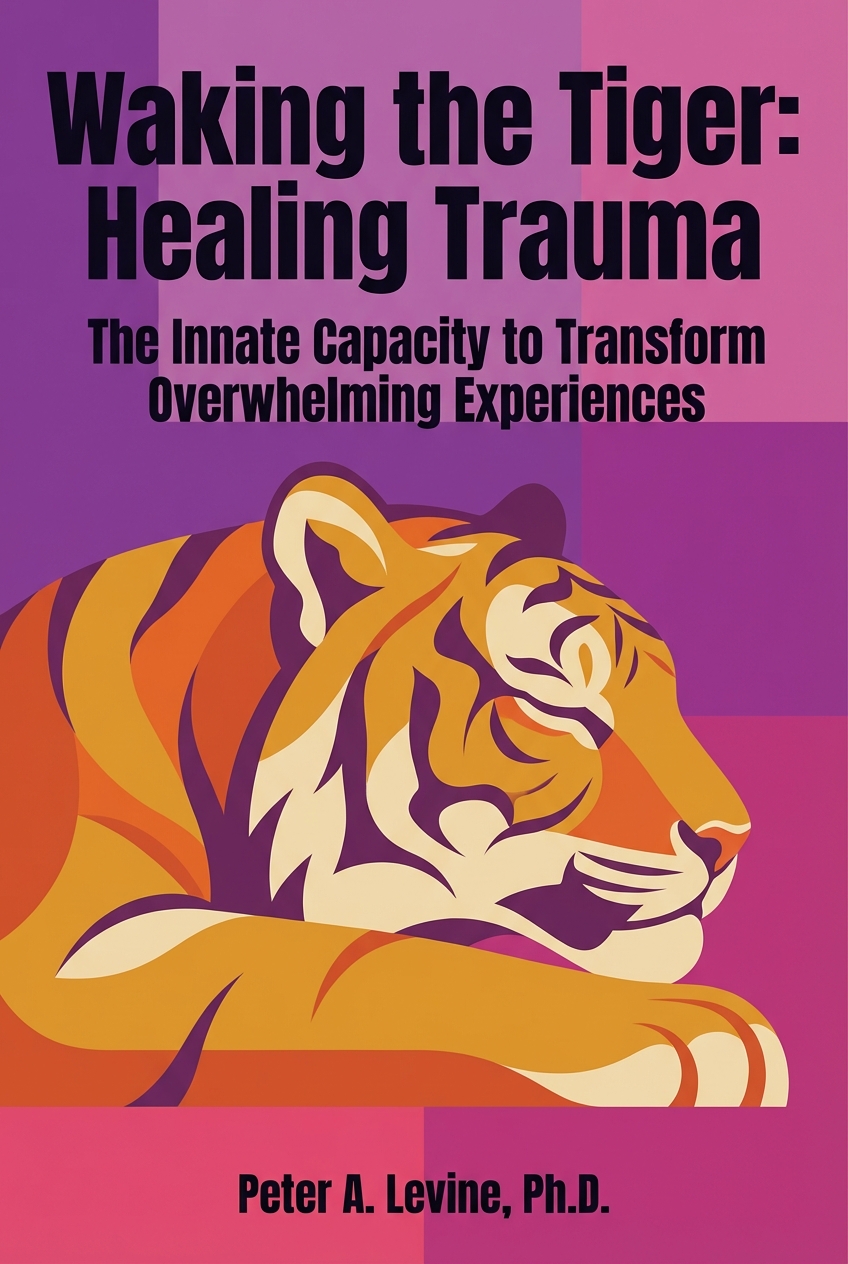
Waking the Tiger: Healing Trauma
The Innate Capacity to Transform Overwhelming Experiences
What's it about
Ever wonder why you feel stuck, anxious, or overwhelmed, even long after a difficult event has passed? Discover the groundbreaking secret to healing trauma not just with your mind, but with your body's own innate wisdom. This is your guide to finally releasing stored-up stress and reclaiming your life. You'll learn why trauma isn't a life sentence but a biological response that can be completed. Peter Levine reveals how to gently "thaw" frozen physiological states through his revolutionary Somatic Experiencing method, transforming anxiety and fear into empowerment, resilience, and a profound sense of wholeness.
Meet the author
Dr. Peter A. Levine is the renowned developer of Somatic Experiencing, a body-oriented approach to healing trauma that has influenced therapeutic practices worldwide for over four decades. His revolutionary insights were born from cross-disciplinary studies in biophysics, psychology, and ethology, particularly his observation of how wild animals recover from life-threatening situations. This unique background allowed him to understand trauma not as a disease, but as a disrupted biological process that our bodies have an innate capacity to heal.
The Script
Why does a deer, after a life-or-death chase with a wolf, simply shake it off and return to grazing, while a human, after a minor car accident, can be haunted by anxiety for years? We assume this is a sign of our sophisticated consciousness, a burden of our complex brains. We tell ourselves to 'get over it' or 'move on,' believing that the mind is the master of our emotional state. But this assumption gets it backwards. Our intellect, the very thing we believe makes us superior, is what often traps the traumatic experience inside us, preventing the natural, physical discharge that animals instinctively perform. The problem is that our bodies are not allowed to complete the biological process they were designed for. We think our way into a cage, while the deer simply shakes its way to freedom.
The man who decoded this profound biological wisdom is Peter A. Levine. His insights came from decades of observing this very paradox in nature and in his clinical practice. As a consultant for NASA during the development of the Space Shuttle program, and with a Ph.D. in medical biophysics, Levine began to see a pattern: humans, unlike wild animals, consistently interrupted their own instinctual responses to threat. He realized that trauma was a biological injury to be healed. "Waking the Tiger" is the culmination of this work, offering a guide to allow our bodies to finally finish a story that was violently interrupted.
Module 1: Trauma Is a Body Problem, Not a Mind Problem
Most of us think of trauma as a psychological wound. A bad memory. A story of something terrible that happened. But Levine argues this view is incomplete. He says trauma is fundamentally a physiological event. It's about biology, not biography.
When you face a life-threatening situation, your body's survival system kicks in. It floods you with energy for fight or flight. But what happens when you can't fight and you can't flee? Imagine being in a car crash. You're trapped. Your body braces for impact. It freezes. This is the immobility response, a primal survival instinct we share with all animals. It's like playing dead.
Here’s the key. After the threat passes, that immense survival energy needs to go somewhere. Levine points to animals. They instinctively shake, tremble, or take deep breaths. This discharges the energy. Their nervous systems reset. Humans, however, often suppress this release. We're told to "be strong" or "pull it together." So, that energy stays trapped. It gets locked in the nervous system. This is the origin of trauma symptoms.
So what does this mean? It means your anxiety, your hypervigilance, your chronic pain might be a sign of a biological process that was interrupted. Levine uses a powerful metaphor. He says unresolved trauma is like driving a car with one foot on the gas and one foot on the brake. The engine is roaring, but you're not going anywhere. This internal conflict creates immense wear and tear.
So, the first big shift is this: Healing trauma requires working with the body's sensations. You can talk about the car crash for years. You can analyze every detail. But if you don't help your body release the frozen energy of that impact, the symptoms will likely remain. The body keeps the score. Healing means letting the body finish its sentence.