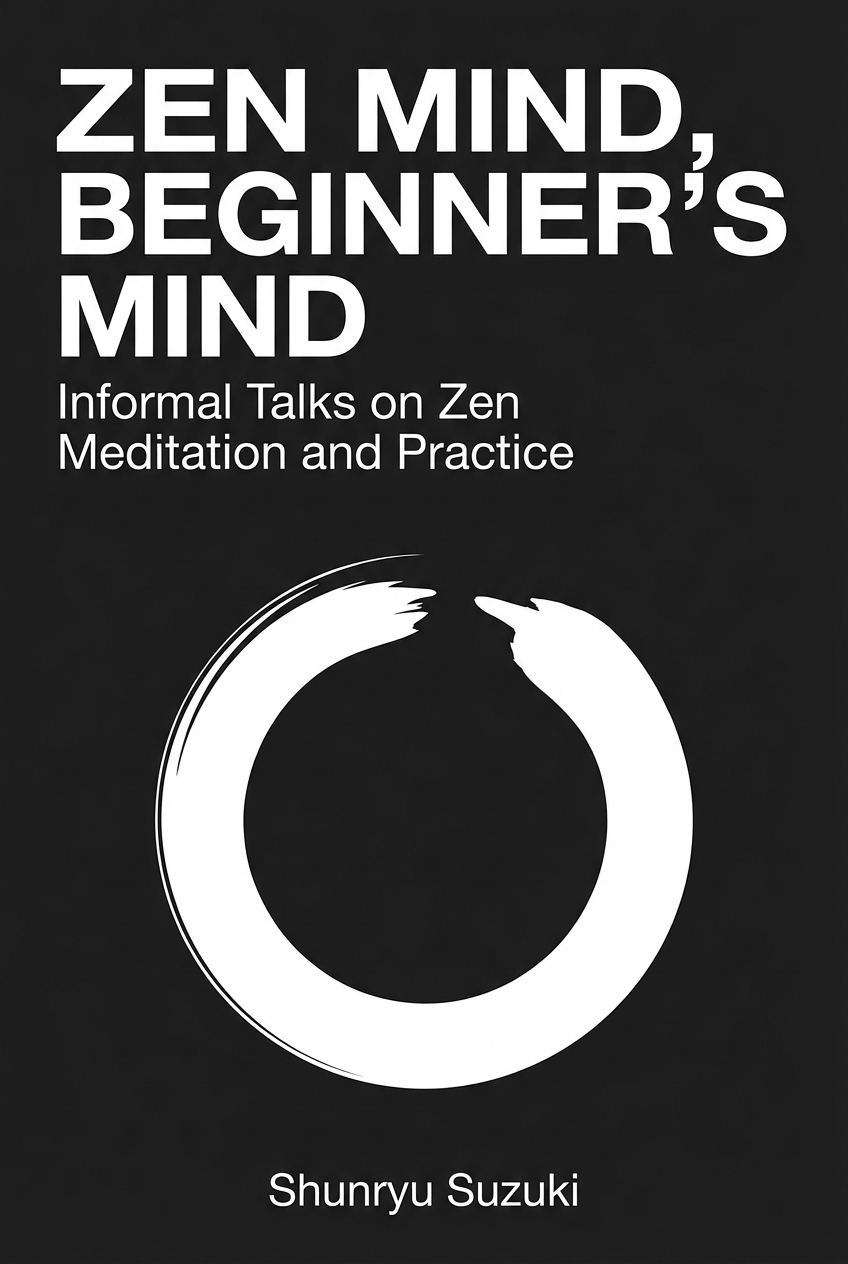
Zen Mind, Beginner's Mind
Informal Talks on Zen Meditation and Practice
What's it about
Tired of your mind racing with endless thoughts and anxieties? What if you could find profound peace and clarity not by mastering complex techniques, but by returning to the simple, open mind of a beginner? This is the core promise of Zen practice. Discover how to embrace the "beginner's mind" to see the world with fresh eyes and approach meditation without judgment. You'll learn practical ways to integrate Zen principles into your daily life, transforming simple posture and breathing into powerful tools for self-awareness and inner calm.
Meet the author
Shunryu Suzuki was a pivotal Sōtō Zen monk who played a crucial role in bringing Zen Buddhism to the West, founding the first Zen monastery outside Asia. Arriving in San Francisco in 1959, he was struck by the sincere interest Americans had in Zen, a quality he called "beginner's mind." This book is a collection of his informal talks to a small group of students in California, capturing the profound yet accessible wisdom that made him such a beloved and influential teacher.
The Script
Becoming an expert is often seen as the ultimate goal. We celebrate the seasoned professional, the veteran with twenty years of experience who can solve problems on autopilot. But what if this accumulation of knowledge, this very expertise, is the greatest barrier to genuine insight? What if the state of being a total beginner—empty, open, and free of preconceptions—is a state to be cultivated? This is the central paradox: the more we know, the less we are able to see. Our expertise builds a fortress of assumptions, making us skillful at repeating the past but blind to the possibilities of the present moment. True mastery is about maintaining the profound curiosity of not knowing.
This exact challenge of seeing the world anew is what brought a group of American students to a small Zen center in 1960s California. They came seeking wisdom from a Japanese Zen master, Shunryu Suzuki. They arrived with notebooks and tape recorders, ready to capture and systematize his teachings, to become experts in Zen. Suzuki, however, saw their earnest efforts as a potential trap. He noticed that as soon as they learned a concept, they clung to it, losing the very openness they were seeking. To counter this, he began giving a series of simple, direct talks. These talks were a way to gently guide his students away from the trap of intellectual accumulation and back to the simple, powerful awareness of a beginner's mind. The book, "Zen Mind, Beginner's Mind," is the result of those talks, a collection of insights born from a teacher's attempt to help his students unlearn what they thought they knew.
Module 1: The Power of Beginner's Mind
The central idea of this entire book is a concept Suzuki calls shoshin, or "beginner's mind." This is a state of openness. It's a mind free from preconceptions, ready to see things as they truly are. In the expert's mind, there are few possibilities. But in the beginner's mind, there are many.
This leads to the first insight. True practice means approaching every moment as if for the first time. Think about reciting a favorite poem or mission statement. The first time, you feel its power. The hundredth time, it can become rote and meaningless. Suzuki points out that this is a risk in any practice, whether it's meditation or leading a team meeting. The beginner’s mind keeps the practice alive. It finds the limitless meaning in the original act, again and again. You have to approach your work with the freshness of discovery.
Building on that idea, Suzuki suggests that a beginner’s mind is a self-sufficient mind. An expert's mind is often busy discriminating, judging, and comparing. It creates a gap between "what is" and "what should be." This creates endless desire and dissatisfaction. A beginner’s mind, however, simply accepts. Because it's not grasping for something outside itself, it remains rich and full. This is the foundation of true security. It's a mind that is whole to begin with, free from the need for external validation.
So what happens next? You stop chasing ghosts. The beginner's mind has no thought of achievement. All self-centered thoughts, like "I have succeeded" or "I am an expert," actually limit your mind. They create a small, defended self. When you let go of the need to achieve a specific outcome or build a certain identity, your mind expands. It becomes more compassionate and open to the world. The paradox is that by dropping the goal, you become far more effective and connected. You are simply present and acting.
We are now ready to examine how this mindset is physically embodied. Let's move to the second module.