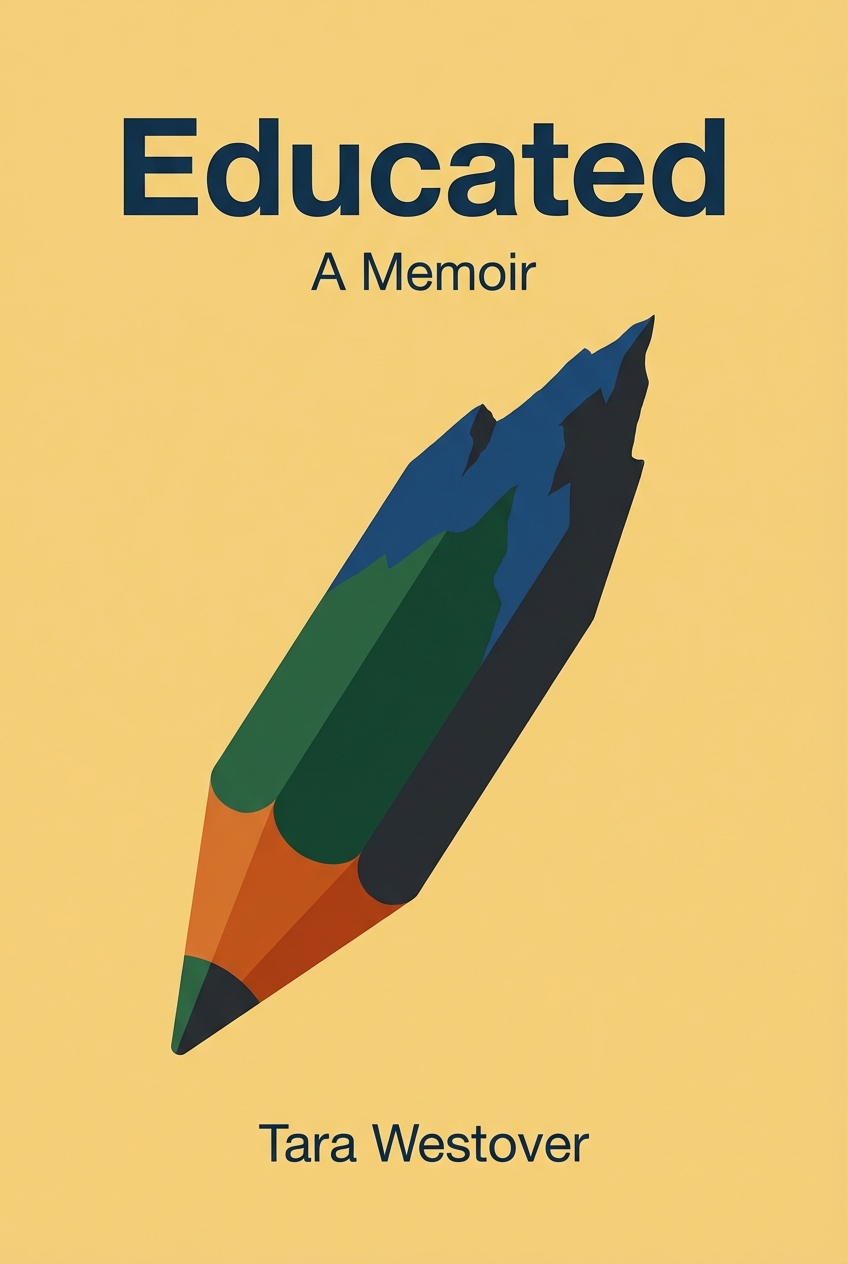
Educated
A Memoir
What's it about
Have you ever felt that your past dictates your future? What if you could break free from the world you were born into and forge a completely new identity? This summary reveals how one woman's thirst for knowledge became her ticket to freedom. Discover the incredible true story of Tara Westover, who grew up in a survivalist family in rural Idaho, completely cut off from mainstream society. You'll learn how she defied her family, taught herself enough to get into college, and journeyed all the way to Cambridge University, showing you the power of education to redefine your life.
Meet the author
Tara Westover is an American historian and writer who, after being raised in a survivalist family with no formal education, earned her PhD from Cambridge University. Her astonishing journey from a remote mountain in Idaho to the halls of one of the world's most prestigious universities forms the basis of her critically acclaimed memoir, Educated. Westover's unique background gives her a powerful and deeply personal perspective on the transformative power of knowledge, self-invention, and the pursuit of a world beyond the one we are given.
The Script
Think of the first stories you were ever told. Were they about your family? A grandparent's journey, a parent's childhood mischief? For most of us, these stories form a foundation, a shared history that tells us who we are and where we belong. They are the initial lines drawn on the map of our identity. But what happens when you begin to suspect that the foundation is unstable? What if the stories you were raised on—the ones that defined your world, your family, and your very self—are not just incomplete, but actively false? This is about realizing the entire narrative framework of your life was constructed to keep you in a specific place, and that the cost of discovering the truth is the family and the home you’ve always known.
This profound and painful dilemma is the engine of Tara Westover's memoir, Educated. She grew up in a scrapyard at the foot of a mountain in rural Idaho, the youngest of seven children in a survivalist family that distrusted doctors, schools, and the government. Her world was one of herbal remedies for horrific injuries and prophecies of the End of Days. Her story is the chronicle of her escape from a life of isolation and violence by seeking an education she was told would corrupt her. Westover wrote this book to make sense of her own fractured past—to document the brutal cost of leaving her family behind in order to find herself, and to understand how knowledge can both save you and sever you from your origins.
Module 1: The Power of Narrative to Define Reality
Westover’s story begins on a remote mountain in Idaho, a place governed by her father’s powerful, all-consuming narratives, not societal laws. This first module explores how stories, whether true or imagined, can become more real and influential than objective fact.
A core insight from the book is that the stories we inherit can build the walls of our world. Westover’s father, Gene, was a master storyteller. He used his interpretations of scripture and current events to construct a reality for his family. For example, Westover’s "strongest memory" of childhood is a violent federal siege on her home, complete with gunfire and her mother falling. But this never happened. It was a vivid mental movie created from her father's terrifying retellings of the 1992 Ruby Ridge standoff. The imagined memory felt as real as any lived experience. This demonstrates a key principle for any leader or professional: the narratives you create or accept will define your team’s reality, their fears, and their perceived limitations.
This leads us to a second powerful idea: ideological narratives can override practical reality, often with dangerous consequences. Gene’s personal reading of a Bible verse led him to declare milk an evil substance. He purged all dairy from the house, forcing the family to eat cereal with water. This was a test of faith and loyalty. His narrative created a new, tangible reality. This principle extends to the family's rejection of modern medicine. Even after a horrific car crash leaves Westover’s mother with a severe brain injury, the family’s first instinct is to rely on herbal remedies and faith. The ideology—that doctors are agents of a satanic government—was more powerful than the observable medical crisis.
So what's the actionable takeaway here? You must consciously audit the narratives that control your environment. Are your team's beliefs about what’s possible based on past successes, or are they constrained by old stories of failure or external threats? Westover’s escape began when she started questioning the stories she’d been told. For a professional, this means actively challenging assumptions and replacing limiting narratives with ones that open up new possibilities.