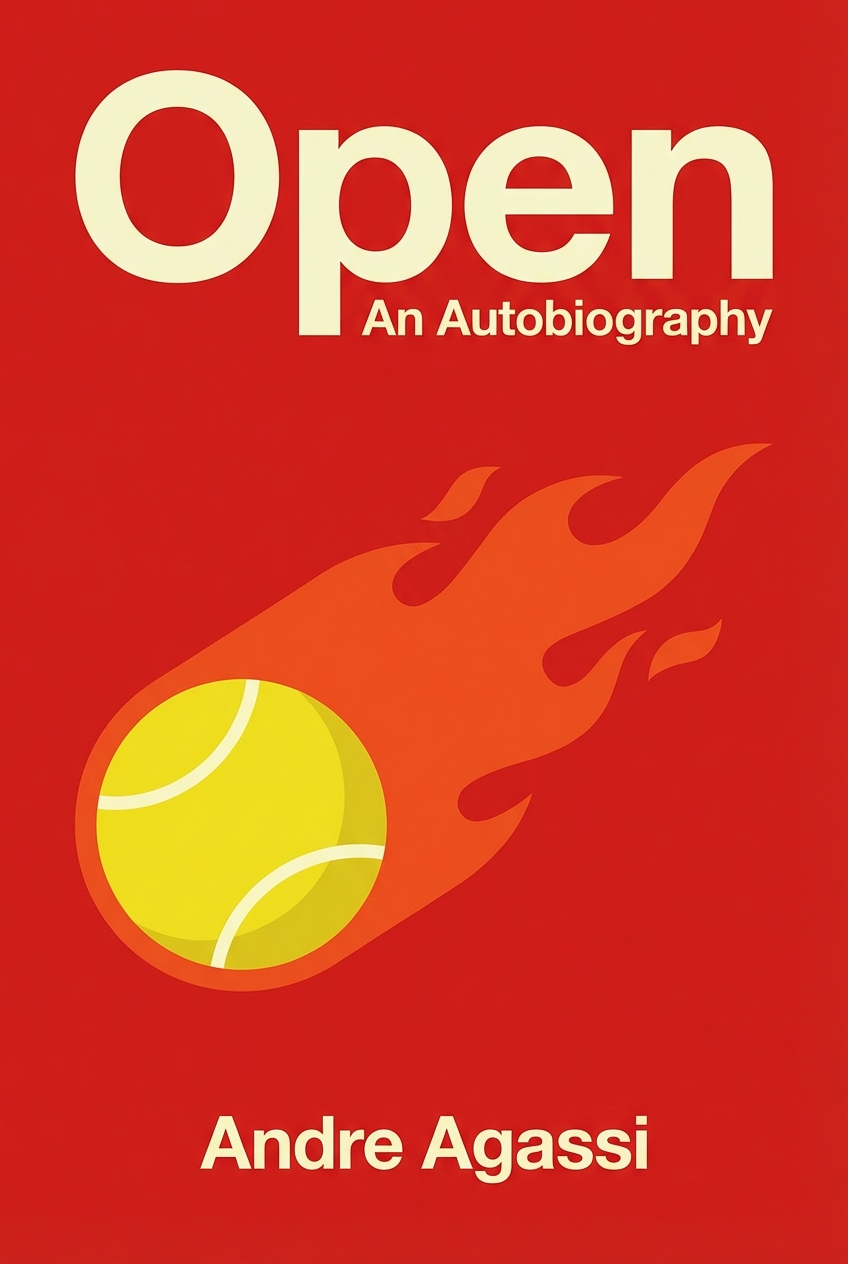
Open
An Autobiography
What's it about
Ever felt trapped in a life you never chose? Discover the shocking truth behind Andre Agassi's legendary career, a story of a man who hated the very sport that made him a global icon. This isn't just about tennis; it's about finding your true self against all odds. You'll learn how Agassi battled a controlling father, crippling self-doubt, and the immense pressure of public life to forge his own path. Uncover the raw, unfiltered story of rebellion, redemption, and the relentless pursuit of authenticity, even when it meant losing everything.
Meet the author
Andre Agassi is a former world No. 1 tennis player, an eight-time Grand Slam champion, and the only man to win the Career Super Slam. Despite his public success, Agassi secretly struggled with the intense pressures of a sport he had come to hate. His autobiography, Open, reveals the raw, often painful, story behind the celebrated icon, detailing his rebellion against the game and his ultimate journey to find purpose both on and off the court.
The Script
The child prodigy is a fragile archetype. We see the final product—the flawless performance, the effortless victory, the seemingly innate genius—and we applaud. We see the 13-year-old chess master, the teenage virtuoso, the young athlete shattering world records, and we marvel at a gift from the gods. What we don't see is the relentless machinery required to manufacture that perfection. We don't see the thousands of hours of joyless repetition, the sacrificed childhood, the crushing weight of a parent's ambition fused to a child's identity. The prodigy often isn't a person; they are a project. Their life becomes a singular, suffocating pursuit of a goal they may not have even chosen, their internal world a casualty of the external accolades.
This is the devastating paradox that Andre Agassi lived for over two decades. As one of the most celebrated and flamboyant tennis players in history, he was the face of a sport he secretly, profoundly hated. From the time he was a small child, drilled relentlessly by his father in the blistering Las Vegas heat, his life was not his own. Every success was a gilded cage, every win a step deeper into a life he despised. After retiring from the sport that had defined and tormented him, Agassi decided to tell the unvarnished truth. Working with Pulitzer Prize-winning journalist J.R. Moehringer, he created Open, a memoir that dismantles the myth of the happy champion to reveal the raw, painful, and ultimately human story of a man searching for his own identity after a lifetime spent performing as someone else.
Module 1: The Prison of Early Talent
The story begins with a brutal truth. Andre Agassi did not choose tennis. Tennis was chosen for him. His father, Mike Agassi, was a man forged by poverty and rage, obsessed with creating a champion. He believed in the cold math of repetition. Hit 2,500 balls a day, nearly a million a year, and a child will become unbeatable. This philosophy turned Andre’s childhood into a relentless grind. The backyard court was his prison. The ball machine, a customized monster his father called "the dragon," was his warden.
This leads to a foundational insight: Forced excellence breeds resentment, not passion. Andre was a prodigy. At age four, he was hitting with Jimmy Connors. But every swing was an act of compliance, not joy. His father’s ambition was a suffocating force. Any deviation from the plan was met with fury. When Andre won a sportsmanship trophy, his father smashed it. The message was clear: only winning mattered. This environment built a deep-seated hatred that would become the central conflict of his life.
Here's the thing. This intense, repetitive training did make him a formidable player. But it came at a tremendous psychological cost. He internalized his father's critical voice. After one loss, he realized he no longer needed his father to torture him. He could do it all by himself. This self-flagellation became a constant companion. Early, high-pressure specialization can stunt emotional and personal development. He was a tennis machine, but he felt like an incomplete person. He yearned for the shared responsibility of a team sport like soccer, a world where the fate of his family didn't rest solely on his shoulders. But that door was slammed shut. His father’s decree was absolute: "You're a tennis player."
The next logical step in this forced journey was the Nick Bollettieri Tennis Academy. It was sold as a golden opportunity, but for Andre, it felt like a sentence. The academy was a brutal, Lord of the Flies-style environment. It was a place of jungle law, spartan barracks, and neglected education. The system was designed to do one thing: produce tennis players. Everything else was secondary. So what happens next? Andre rebelled. Rebellion is often a desperate search for identity in a controlled environment. He got a pink mohawk. He wore eyeliner and torn jeans in a tournament final. These were cries for help. They were his clumsy attempts to make his invisible inner self visible, to show the world he was unhappy and wanted to go home. The famous "Image is Everything" persona was born from a profound lack of confidence. It was a mask to hide behind.