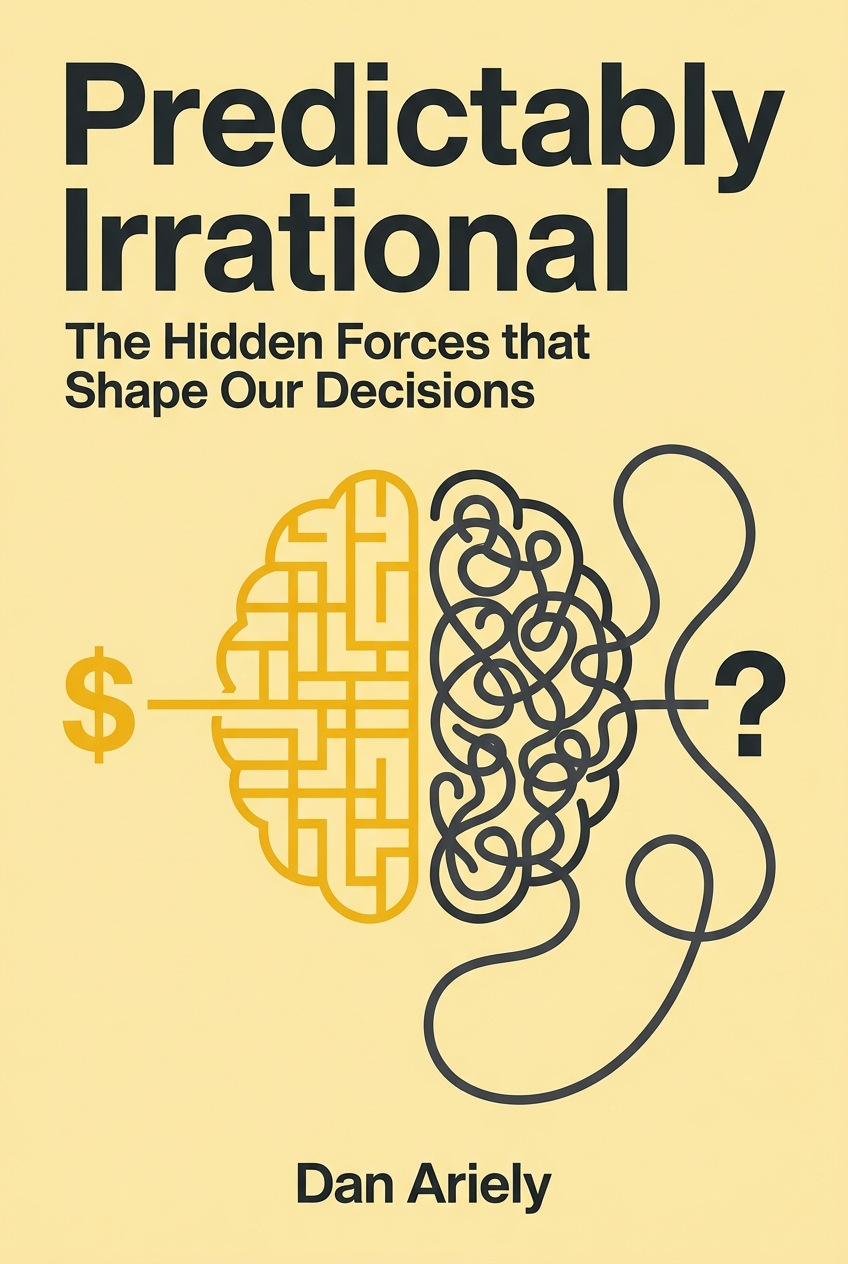
Predictably Irrational
The Hidden Forces that Shape Our Decisions
What's it about
Ever wonder why you overspend on a sale, stick with a bad decision, or procrastinate on important tasks? This book summary reveals the hidden psychological forces that make your choices surprisingly irrational—and shows you how to start making smarter, more deliberate decisions today. You'll discover the truth about pricing, the power of "free," and why you can't seem to break certain habits. Learn the predictable patterns behind your own irrational behavior so you can finally regain control, avoid common mental traps, and achieve your personal and professional goals.
Meet the author
Dan Ariely is a world-renowned professor of psychology and behavioral economics at Duke University, whose groundbreaking research explores the hidden forces that influence our choices. After a serious accident left him hospitalized for years, he became fascinated by how people make decisions, especially irrational ones. This firsthand experience with human behavior in extreme circumstances inspired his life's work and the revolutionary insights found within his bestselling books, making complex ideas accessible and relevant to everyone.
The Script
Think of the last time you bought a more expensive item because it was 'on sale,' even though a cheaper, everyday-priced alternative was right next to it. Or consider how a free sample can make you feel obligated to buy the full product, even if you didn't love it. These are patterns, not random quirks. We like to think of ourselves as logical beings, carefully weighing pros and cons before making a choice. Yet, our decision-making is often guided by invisible forces—the power of 'free,' the pull of social norms, the arbitrary anchor of a first price we see. We consistently overpay, underestimate, and misjudge our own desires in ways that are predictably irrational. We are systematically flawed in the same ways, over and over again.
This peculiar architecture of the human mind became the life's work of Dan Ariely, a professor of psychology and behavioral economics. His fascination with these irrational yet predictable behaviors started from a place of intense personal experience, not a sterile university lab. As a young man, Ariely suffered third-degree burns over 70% of his body, leading to a long and excruciating recovery. During his hospitalization, he was a captive observer of his own irrational pains and the often-flawed decisions made by his well-meaning caregivers. He questioned why nurses, convinced it was less painful, ripped off his bandages quickly, despite his protests that a slow removal was better. This agonizing experience sparked a lifelong quest to understand the hidden forces that truly drive our choices, leading him to design the clever experiments that reveal the predictable irrationality in us all.
Module 1: The Illusion of Value
We believe we know what things are worth. But we don't. We operate without an internal value meter. Instead, we figure out value by comparing one thing to another. This is the principle of relativity, and it’s the first driver of our irrationality.
The author shows how this works with a classic experiment using The Economist magazine. People were offered two subscription choices. An online-only subscription for $59. Or a print-and-online subscription for $125. Most people chose the cheaper online-only option. It seemed like the rational choice. Then, a third option was introduced. This was the decoy. It was a print-only subscription, also for $125. Suddenly, everything changed. The print-and-online package now looked like a fantastic deal. You get the online version for free! As a result, the majority of people switched their choice to the more expensive $125 package. Nothing about the products changed. Only the context. Your choices are manipulated by the options you are presented with, not just the options themselves.
This leads to the core insight: we make decisions based on relative comparisons. Marketers use this constantly. Think about a restaurant menu. You often see a ridiculously expensive entrée at the top. The restaurant doesn't expect to sell many of them. That dish is there to make the second-most expensive dish look like a reasonable choice. We gravitate toward the middle. We avoid extremes.
So what's the next step? This reliance on comparison makes us vulnerable to a phenomenon called anchoring. The first price we see for a new product sets an anchor in our mind. From that point on, all other prices are judged relative to that initial anchor. Even if the anchor is completely arbitrary. In one study, people were asked to write down the last two digits of their social security number. Then they bid on items like a bottle of wine. People with higher social security numbers consistently bid more. The number was random, but it anchored their perception of value.
Here's the thing. Once an anchor is set, it creates what Ariely calls arbitrary coherence. We might buy our first cup of Starbucks coffee for a high price. That price becomes our anchor for "premium coffee." The next time we buy it, we are just being coherent with our past decision. This is how habits form. We follow our own past behaviors, assuming they were rational, even if they were based on a random anchor. This is self-herding. We line up behind our own previous choices. This means our first decisions are critical. They have an outsized influence on our future behavior for years to come.