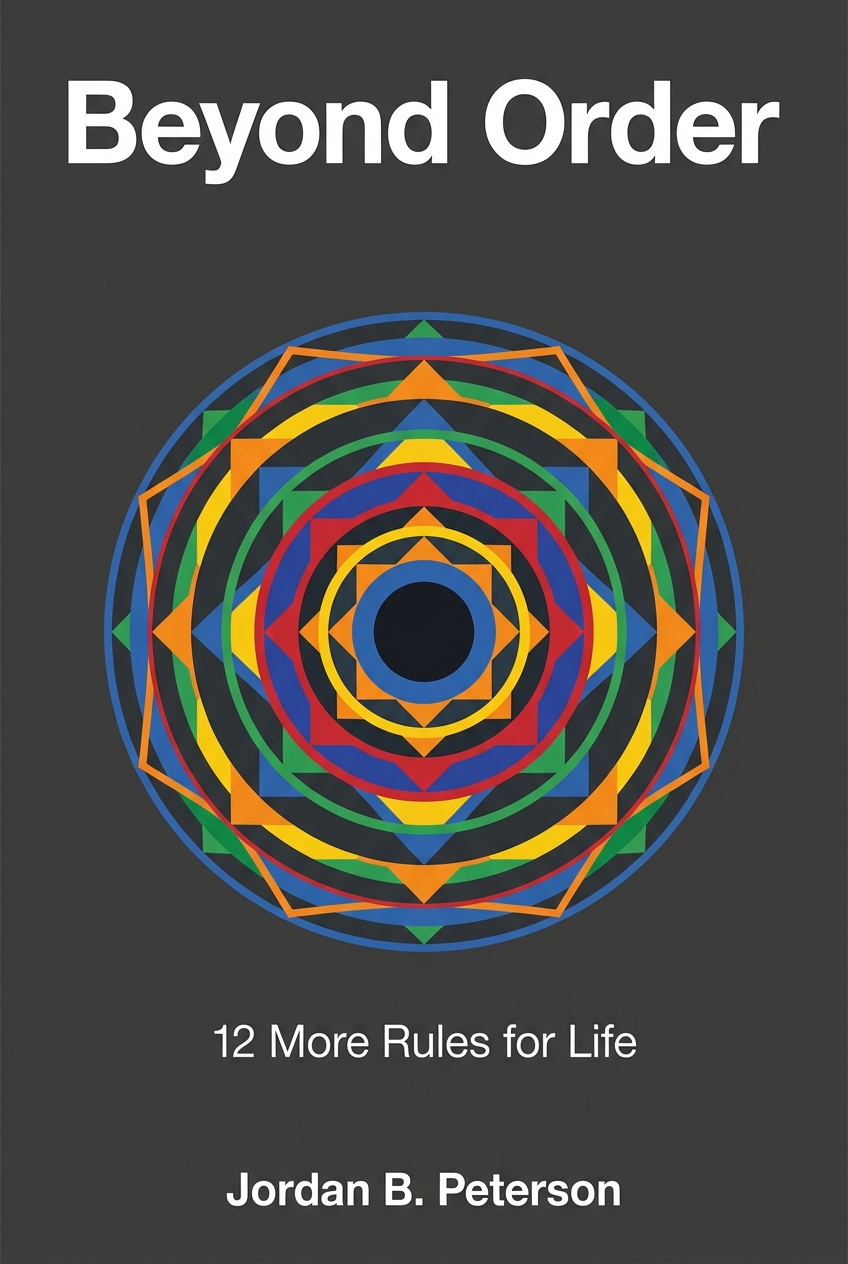
Beyond Order
12 More Rules for Life
What's it about
Feeling overwhelmed by chaos and uncertainty? Learn how to find stability and meaning even when your world feels like it's falling apart. This summary reveals how to create order from chaos and turn your greatest challenges into your most profound strengths. Discover Peterson’s 12 new rules for navigating the modern world. You'll learn why you should embrace tradition, how to cultivate gratitude in the face of suffering, and why daring to be truthful is the ultimate path to a meaningful life. Transform potential into reality and find your balance.
Meet the author
Dr. Jordan B. Peterson is a clinical psychologist and professor emeritus at the University of Toronto, whose lectures on mythology and psychology have been viewed by hundreds of millions. His work synthesizes insights from clinical practice, ancient wisdom, and modern science to offer profound guidance for navigating life's inherent chaos. This unique blend of experience provides the foundation for the powerful principles found in his bestselling books, helping readers find meaning and order in their lives.
The Script
The old sailboat, weathered and scarred from a thousand voyages, sits in its slip, perfectly secured. Every rope is coiled, every cleat is tied with a practiced knot. The deck is swabbed, the sails are furled, the hull is clean. This is a vessel of pure order, a testament to discipline and careful maintenance, safe and predictable. But in this state of perfect stillness, it fails its essential purpose. It's a boat, built for the open sea—for the unpredictable wind, the sudden squall, the exhilarating chaos of the unknown that gives it meaning. It cannot stay in the harbor forever, nor can it survive the ocean without its internal structure and the sailor's practiced skill. We live our lives navigating this same paradox: too much rigid control and we stagnate, our potential unrealized; too much chaos and we are overwhelmed, shattered by the storm. How do we learn to dance on that knife's edge between the two?
This question of balance became intensely personal for Jordan B. Peterson in the years following the unexpected, global success of his first book, 12 Rules for Life. That book was a guide for pulling oneself out of chaos and establishing order. But as he toured the world, speaking to massive audiences, he saw the other side of the coin. He encountered people who had followed the rules so perfectly that their lives had become brittle, constricting cages. He also watched as his own life, and the health of his family, was thrown into sudden, terrifying disarray. Drawing from his work as a clinical psychologist and his deep study of mythology and philosophy, Peterson began to formulate a necessary complement to his first book. Beyond Order emerged from this period of profound crisis, offering guidance for when the structure you've so carefully built is not enough, or worse, has become the problem itself.
Module 1: The Dance Between Order and Chaos
Life is a constant negotiation between two great forces. Peterson calls them Order and Chaos. Order is the world you know. It’s your schedule, your job description, your stable relationships. It’s predictable and secure. Chaos is the unknown. It’s the unexpected job offer, the sudden illness, the disruptive idea that changes everything. It’s both terrifying and full of potential. The key to a meaningful life is to stand with one foot firmly in order while tentatively exploring the unknown with the other.
This is where Peterson’s first major insight comes into play. Do not carelessly denigrate social institutions or creative achievement. The established structures around us—family, community, even copyright law—are the hard-won products of generations wrestling with chaos. They are imperfect, but they provide the stable ground we need. The author points to his own 50-year marriage as a testament to the value of a core social institution. It’s a creative achievement built over decades, providing a bulwark against life’s storms. To dismiss these structures lightly is to kick away the foundations of your own stability.
But stability alone is not enough. You must also engage with the world. This leads to the next insight: Work as hard as you possibly can on at least one thing and see what happens. This is about choosing a meaningful, difficult goal and committing to it. This focused effort is your controlled expedition into chaos. It’s how you test yourself, develop competence, and create new value. Peterson himself modeled this by writing Beyond Order according to a plan laid out years earlier, pushing through the chaos of a global pandemic and personal illness to bring a new piece of order into the world.
Of course, this journey will reveal uncomfortable truths. And here’s the thing: Do not hide unwanted things in the fog. We all have a tendency to let difficult problems, painful memories, or unspoken resentments remain vague and unaddressed. We create a "fog" of avoidance. Peterson argues this is a disastrous strategy. Unaddressed problems don't disappear; they fester and grow. He gives a direct method for dispelling this fog: if old memories still upset you, write them down carefully and completely. Drag them into the light. This act of clarification is the first step toward resolution. It transforms a haunting specter into a problem you can actually solve.
Finally, as you navigate this path, you will be tempted by simple answers. This is why Peterson warns, Abandon ideology. Ideologies are rigid, one-size-fits-all explanations for a complex world. They promise clarity but deliver blindness. Whether it’s political, economic, or social, a rigid ideology encourages resentment and divides the world into simple heroes and villains. Peterson points to historical examples, like destructive Soviet posters, to show how utopian ideologies justify tearing down valuable institutions and people. The alternative is to think for yourself, to ground your beliefs in your direct experience, and to embrace nuance.