All Books
Self-Growth
Business & Career
Health & Wellness
Society & Culture
Money & Finance
Relationships
Science & Tech
Fiction
Topics
Blog
Download on the App Store

Tools of Titans

The Tactics, Routines, and Habits of Billionaires, Icons, and World-Class Performers

15 minTim Ferriss

What's it about

What if you could peek inside the minds of the world's top performers and steal their playbooks? This summary distills the proven tactics, routines, and habits of billionaires, icons, and elite athletes, giving you a blueprint for achieving extraordinary results in your own life. Learn the unconventional morning routines that prime you for focus, discover the simple workout that legendary athletes swear by, and uncover the philosophical principles that guide billionaire investors. Tim Ferriss has done the work of interviewing hundreds of titans; now you get their best tools.

Meet the author

Tim Ferriss, host of the globally acclaimed podcast 'The Tim Ferriss Show,' has deconstructed the habits of hundreds of world-class performers for millions of listeners. This book is the direct result of his relentless curiosity and unprecedented access to the world’s most successful people. It distills thousands of hours of interviews into a curated collection of the specific tools and routines that have helped his legendary guests achieve greatness, offering a playbook for excellence in any field.
Listen Now

Opens the App Store to download Voxbrief

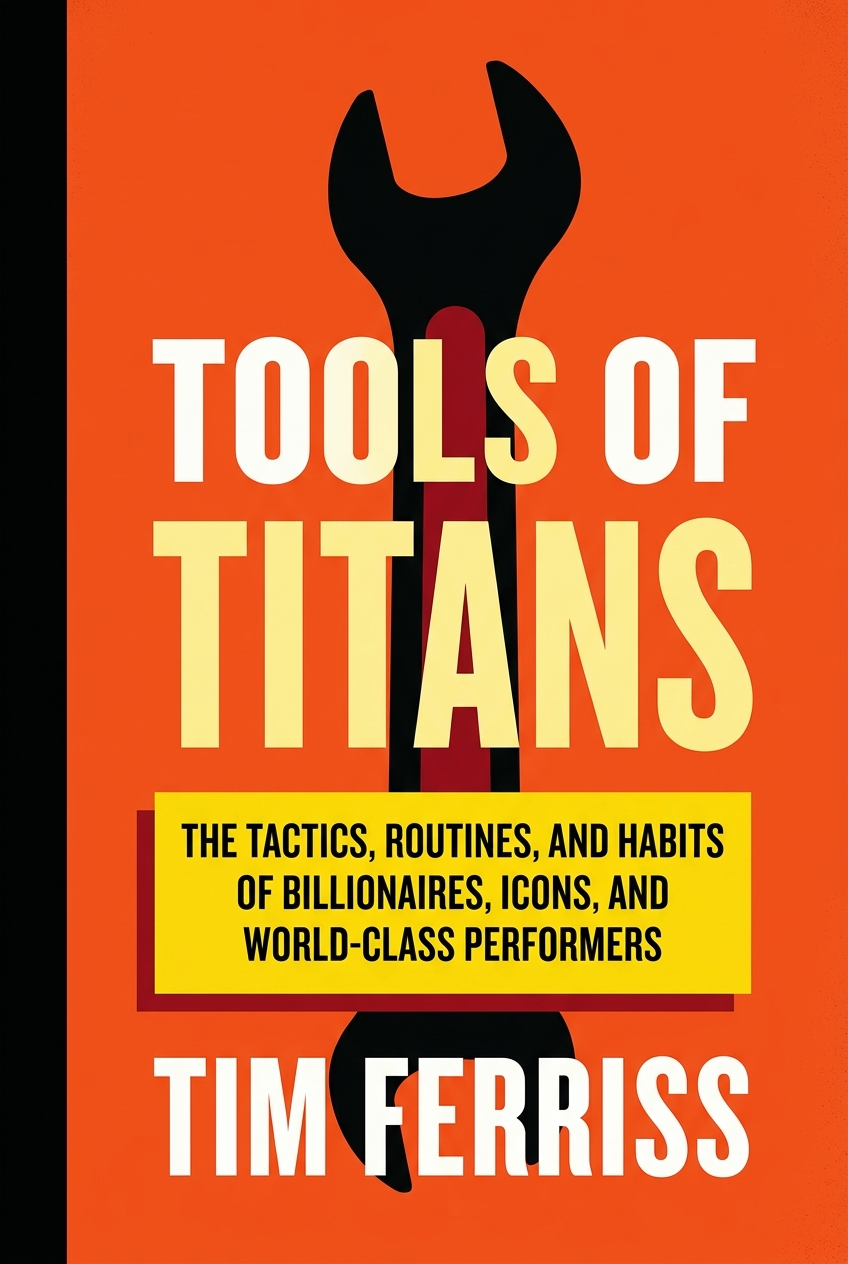
Tools of Titans book cover

The Script

When Arnold Schwarzenegger decided to become the highest-paid actor in Hollywood, the industry laughed. Agents told him everything was wrong: his accent was too thick, his body was bizarrely over-muscled for the screen, and his last name was a marketing nightmare. He was advised to change all of it. Instead, he changed nothing. He applied the same brutal, simple logic he used to win seven Mr. Olympia titles. For him, learning a script was just like doing more repetitions in the gym. Nailing a difficult scene was the same as pushing through a final, painful set of squats. He saw no fundamental difference between conquering bodybuilding and conquering Hollywood. Both were systems that could be dominated through relentless practice and a vision of the outcome so clear it felt like a memory. This was a transferable tool, a mental framework that made the impossible seem merely difficult.

This idea—that extraordinary success is often built on a set of replicable, if unusual, habits—is precisely the territory explored by one of the most dedicated human guinea pigs of our time. For years, Tim Ferriss, an author and early-stage tech investor known for his own radical experiments in accelerated learning, had been deconstructing skills from tango dancing to language fluency. But he wondered if the same process could be applied to the less tangible assets of the world's most successful people: their mindsets, their decision-making frameworks, and their daily rituals. This curiosity sparked 'The Tim Ferriss Show,' a podcast that quickly became a global phenomenon.

The podcast became his personal laboratory for reverse-engineering excellence. He sat down for hours with hundreds of icons—from Navy SEAL commanders and chess prodigies to billionaire financiers and entertainment legends—asking intensely practical questions that others overlooked. He didn't care about their official bios; he wanted to know about their morning routines, their workout regimens, their most impactful failures, and the books that fundamentally shaped their thinking. 'Tools of Titans' is the direct result of that relentless questioning. It began as Ferriss's private collection of notes, a personal playbook filled with the most effective and actionable tactics he had gathered. After years of listeners begging for access to these insights, he compiled and organized his notebooks into a new kind of encyclopedia of hard-won wisdom, tested on the front lines of business, sports, and life.

Module 1: Hacking Health & Human Performance

The titans in this book treat their bodies like a high-performance system. They train and regenerate with scientific precision. Their approach often runs counter to mainstream advice. It begins with a willingness to get uncomfortable.

A core principle is to embrace discomfort to build resilience. World-champion obstacle course racer Amelia Boone offers a clear example. She intentionally trains in the rain and cold. Why? Because she knows her competitors are probably inside. She rehearses the worst-case scenario. This builds a mental and physical edge that's impossible to replicate in a comfortable gym. Gymnastics coach Christopher Sommer echoes this. He tells his athletes they must be willing to be a "pud now" to become a "stud later." This means embracing the discomfort of working on your most embarrassing weaknesses. True strength is forged by confronting difficulty directly.

Building on that idea, these performers know that growth happens during recovery, not just during the workout. That's why they prioritize strategic regeneration over mere training. Dr. Rhonda Patrick discusses "hyperthermic conditioning." This is a fancy term for calculated heat exposure through saunas or hot baths. One study showed this practice increased endurance by 32%. It can also dramatically boost growth hormone levels, which is critical for repair. Recovery is an active process. Many use aggressive foam rollers like the RumbleRoller or tools like hydrolyzed gelatin to repair connective tissue. The goal is to build a body that can withstand and adapt to immense stress.

Now, let's turn to fuel. Many titans use powerful metabolic tools to optimize their energy and cognition. Specifically, they use ketosis and fasting for peak performance. The ketogenic diet is a high-fat, very low-carb approach. It shifts your body from burning glucose to burning fat, or ketones, for fuel. Scientist Dom D'Agostino, a leading researcher in this field, has shown its power. He once deadlifted 500 pounds for 10 reps on the seventh day of a fast. This demonstrates that strength can be maintained, or even increased, in a fasted state. Ferriss himself used a strict ketogenic diet and extended fasting to completely eliminate his symptoms of Lyme disease after antibiotics failed. This is about strategically using metabolic states to enhance physical and mental output.

And here's the thing. All these advanced tactics rest on a simple foundation. Strength is a skill trained with consistency, not just intensity. Pavel Tsatsouline, a former Soviet special forces instructor, champions this idea. He developed a method called "Grease the Groove." Instead of training to failure once, you perform frequent, sub-maximal sets of an exercise throughout the day. To improve your pull-ups, you might do sets of half your maximum reps several times a day. This trains the movement as a neurological skill. It improves efficiency without causing burnout. This blue-collar approach of showing up, doing the work consistently, and going home is a common thread. It proves that lasting results are forged through disciplined practice.

Module 2: Deconstructing Wealth & Business

The titans who excel in business and investing often play a different game entirely. They build their success on unique principles that allow them to sidestep competition and create disproportionate value.

One of the most powerful strategies is to create a new category instead of competing in a crowded one. Al Ries and Jack Trout, authors of "The 22 Immutable Laws of Marketing," explain this concept well. It's easier to be first in a new category than to be better in an existing one. Amelia Earhart isn't remembered as the third person to fly solo across the Atlantic. She is remembered as the first woman to do so. She created a new category and owned it. Ferriss applied this directly. He didn't write another productivity book. He coined the term "lifestyle design," creating a new field that he dominated from the start. This approach shifts the focus from outperforming competitors to making them irrelevant.

So what happens next? Once you have a unique position, you don't need to appeal to everyone. In fact, it's better if you don't. The key is to build a sustainable career on 1,000 true fans, not mass appeal. This concept, popularized by Kevin Kelly, is simple but profound. A true fan is someone who will buy anything you produce. They will drive 200 miles to see you speak. If you can cultivate 1,000 of these fans and earn an average of $100 profit from each per year, you have a $100,000 income. The internet makes this possible. It allows creators to connect directly with their audience, bypassing traditional gatekeepers. This model provides a path to a sustainable living without the need for celebrity-level fame. It’s the foundation for both modest success and, as Ferriss notes, massive hits like Uber, which started by focusing on a tiny, dedicated user base.

But flip the coin. To make these bold moves, you need leverage. You need the freedom to say no. This is why many titans secure financial independence to empower creative choices. Arnold Schwarzenegger provides a masterclass in this. Before his film career took off, he invested his bodybuilding and seminar earnings into real estate. He became a millionaire before he ever starred in a major movie. This financial security gave him immense power. He didn't have to take bad roles to pay the rent. He could wait for the right project, like Conan the Barbarian. George Lucas did the same. He famously negotiated to keep the toy rights for Star Wars. That decision was worth billions. It gave him the freedom to build his own creative empire. Financial independence is about creating options.

This brings us to a crucial operational tactic used by top investors. To make robust decisions, you must stress-test every major idea with a formal "red team." Venture capital firm Andreessen Horowitz lives by this. Before any partner makes a deal, the idea is subjected to a brutal "torture test." The other partners attack it from every angle. They try to find every flaw. If the proposing partner still believes in the idea after this assault, the entire firm commits to supporting it. This process separates weak ideas from resilient ones. It replaces emotional conviction with battle-tested logic. It's a system for making better bets by embracing structured, internal conflict.

Read More