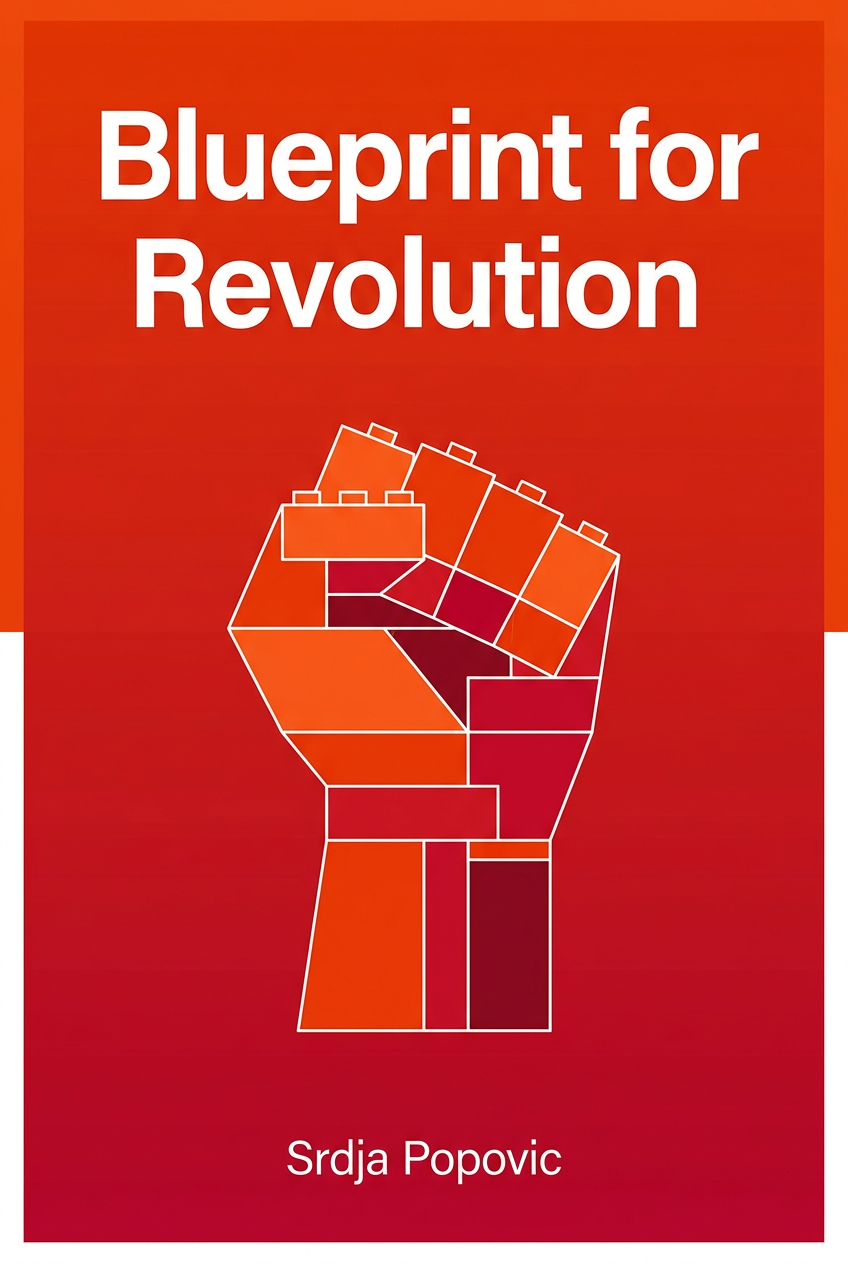
Blueprint for Revolution
How to Use Rice Pudding, Lego Men, and Other Nonviolent Techniques to Galvanize Communities, Overthrow Dictators, or Simply Change the World
What's it about
Want to change the world but don't know where to start? This book offers a practical blueprint for nonviolent protest, showing you how to challenge authority and win. Learn how a group of students in Serbia used humor and rock music to topple a dictator. Discover the secrets of "laughtivism" and how to use everyday items like rice pudding and Lego men as powerful tools for social change. You'll get a step-by-step guide to planning creative, low-risk movements that attract supporters and make a real, lasting impact on your community or country.
Meet the author
Srdja Popovic is a Nobel Peace Prize nominee and the co-founder of Otpor!, the Serbian youth movement that overthrew dictator Slobodan Milošević through nonviolent protest. This firsthand experience leading a successful grassroots revolution inspired him to create the Centre for Applied Nonviolent Action and Strategies CANVAS. Through CANVAS, he has trained thousands of pro-democracy activists in over 50 countries, transforming his on-the-ground tactics into a universal guide for changing the world, one creative and peaceful action at a time.
Opens the App Store to download Voxbrief

The Script
In 1998, a group of friends in Belgrade, Serbia, were tired of living under the thumb of a dictator. They were students, artists, and rock musicians. Their enemy, Slobodan Milošević, had tanks, secret police, and a state-run media machine. Their own arsenal was… different. It included a barrel painted with the dictator's face that people could hit for a dinar, a satirical 'New Year's Eve' party held in the middle of the day, and a flock of turkeys released near the parliament building, each with a sign that read 'Join Us.' While the regime expected grim-faced marches and angry protests, they were met with laughter, absurdity, and a growing sense of public ridicule that was impossible to suppress.
This was a calculated campaign of 'laughtivism.' The group called themselves Otpor!, Serbian for 'Resistance!', and their symbol was a simple, stenciled black fist—a logo that became more recognizable and trusted than any government institution. They transformed the grim business of political opposition into something cool, something you'd want to join. This movement, built on humor and strategic nonviolence, was the brainchild of Srdja Popovic and his friends. After successfully leading the movement that toppled Milošević, Popovic co-founded the Centre for Applied Nonviolent Action and Strategies . He realized the playful, powerful methods they had stumbled upon were a universal set of principles that could be taught, adapted, and used by anyone, anywhere, wanting to challenge oppression. He wrote 'Blueprint for Revolution' to share that story and offer a practical guide, showing how a barrel, a rock band, and a good joke can be more powerful than an army.
Module 1: Start Small, Start Smart
Many people believe that to create big change, you need a big, dramatic start. A massive protest. A bold, confrontational move. Popovic argues this is exactly the wrong approach. The first rule of successful movements is to start with small, winnable battles that build momentum. Big, abstract goals like "economic justice" or "corporate transparency" are overwhelming. They don't give people a clear first step. But a specific, tangible problem? That’s something people can rally around.
Take the story of Itzik Alrov in Israel. He was frustrated with "piggish capitalism," but he didn't launch a crusade against the entire economic system. He noticed the price of cottage cheese, a household staple, had skyrocketed. So he started a Facebook page calling for a one-month boycott. It was a simple, concrete ask. Over 100,000 people joined. The pressure worked. The country's largest dairy company lowered its prices. This small victory gave people a taste of their own power. It proved that collective action works. And it paved the way for much larger social justice protests later that year.
This leads to a related insight: choose issues with universal appeal. Most people are busy. They are focused on their daily lives. They don't have time for niche or abstract causes. To get their attention, you have to connect with what they already care about. Harvey Milk, the pioneering gay rights activist in San Francisco, learned this the hard way. His early campaigns, focused solely on gay rights, failed to gain traction with the broader public. So he pivoted. He started a campaign to clean up dog waste in public parks. It was a problem that annoyed everyone, gay or straight. He staged a press event where he deliberately stepped in dog feces. The stunt got huge media attention. He solved a common problem, built credibility, and created a coalition of supporters who were then more willing to listen to his broader message about equality.
Finally, a critical first step is to develop a clear and appealing "vision of tomorrow." People need to be for something. And that vision must be concrete and speak to people's everyday needs. When activists in the Maldives were planning their movement against a dictator, they held workshops where people role-played as police officers, business owners, and elders. They discovered what these groups actually wanted: respect, stable pay, affordable housing, and pensions. Their vision became about delivering those tangible benefits, which made the movement far more compelling to a wider audience.
Module 2: Brand Your Movement, Not Your Tactics
Once you have a clear, small goal, you need to give people a way to identify with it. This is where branding comes in. Popovic emphasizes that successful movements don’t just have ideas; they have identities. The key is to unify diverse grievances under a common, recognizable brand. In Serbia, Popovic's movement, Otpor!, was fighting a dictator. But different people had different complaints. Some were angry about the economy. Others about the war. Others about censorship.
Otpor! gave them a single symbol to rally around: a stylized black fist. It was simple, powerful, and easy to reproduce. Activists spray-painted it on walls across the country. They printed it on stickers and t-shirts. The fist represented resistance itself. It allowed a student angry about tuition, a grandmother worried about her pension, and a soldier tired of war to all feel like they were part of the same fight. This visual identity created a sense of unity and momentum long before they ever organized a mass protest.
And here's the thing. Popovic suggests a subtle but powerful shift in thinking. He argues that you should name your movement after an identity, not a tactic. Think about Occupy Wall Street. The name "Occupy" describes an action. If you weren't physically occupying a park, it was hard to feel like you were part of the movement. Polling showed that nearly half of Americans agreed with the movement's ideas, but far fewer actively participated. The name created a barrier.
Now, contrast that with the movement's core message: "We are the 99 percent." That’s an identity. It’s a statement about who you are. It’s inclusive. You don't have to camp in a park to be part of the 99 percent. You just have to feel that the economic system is unfair. By focusing on a shared identity, you make it easier for a diverse coalition to form. You create a bigger tent. This is how you build the numbers needed for real change.