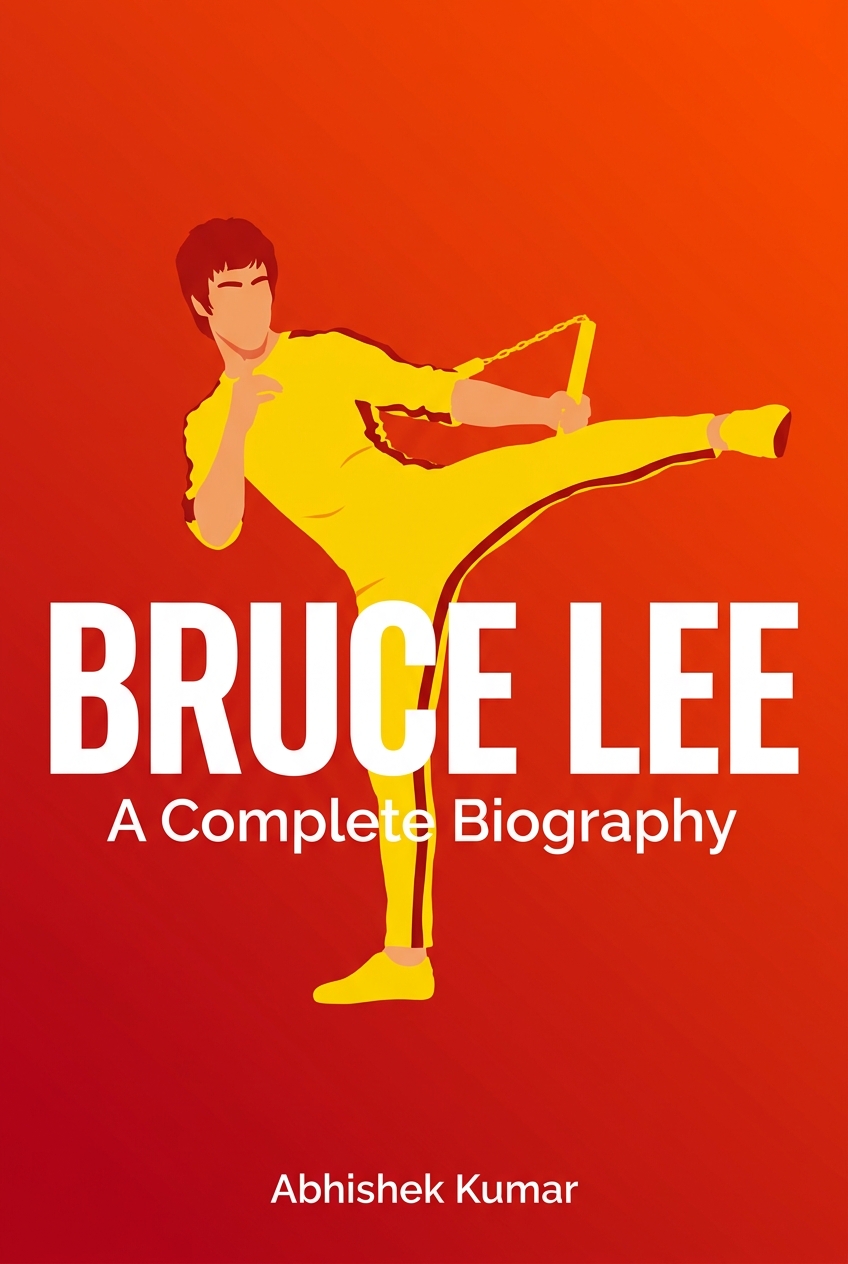
Bruce Lee
A Complete Biography
What's it about
Ever wonder what made Bruce Lee an unstoppable force, not just in martial arts but in life? This biography uncovers the core principles that transformed him from a street fighter into a global icon. Learn how to apply his legendary focus and discipline to conquer your own challenges and achieve greatness. Discover the man behind the myth and the philosophies that fueled his ambition. You'll get a behind-the-scenes look at his innovative training methods, his relentless pursuit of self-improvement, and the spiritual wisdom that guided his every move. This isn't just a life story; it's a blueprint for mastering your mind, body, and destiny.
Meet the author
Abhishek Kumar is an award-winning martial arts historian and one of the few biographers to have been granted exclusive access to the Lee family's private archives. This unparalleled research, combined with his lifelong dedication to Jeet Kune Do, allowed him to uncover the personal philosophies and untold stories behind the legend. His work moves beyond the icon to reveal the man, offering the definitive account of Bruce Lee's extraordinary life and impact.
Opens the App Store to download Voxbrief

The Script
In the mid-1990s, basketball superstar Michael Jordan, at the absolute peak of his global fame, abruptly retired to pursue a childhood dream of playing professional baseball. The move was baffling. Why would the undisputed master of one domain abandon his throne to become a struggling rookie in another? Commentators saw it as a bizarre, ego-driven detour. But for those who looked closer, it was something else entirely: a profound test of core principles. Jordan was pressure-testing his own philosophy of discipline, focus, and competitive fire in an environment where his natural gifts meant almost nothing. It was a radical act of self-inquiry, stripping away the legend to see what the man underneath was truly made of.
This kind of deep, philosophical self-excavation, where physical practice becomes a vehicle for spiritual and intellectual growth, didn't start with Jordan. Decades earlier, another global icon was turning his own physical art form into a laboratory for life itself. Bruce Lee was a philosopher who used combat as a metaphor for overcoming personal limitations. He dismantled rigid, ancient traditions to create a fluid, adaptable system for thinking, not just for fighting. This relentless quest to unify mind, body, and spirit is what captivated Abhishek Kumar. As a journalist and cultural commentator who has spent his career dissecting the underlying philosophies of modern icons, Kumar saw that Lee’s true legacy was a profound and practical method for living an authentic, powerful life. He wrote this book to distill that method, separating the man from the myth to reveal the timeless principles anyone can apply.
Module 1: Be Water, My Friend
This is perhaps Bruce Lee’s most iconic teaching. It sounds simple. But its implications are profound. The core idea is to cultivate a mindset that is formless and adaptable. Just like water.
Water can be gentle. It can flow around obstacles without resistance. But it can also be powerful. It can crash with immense force. It has no fixed shape. It becomes whatever container it enters, whether a cup, a bottle, or a teapot. Yet, it never stops being water. This is the model for personal and professional life. You must be formless, shapeless, like water. This means you don't cling to a single strategy or identity. You adapt.
In a startup environment, this is crucial. A product roadmap is essential. But what happens when market feedback tells you the map is wrong? The rigid leader doubles down. They force the plan. The fluid leader adapts. They listen to the data, pivot the strategy, and find a new path. They become the new container. Lee contrasted this with rigidity. He said to be pliable like a living person, not stiff and brittle like a corpse. In his view, pliability is life. Rigidity is death.
This brings us to the next layer of this philosophy. To be like water, you must first empty your mind. True learning requires emptying your cup. If your cup is already full of your own opinions, preconceptions, and ego, there is no room for anything new. You cannot learn. You can only reinforce what you already believe. This is a direct challenge to the expert mindset. The expert often becomes trapped by their own expertise. They see every problem through the lens of their past successes.
Lee advocated for a beginner's mind. A mind that is open, curious, and ready to receive. This doesn't mean you discard your experience. It means you don't let your experience build a wall around your mind. In a meeting, are you listening to understand? Or are you just waiting for your turn to speak? Emptying your cup means creating the space to truly hear what others are saying. It’s about absorbing what is useful and rejecting what is not.
And here's the thing. This fluidity isn't just about defense or reaction. It's also about action. Lee had a saying: "Moving, be like water; still, be like a mirror; respond like an echo." Let's break that down. "Moving, be like water" is about dynamic adaptation. "Still, be like a mirror" is about observing reality without judgment or distortion. It’s seeing things as they are, not as you wish they were. This is the essence of clear-headed decision-making.
Finally, "respond like an echo." An echo doesn't invent. It doesn't overthink. It responds naturally and instantly to the sound it receives. This points to a state of flow. It's about acting from a place of deep intuition, where your response is perfectly tailored to the moment. The goal is to discover truth. Knowledge is static. It's something you can collect. But truth is alive. It's a process of discovery. And that discovery happens in the present moment, when you are fluid, open, and responsive.
Now, let's move to the second module, which builds on this idea of finding your own truth.
Module 2: The Art of Honest Self-Expression
Bruce Lee’s biggest break with tradition wasn't just physical. It was philosophical. He saw traditional martial arts styles as rigid systems. They forced every student into the same mold. He called them a "gospel truth" that created uniform "products" instead of unique individuals. He believed this was fundamentally wrong.
This led him to his most powerful conclusion. Your primary goal is honest self-expression. Stop trying to be a second-rate version of someone else. Instead, be a first-rate version of yourself. He famously said, "Do not go out and look for a successful personality and duplicate him." The world is full of people trying to copy Steve Jobs, Elon Musk, or some other icon. Lee would say this is a fool's errand. The real question is not "How can I be like them?" The real question is, "How can I be me?"
This is terrifying for many. It's easier to follow a template. It feels safer. But genuine success, the kind that is fulfilling and sustainable, comes from authenticity. It comes from expressing yourself sincerely. In martial arts, Lee said this was the hardest thing to do. It means no phoniness. No showing off. No fancy movements that aren't true to your nature and the situation at hand. The same applies in business. Are your presentations full of jargon to make you sound smart? Are your company values just words on a wall, or are they a true reflection of your culture? Honesty is difficult. It makes you vulnerable. But it's also where your true power lies.
So how do you find this authentic self? This leads to the next core insight. All knowledge is ultimately self-knowledge. We spend our lives learning about the world. We study engineering, finance, marketing, history. Lee argues that the ultimate purpose of all this external learning is to understand ourselves better. Every book you read, every project you work on, every conversation you have is a mirror. It reflects back a piece of who you are. The key is to pay attention.
This is the difference between what he called self-actualization and self-image actualization. Self-image actualization is about crafting a persona for the world. It’s about building a brand. It’s about getting likes, promotions, and external validation. Self-actualization, on the other hand, is an internal process. It’s about discovering and expressing the person you truly are, regardless of external approval. It is a much harder, but infinitely more rewarding, path.
Building on that idea, the process of discovering yourself is an active one. It is not passive contemplation. You must research your own experience: absorb what is useful, reject what is useless, and add what is uniquely your own. This is the formula for creating your own philosophy, your own style, your own life. Think of your life and career as a laboratory. Every experience is an experiment. Some things will work for you. Absorb them. Integrate them into your toolkit. Other things, even popular "best practices," won't fit. Reject them without guilt.
And most importantly, what is missing? What can only you bring to the table? This is the final, crucial step: "add what is essentially your own." This is where innovation happens. This is where you move from being a consumer of ideas to a creator of value. This is how Bruce Lee created Jeet Kune Do, his own martial art. He took what worked from various styles, discarded the rigid rituals, and added his own unique insights. You can apply the same process to your career, your leadership style, or even your personal life.
From this foundation of self-knowledge, we can now explore how to translate that inner state into outer results.