All Books
Self-Growth
Business & Career
Health & Wellness
Society & Culture
Money & Finance
Relationships
Science & Tech
Fiction
Topics
Blog
Download on the App Store

By Elif Shafak The Forty Rules of Love

A Novel of Rumi (1st First Edition) [Hardcover]

14 minElif Shafak

What's it about

Are you searching for a deeper connection to love, spirituality, and your own purpose? Discover how an ancient mystic's wisdom can transform your modern life, guiding you toward a more meaningful existence filled with passion, acceptance, and profound self-awareness. This journey isn't just a story; it's a roadmap. Uncover the forty timeless rules of love as a 13th-century poet, Rumi, and his spiritual companion, Shams of Tabriz, reveal them. You'll learn how their transformative friendship, woven into a captivating modern-day narrative, can help you break free from convention, embrace universal love, and find the courage to live from your heart.

Meet the author

Elif Shafak is an award-winning British-Turkish novelist and the most widely read female author in Turkey, celebrated for her powerful storytelling and advocacy for women's rights. Drawing on her deep knowledge of Sufi mysticism and her own nomadic identity, Shafak masterfully bridges Eastern and Western traditions. In The Forty Rules of Love, she explores the transformative power of Rumi's timeless wisdom, weaving together historical narrative and contemporary life to illuminate a path toward universal love and spiritual connection.
Listen Now

Opens the App Store to download Voxbrief

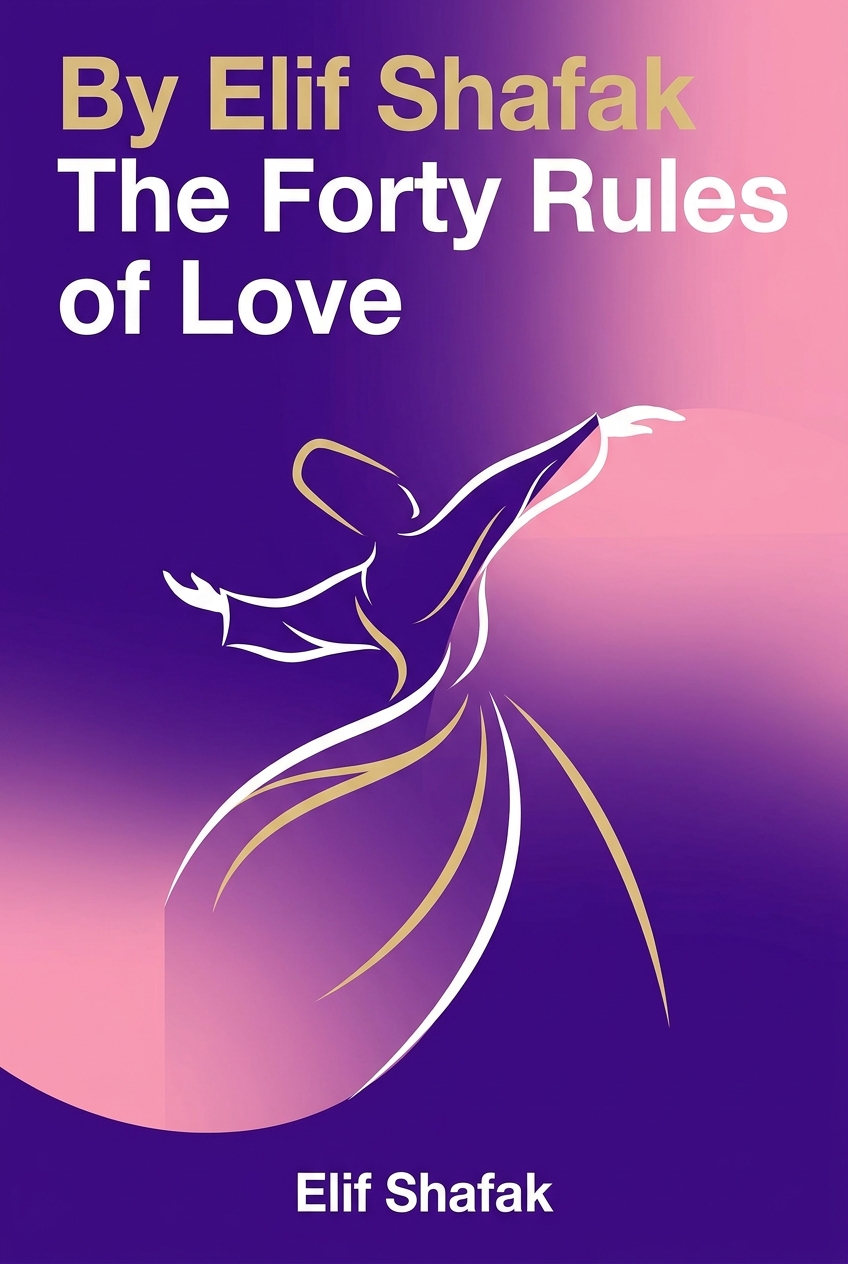
By Elif Shafak The Forty Rules of Love book cover

The Script

Think of the last time you bought a pre-made spice blend from the store. It comes in a sealed jar, every ingredient precisely measured, promising a perfect, consistent flavor every single time. It's reliable, safe, and predictable. Now, think of a family elder grinding spices by hand—a pinch of this, a dash of that—following not a recipe card but a feeling, a memory, a story. The result is never exactly the same twice. It's alive, a little wild, and carries the warmth of the hands that made it. One is the logic of the head, a world of rules and predictable outcomes. The other is the wisdom of the heart, a world of connection and soulful transformation.

Most of us live in the world of pre-measured blends, our lives organized around certainty and control. We follow the rules for a successful career, a stable home, and a sensible life, yet can still feel a deep, unnameable emptiness, a longing for that unmeasured, soulful flavor. It’s this profound disconnect—the chasm between a life that looks right and one that feels right—that captivated the novelist Elif Shafak. A storyteller with a PhD in political science, Shafak has built her life's work exploring the tensions between East and West, tradition and modernity, the rational mind and the spiritual heart. She noticed how modern life often silences the heart's longing for a deeper, more transcendent love. Shafak wrote The Forty Rules of Love as an invitation to bridge that gap, weaving together the tale of a modern woman's quiet desperation with the explosive, life-altering spiritual bond between the 13th-century poet Rumi and the wandering dervish Shams of Tabriz.

Module 1: The Still Lake and the Thrown Stone

Our modern story begins with Ella Rubinstein. She's forty years old. She lives in a beautiful home. She has a long-standing marriage, three children, and a life of predictable comfort. Her world is a still lake, calm and undisturbed. But this stillness hides a deep stagnation. Ella's marriage lacks passion. Her days are a sequence of routines. She has everything she's supposed to want, yet she feels an inner void. As a literary agent’s reader, she receives a manuscript titled Sweet Blasphemy. It’s a novel about the 13th-century mystic Shams of Tabriz. This book is the stone thrown into her still lake.

The first major insight is that a stable life built on external expectations can mask deep inner emptiness. Ella’s life is a perfect picture of success. A Victorian house. Financial security. She has rationalized her lack of emotional connection, believing love is secondary to understanding and compassion. But inside, she feels like her life is an obituary. She is defined by her roles as a wife and mother, not by her own identity. This is a trap many high-achievers fall into. We build a life that looks good on paper. We follow the script. But we forget to check if we're actually happy.

From this foundation, we see how love operates as a disruptive force. The author, Aziz Zahara, is a modern-day Sufi nomad. His words in the manuscript speak directly to Ella’s unspoken feelings. She starts an email correspondence with him. This connection, though digital, is real and powerful. It awakens a part of her that has been dormant for decades. And here's the thing: Profound transformation often defies rational explanation and bypasses our usual caution. Ella was not a risk-taker. Changing her coffee brand was a major effort. Yet, this connection inspires her to do the unthinkable. She files for divorce after twenty years. No one, including Ella herself, can explain it. It’s a force that operates outside of logic.

This brings us to a critical rule from the book: The path to truth is a labor of the heart. Shams of Tabriz, the mystic in the manuscript, teaches this rule. He argues that our primary guide should be our heart. We must meet, challenge, and ultimately prevail over our ego with our heart. Ella’s journey shows this in practice. Her mind tells her to stay in her safe, predictable life. Her heart, awakened by Aziz, pulls her toward the unknown. For professionals who rely on data and logic, this is a challenging idea. It suggests that our biggest breakthroughs might come from trusting our intuition, not just our intellect.

Finally, the story reveals that feeling incomplete is a universal human condition, but few actively seek what's missing. Through Aziz's blog, Ella encounters a gallery of portraits. Each subject is missing something. A tooth. An earring. A finger. The caption explains the metaphor. We all feel incomplete. We sense we've lost something essential. Most of us never find out what it is. Ella’s story is about the courage to finally ask that question. She stops rationalizing her unhappiness and admits it to herself. This admission is the first step toward real change. Acknowledging our own inner void is the starting point of a more authentic journey.

Module 2: The Forty Rules and the Religion of Love

Now, let's turn to the historical heart of the book: the relationship between the scholar Rumi and the mystic Shams of Tabriz. This is the source code for the transformation we see in the modern narrative. Rumi is a respected 13th-century cleric. He is a man of intellect, dogma, and social standing. Shams is a wandering dervish. He is unconventional, provocative, and follows a path he calls the "religion of love." Their meeting changes everything.

The central framework of their philosophy is a set of forty rules. These rules are perspectives designed to shift one's consciousness from the head to the heart. A key rule states that how we see God is a direct reflection of how we see ourselves. If our image of the divine is full of fear and blame, it means we carry fear and blame inside us. If we see a God of love and compassion, it's because we possess those qualities. This rule reframes spirituality as a mirror for our own inner state. It's about cultivating our own inner capacity for love. For a leader in a competitive environment, this is a powerful idea. Your perception of the market, your team, or your rivals is a reflection of your own internal mindset—be it fear-driven or opportunity-focused.

This leads to another core tenet: True spiritual seeking often conflicts with worldly power and comfort. Shams consistently challenges figures of authority. He tells a wealthy judge that his attachment to status and luxury prevents him from finding God. He argues that formal religion, or sharia, is just a boat. The true seeker must eventually leave the boat and plunge into the ocean of truth. This is a radical idea. It suggests that our credentials, our titles, and our accumulated knowledge can become cages. To grow, we might need to risk our reputation and step outside the systems that gave us security. Rumi, a man of immense status, eventually does just this. He follows Shams, alienating his students and shocking his community.

Building on that idea, the rules teach that love is the antidote to judgment and the key to true purity. In one powerful scene, a prostitute is dragged from a mosque by an angry mob. Shams intervenes. He tells the crowd that if they were truly focused on God, they wouldn't have even noticed her. He later tells the woman, "Real filth is the one inside. The stain of hatred and bigotry. You can purify your body through abstinence and fasting, but only love will purify your heart." This is a direct challenge to the performative morality we often see. True ethics are about purifying our own hearts through love and compassion.

Finally, Shams presents a revolutionary idea about destiny. Destiny is a co-creation between divine will and human choice. He explains that destiny doesn't mean your life is strictly predetermined. To leave everything to fate is a sign of ignorance. The universe is a symphony, and your destiny is the level at which you play your instrument. You might not be able to change your instrument, but how well you play is entirely in your hands. This empowers us. We are active participants in our own lives. We have the agency to play our part with skill, passion, and intention.

Read More