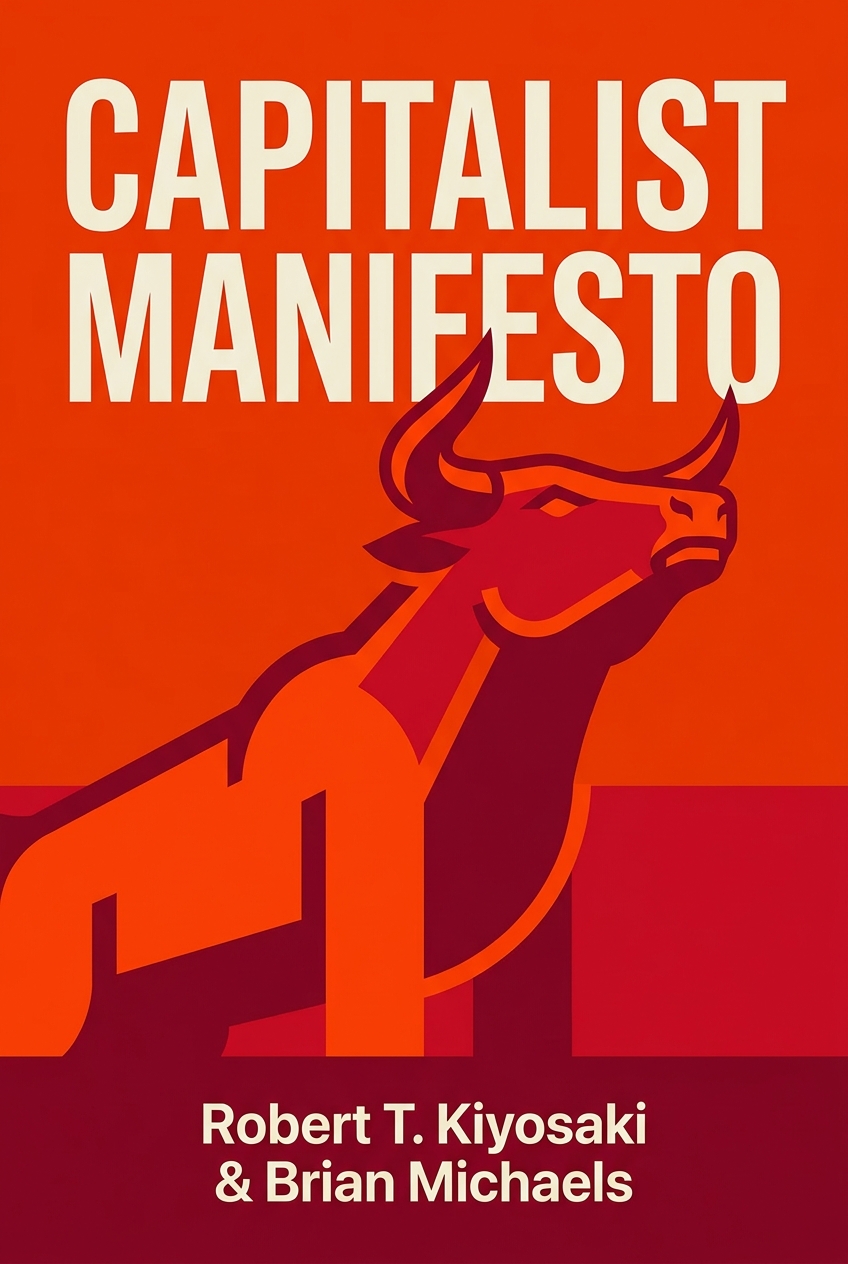
Capitalist Manifesto
What's it about
Tired of working hard just to get by while the rich seem to get richer? Discover the hidden rules of money that the wealthy use to build fortunes, rules that are deliberately kept from the middle class and the poor to maintain a broken system. This manifesto exposes the flaws in our educational and financial systems that keep you trapped. You'll learn why your savings are losing value, how debt can be used as a powerful tool for wealth creation, and the crucial steps you must take to stop being a pawn and start winning the game of capitalism.
Meet the author
Robert T. Kiyosaki, author of the 1 personal finance book of all time, Rich Dad Poor Dad, is globally recognized for challenging and changing how tens of millions think about money. Drawing from his military background as a helicopter gunship pilot and his entrepreneurial ventures, Kiyosaki, along with real estate investor Brian Michaels, champions financial education and the power of capitalism. Their combined experience provides a raw, unfiltered look at how anyone can build wealth by understanding how money truly works.
The Script
Our society treats education as a sacred ladder to success. We're taught that climbing it—earning degrees, accumulating certifications, and mastering specialized knowledge—is the only reliable path to a secure and prosperous life. This belief is so ingrained that we rarely question its foundation. Yet, for millions, the rungs of this ladder feel increasingly rickety. They follow the script perfectly, only to find themselves burdened by debt, trapped in jobs they dislike, and financially vulnerable. This is a failure of the ladder itself. The educational system, once a promise of uplift, has become a finely tuned machine for producing compliant employees, not independent thinkers or wealthy individuals. It teaches us how to work for money, but remains silent on how to make money work for us, leaving a critical gap in our ability to navigate the real world of assets and liabilities.
This glaring discrepancy between academic achievement and financial freedom is precisely what drove Robert T. Kiyosaki to challenge the conventional wisdom he was taught. After his own journey through military service and various business ventures, he saw that the lessons of the rich were not being taught in schools. Teaming up with Brian Michaels, an author and business collaborator, Kiyosaki set out to codify the unwritten rules of wealth creation. Their work is a direct challenge to a curriculum that prioritizes job security over financial literacy. They argue that this educational deficit is the true source of the growing divide between the haves and have-nots, and wrote this book as a declaration of independence from a system they believe is failing to prepare people for the capitalist world they actually live in.
Module 1: The Ideological War for Your Mind and Money
The book opens with a stark premise. America is in the midst of a quiet war fought with ideas. Kiyosaki argues this conflict is between two opposing systems: capitalism, which he defines by private ownership and individual freedom, and communism, which he claims is advancing through "small doses of socialism."
The author's first major point is that traditional education is a primary vehicle for anti-capitalist indoctrination. He contends that schools intentionally omit financial education. This leaves graduates financially illiterate and susceptible to a "Poor Dad" mindset. This mindset follows a familiar script: go to school, get a job, pay high taxes, save rapidly devaluing money, and pour what's left into a volatile stock market. This path, he argues, creates compliant employees, not empowered owners. It produces "brain slaves," specialists who are dependent on a system, rather than generalists who can build their own.
Building on that idea, the book asserts that this educational failure is a deliberate strategy. Citing historical figures from Marx to Lenin, Kiyosaki claims that controlling the minds of the young is the most effective way to reshape a society. He points to the rise of what he calls "post-modernist" thought in universities and the influence of powerful teachers' unions like the National Education Association . He argues these forces prioritize ideological agendas over factual, practical knowledge. The result is a generation taught to see themselves as victims of an oppressive system rather than as architects of their own success.
So what happens next? This ideological conditioning makes people vulnerable to the third core insight of this module: government and financial institutions exploit this ignorance to transfer wealth. The author points to the 1971 decision to take the U.S. dollar off the gold standard as a pivotal moment. This turned money from a store of value into a tool of debt and control, a currency he calls "fake money." Since then, he argues, the Federal Reserve has engaged in massive money printing, creating inflation that silently taxes the savings of the poor and middle class. He frames this as the "Gross Universal Cash Heist," or GRUNCH, a slow, systemic theft of wealth from the uneducated.
Finally, Kiyosaki presents a chilling parallel. He argues that modern social and political trends mirror historical totalitarian playbooks. He compares "little atrocities" from history, like forcing certain groups to wear identifying markers, to modern mandates related to health or speech. He warns that a society that accepts censorship, celebrates victimhood, and allows the state to dictate truth is on a dangerous path. The book is a call to recognize these patterns before it’s too late.