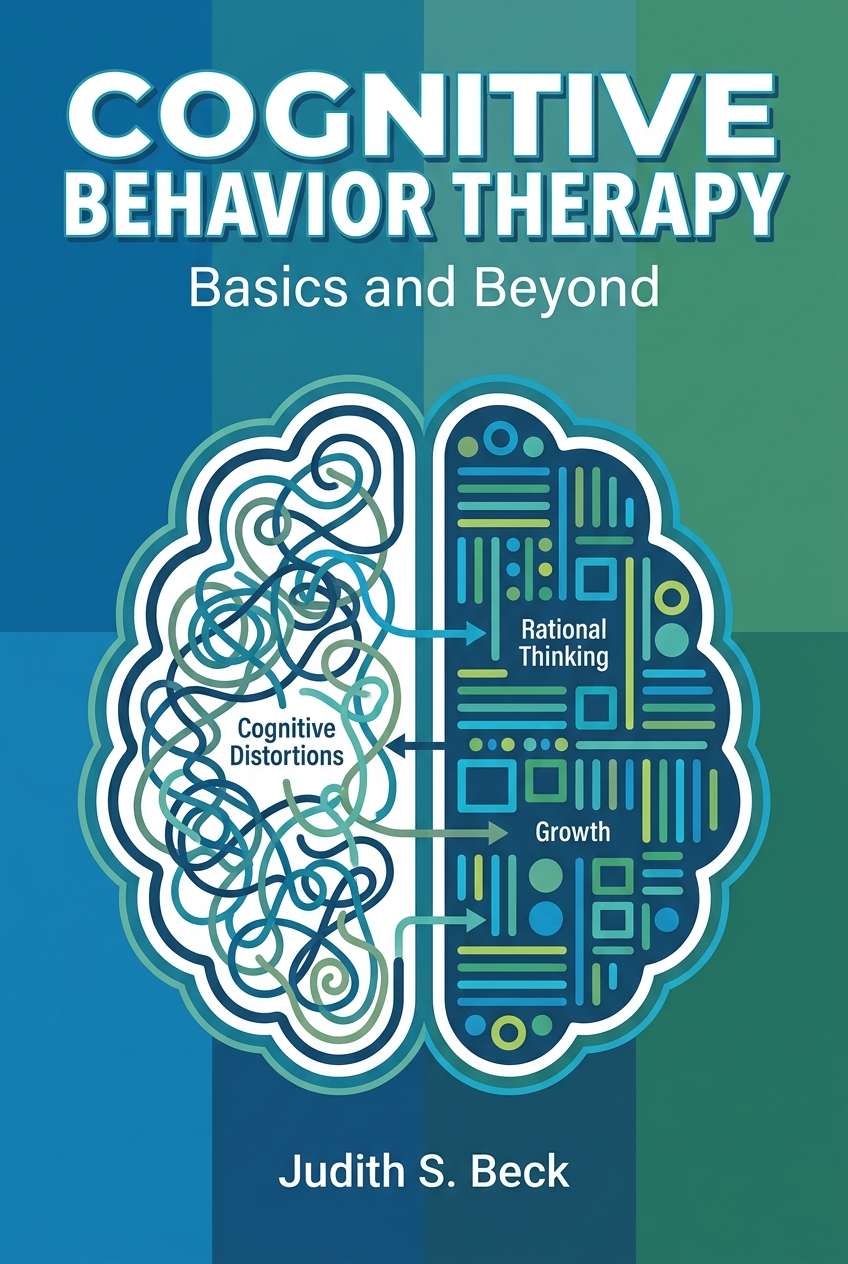
Cognitive Behavior Therapy
Basics and Beyond
What's it about
Struggling to manage your own thoughts and emotions, or help others do the same? This guide unlocks the core principles of Cognitive Behavioral Therapy, a powerful, evidence-based method for transforming negative thinking and building lasting mental resilience. You'll learn the step-by-step process used by expert clinicians to identify and reframe distorted thoughts, develop effective coping strategies, and set achievable goals. Discover how to structure sessions, build strong therapeutic relationships, and apply proven techniques to create meaningful change for yourself or your clients.
Meet the author
Dr. Judith S. Beck is President of the renowned Beck Institute for Cognitive Behavior Therapy, which she co-founded with her father and CBT originator, Dr. Aaron T. Beck. A distinguished clinician, educator, and researcher, she has dedicated her career to training thousands of health professionals worldwide. Her extensive experience in both practicing and teaching CBT provides the authoritative, practical, and accessible foundation for the techniques and strategies detailed within this landmark text.
Opens the App Store to download Voxbrief

The Script
A professional baker and a home cook are given the exact same recipe for a sourdough starter: flour, water, time. The home cook follows the instructions perfectly, measuring precisely and setting timers. Yet, after a week, their starter is sluggish, sour in the wrong way, and fails to make the bread rise. The professional baker, however, seems to almost ignore the recipe. They feel the dough, smell the starter, and watch the bubbles. They add a little more water on a dry day, a little less on a humid one. They move it to a warmer spot in the kitchen when it seems slow. Their starter becomes vigorous and active, producing a perfect loaf. The home cook followed the instructions, but the baker understood the process. The baker knew that the recipe was a guide for interacting with a living system. They knew how to observe the starter’s behavior and make small, intelligent adjustments.
This gap between following instructions and understanding the process is precisely what Judith S. Beck noticed in the world of psychotherapy. She saw that therapists could learn the 'recipes' for helping people—the techniques and interventions—but would still struggle to get results. They were missing the intuitive, responsive skill of the baker. As the daughter of Aaron T. Beck, the founder of cognitive therapy, she grew up at the epicenter of this psychological revolution. But her own work as a clinician and teacher revealed a critical need. She saw that the 'how' of therapy was just as important as the 'what'. This book, "Cognitive Behavior Therapy," was her answer. It was designed to teach therapists how to think like a baker—how to observe, assess, and adapt their approach to the unique, living needs of each person in their care.
Module 1: The Cognitive Model—How Your Thoughts Shape Your Reality
The central premise of Cognitive Behavior Therapy, or CBT, is deceptively simple. Our interpretation of events is what upsets us. This is the cognitive model. It proposes a clear sequence: a situation triggers a thought, which then creates an emotional, behavioral, and even physiological reaction. Understanding this sequence is the first step toward taking control.
Your thoughts are not always deliberate. They often come as automatic thoughts, the rapid, evaluative cognitions that pop into your mind. These are the knee-jerk reactions, the mental shorthand you use to make sense of the world. For example, if a coworker walks past your desk without saying hello, one person might think, “She must be mad at me,” and feel anxious. Another might think, “She must be busy,” and feel nothing. The situation is identical. The automatic thought is the variable that changes everything.
The book uses a client named Abe to illustrate this. When Abe thinks about doing something, like taking his grandkids out, his automatic thought is, "Everything is too hard." This thought triggers the emotion of sadness and the behavior of staying on the couch. The thought is an interpretation, but it creates a real, tangible outcome.
So, where do these automatic thoughts come from? Underneath automatic thoughts are deeper, more stable intermediate and core beliefs. These are the fundamental rules and assumptions you hold about yourself, others, and the world. Core beliefs are global and absolute, like "I am incompetent" or "I am unlovable." They are often formed in childhood and feel like undeniable truths. Intermediate beliefs are the attitudes and rules that stem from these core beliefs. For example, if your core belief is "I am incompetent," an intermediate belief might be, "If I try to do something difficult, I will fail." These beliefs act like a filter, coloring how you interpret every new situation and generating the automatic thoughts that shape your daily experience.
This leads to a crucial insight. You can learn to identify, evaluate, and change your dysfunctional thinking. This process is called cognitive restructuring. It's a learnable skill. The first step is simply noticing. When your mood shifts, ask yourself: "What was just going through my mind?" By catching the automatic thought, you can hold it up to the light. You can question it. Is it 100% true? Is there another way to see this situation? For Abe, this meant learning to catch the thought "Everything is too hard" and challenging it with evidence: "Wait, I was able to pay that bill yesterday. Maybe I can handle a short walk." This doesn't erase the feeling instantly, but it breaks the cycle. It introduces a new possibility, a more balanced and realistic way of seeing the world.