All Books
Self-Growth
Business & Career
Health & Wellness
Society & Culture
Money & Finance
Relationships
Science & Tech
Fiction
Topics
Blog
Download on the App Store

Confucius

The Secular as Sacred

16 minHerbert Fingarette

What's it about

Ever feel like your daily routines are just... empty? What if you could transform your everyday actions into powerful, meaningful rituals that bring a sense of purpose and connection to your life? This summary reveals how to find the sacred in the secular, turning ordinary moments into extraordinary experiences. You'll discover the core of Confucius's philosophy, not as ancient history, but as a practical guide for modern life. Learn how simple, conscious acts of respect and ceremony can build stronger relationships, deepen your self-awareness, and unlock a profound sense of community and personal fulfillment without needing to believe in any gods or supernatural forces.

Meet the author

Herbert Fingarette was a celebrated professor of philosophy at the University of California, Santa Barbara, whose groundbreaking work redefined modern interpretations of Confucius for the Western world. Initially trained in psychotherapy and law, Fingarette brought a unique, multi-disciplinary lens to ancient Chinese thought. This diverse background allowed him to uncover the profound psychological and social power within Confucian rituals, revealing them not as empty gestures but as the very actions that constitute human dignity and community.
Listen Now

Opens the App Store to download Voxbrief

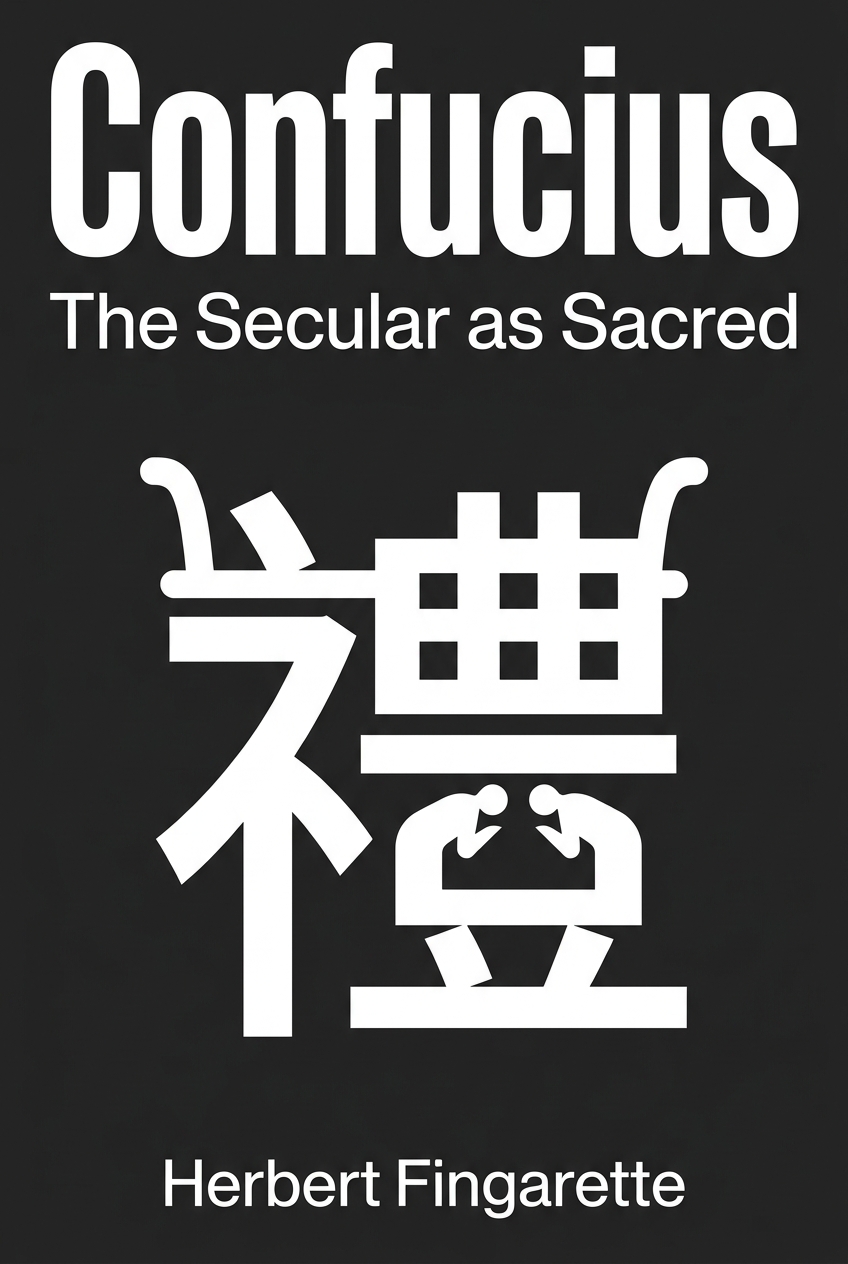
Confucius book cover

The Script

We treat ceremony as an empty, decorative shell—a polite but hollow gesture. A graduation, a wedding, a handshake—these are seen as mere formalities, the wrapping paper around the real gift of personal feeling or achievement. We believe the true meaning lies hidden inside us, in our private intentions and sincere emotions. The external performance is secondary, an optional script we can follow or discard. We think of ourselves as solid, pre-existing selves who then choose to participate in these rituals. But what if this entire model is backward? What if the ritual is the very tool that forges meaning? What if the performance of the ceremony is what calls the self into existence, rather than the other way around? What if, instead of expressing who we are, these sacred social acts are what make us human in the first place?

This radical reframing of human experience is precisely what philosopher Herbert Fingarette stumbled upon when he set out to write a conventional critique of Confucius. As an accomplished analytic philosopher and psychotherapist, Fingarette approached the ancient text expecting to find quaint but outdated moral prescriptions. Instead, he was shocked to discover a profound psychological system that completely overturned his Western assumptions about the self, choice, and morality. He found a world where the 'magic' of human connection was a skill cultivated through meticulous, repeated action. Fingarette realized he was looking at a brilliant blueprint for how individuals are created through their relationships and rituals. This short, powerful book was the result of that intellectual collision—his attempt to translate this startlingly modern, yet ancient, vision for a Western audience that had, in his view, completely forgotten the power of the sacred act.

Module 1: The Family as the Root of Everything

We often think of maturity as autonomy. It's the ability to stand on our own two feet, make our own decisions, and be independent. But this book argues that this obsession with individualism is the source of a deep, pervasive loneliness in Western culture. We create social groups and networking events, but they often feel shallow. They don't address the core problem. We haven't been trained in the art of deep, ordered relationships.

This is where Confucius offers a profound corrective. For him, the family is the "root of Goodness." It is the primary training ground for every social skill we will ever need. Mastering family relationships is the prerequisite for all other forms of love and community. Confucius identified five basic relationships that form the bedrock of a healthy society: ruler and subject, father and son, husband and wife, elder and younger brother, and friend and friend. Three of these are found within the family. It's here we learn to handle authority, to care for those dependent on us, and to navigate peer dynamics. If you can learn to be a good son or a good sister, you have the foundational skills to be a good employee, a good leader, and a good neighbor.

So what happens when we neglect this root? The book gives the example of Sandy, a successful professional who feels intensely lonely despite being active in her church. She's in small groups and attends social events, but the connections feel superficial. The author argues this is because our culture encourages us to seek connection without teaching us the underlying discipline of relationship. We’re trying to build a house without a foundation.

This leads to a critical insight. Our capacity for love expands with practice. The author uses the beautiful analogy of having a second child. A parent's heart doesn't divide its love; it grows to love both children fully. In the same way, practicing deep, committed love within the family doesn't trap our love there. Instead, it trains and expands our heart, making us capable of extending that same quality of love to our friends, our community, and even our enemies.

And here's the thing. There are two ways to get this wrong. The first error is clannishness, where love stops at the family's edge. This was a problem Jesus addressed in his own culture. But the second error is the modern Western one: neglecting the family altogether. We see estrangement as a normal part of life, a byproduct of career moves or minor disagreements. We fail to see that in abandoning these primary relationships, we are abandoning our own training. Jesus himself, even while expanding the definition of family, demonstrated profound filial piety by caring for his mother from the cross. The message is clear: True community is built by people who have first learned to love deeply within the messy, demanding context of family.

Module 2: The Joy of Not Knowing

We have a deep, natural love for knowledge. Knowledge is power. It brings certainty, control, and a sense of arrival. We want the answers. We want the five-point plan. We want the finished product. But what about learning? Learning is the opposite. It’s a process of being incomplete, uncertain, and dependent. It's a "power-down" position. Most of us tolerate learning only as a means to the end, which is knowledge.

Confucius flips this on its head. He suggests that a flourishing life is found in loving the process of learning. For him, knowledge is just a byproduct of a life dedicated to continual learning. This has huge implications for how we teach, lead, and grow. A teacher focused on knowledge transfer will give clear, exhaustive answers. But a teacher focused on cultivating a love of learning—like Confucius—will do something different. He might offer a paradox or a cryptic saying. He famously said he wouldn't help a student who couldn't figure out the other three corners of a square after being shown just one. The goal is to spark the student's own engine of inquiry. It’s about cultivating the joy of moving from uncertainty to certainty for oneself.

This brings us to a crucial distinction between two types of scholars, or learners. A well-ordered love of learning avoids the extremes of the "wild" and "fastidious" scholar. The "wild scholar" is obsessed with novelty. They chase new, "relevant" ideas but risk becoming reckless by ignoring the foundations of tradition and established wisdom. In contrast, the "fastidious scholar" clings rigidly to the past. They can recite traditional knowledge perfectly but engage in no fresh or critical thinking. Their knowledge becomes detached from real life. The Confucian ideal is to walk the middle path, balancing deep respect for tradition with an active, curious mind.

So here's what that means for us. The book challenges us with a thought experiment. Imagine you had a "Knowledge Button" that, if pressed, would give you complete, instantaneous knowledge of your spouse or closest friend. Would you press it? The author says no. He would reject it because the lifelong process of discovery—the arguments, the misunderstandings, the slow journey of learning another person—is where the real value lies. The joy is in the finding out.

Embracing this requires a radical dose of humility. Genuine growth requires embracing a "power-down" position of submission and dependence. We live in a culture obsessed with leadership, but we've forgotten the art of following. The author points out that even Jesus's leadership flowed from his perfect submission to the Father. Learning requires us to be humble enough to be guided, to be incomplete, and to trust the process. It means finding joy in the lifelong journey of asking better questions.

Read More