All Books
Self-Growth
Business & Career
Health & Wellness
Society & Culture
Money & Finance
Relationships
Science & Tech
Fiction
Topics
Blog
Download on the App Store

Crossing the Chasm

Marketing and Selling High-Tech Products to Mainstream Customers

13 minGeoffrey A. Moore

What's it about

Is your innovative product stuck with a small group of early fans while the mainstream market ignores you? Geoffrey Moore reveals why this "chasm" exists and provides the essential playbook for successfully leaping across it to achieve mass-market success. You'll learn the critical difference between visionary early adopters and pragmatic mainstream buyers. Discover how to target a single "beachhead" niche, dominate it completely, and use that momentum to launch your product into the lucrative mainstream, leaving your competitors behind in the chasm.

Meet the author

Geoffrey A. Moore is a world-renowned organizational theorist and management consultant whose Technology Adoption Life Cycle framework has become the bible for high-tech entrepreneurs. Drawing from his extensive experience advising startups and established tech giants in Silicon Valley, Moore identified the critical gap—the chasm—that prevents innovative products from reaching mainstream success. His work provides a practical roadmap for navigating this perilous transition, turning disruptive ideas into market-leading realities.
Listen Now

Opens the App Store to download Voxbrief

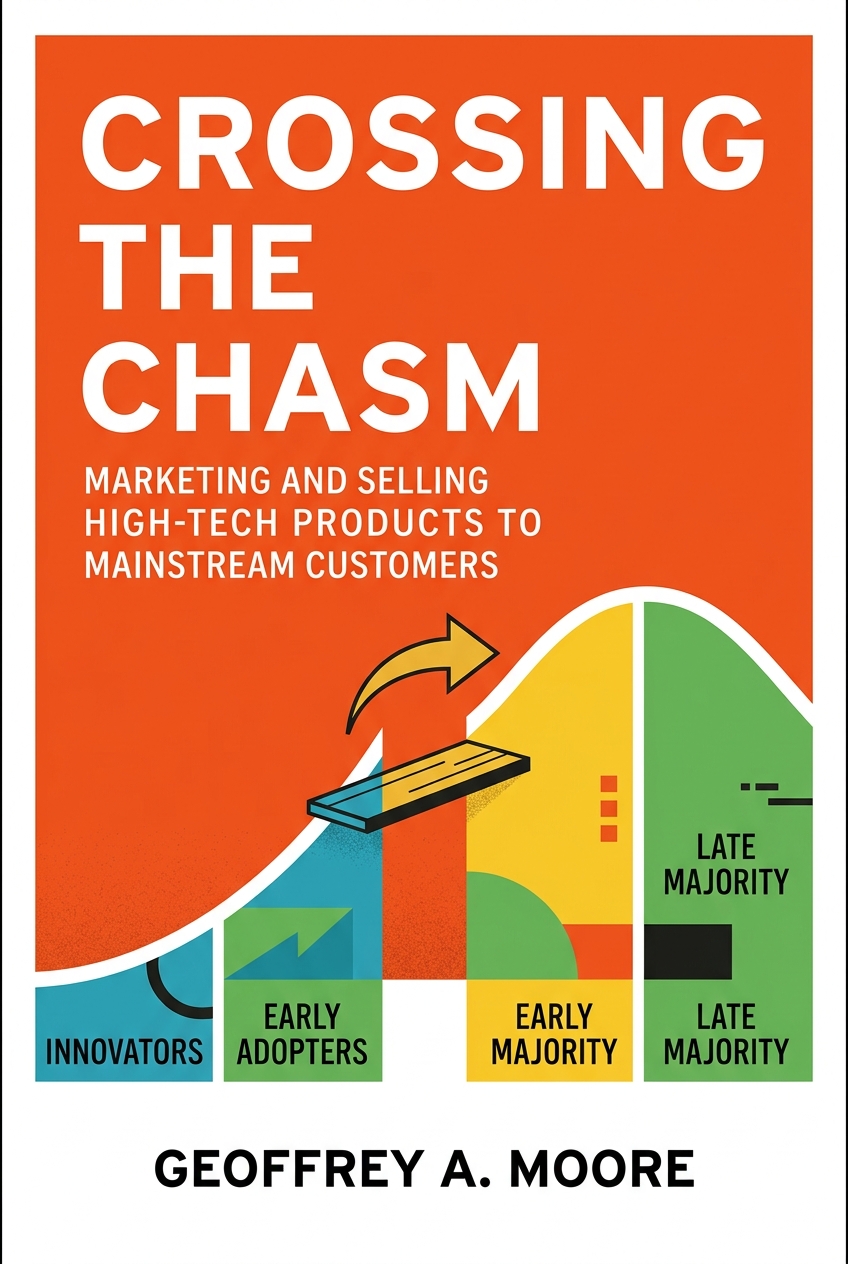
Crossing the Chasm book cover

The Script

Every successful technology company eventually reaches a point where its most devoted customers become its most dangerous advisors. They are the visionaries, the enthusiasts who embraced your product when it was just a fragile idea. They provided the crucial early feedback, the word-of-mouth marketing, and the revenue that kept the lights on. They are, by all accounts, your greatest asset. And yet, listening to them is precisely what will drive your company into the ground.

This paradox is about recognizing that the very qualities that make early adopters invaluable—their tolerance for glitches, their love of newness for its own sake, their desire for radical change—are the exact opposite of what the vast mainstream market requires. The mainstream wants stability, proven results, and a whole, complete solution. Following the advice of your initial champions to add more niche features or to double down on revolutionary rhetoric only makes your product more alienating to the pragmatic majority you need to win over for long-term survival. The path paved by your most ardent supporters leads directly off a cliff.

This baffling pattern, where booming initial success repeatedly gave way to sudden, inexplicable collapse, wasn't just a theoretical puzzle for Geoffrey Moore. As a marketing consultant working in the heart of Silicon Valley during its formative years, he had a front-row seat to this corporate tragedy playing out over and over. He watched brilliant teams with groundbreaking products ride a wave of early hype, only to vanish a year or two later. He realized their failure wasn't due to a lack of funding, poor engineering, or bad marketing in the traditional sense. They were failing because they were trying to cross a massive, invisible chasm in the marketplace without realizing it was there. Moore wrote this book as a practical field guide to identify and navigate that treacherous gap, born from watching so many promising ventures perish within it.

Module 1: The Technology Adoption Life Cycle and the Chasm

To understand the core problem, we need to look at how people adopt new technology. Moore uses a model called the Technology Adoption Life Cycle. It segments the market into five distinct groups. Each group has a different psychological profile.

First, you have the Innovators. These are the tech enthusiasts. They love technology for its own sake. They'll play with a new product just to see how it works. They are the gatekeepers who provide crucial early feedback.

Next come the Early Adopters, who Moore calls Visionaries. These are the executives and entrepreneurs who see a new technology and immediately grasp its strategic potential. They want a quantum leap. A fundamental breakthrough that gives them an edge. They are willing to take huge risks and piece together an incomplete product to achieve their dream. These two groups make up the early market.

This is where many companies get into trouble. They succeed with Innovators and Visionaries and assume the rest of the market will follow. But the next group is completely different.

This brings us to the Early Majority, or the Pragmatists. And this is the key to everything. Pragmatists do not buy based on a vision; they buy based on proven, reliable solutions. They are risk-averse. They want to see the product working successfully in companies like theirs. They need references from their peers. They want a complete, well-supported solution from a market leader. Their goal is a productivity improvement.

After the Pragmatists come the Late Majority, or the Conservatives. They are even more skeptical. They buy only when a technology has become an established standard. Finally, you have the Laggards, who actively avoid new technology.

The traditional marketing model assumes a smooth transition from one group to the next. You win the Innovators, use them as references for the Early Adopters, and so on. But Moore’s critical insight is that this is an illusion. There are cracks between each group. And between the Visionaries and the Pragmatists, there is a giant, gaping chasm.

So what's the issue? The chasm exists because Visionaries and Pragmatists have fundamentally incompatible values. A visionary is a terrible reference for a pragmatist. A Pragmatist looks at a Visionary’s high-risk, custom project and sees chaos, not opportunity. They want stability and proof. This creates a catch-22. Pragmatists won't buy without references from other Pragmatists. But no Pragmatist will be the first to buy. This is the chasm. It’s a period where the early market is saturated, but the mainstream market refuses to engage. Your revenue flattens. Your cash burns. And your company faces extinction.

Module 2: The D-Day Strategy for Crossing the Chasm

We've established the problem: a deadly gap between the early market and the mainstream. So, how do you cross it? Moore argues that you cannot just tiptoe across. You must invade. He proposes a strategy modeled on the D-Day invasion of Normandy. The core idea is to concentrate overwhelming force on a single, specific, and defensible target.

The fatal mistake most companies make in the chasm is becoming sales-driven. They get desperate for revenue. They start chasing any and every lead, no matter the industry or use case. This scatters resources. It prevents them from delivering a complete, repeatable solution for anyone. It creates zero word-of-mouth, because a customer in banking doesn't talk to a customer in manufacturing. This approach is a guaranteed way to fail.

Instead, you must become market-driven. To cross the chasm, you must focus all your resources on dominating a single niche market segment. This is the "big fish, small pond" strategy. Your goal is to become the undisputed market leader within a tiny, well-defined market. This niche is your beachhead. It must be small enough that you can realistically become the leader within 12 months.

Why does this work? Because Pragmatists buy from market leaders. By dominating a niche, you create the proof they need. You generate a critical mass of references from customers who all talk to each other. This creates a powerful word-of-mouth effect. It establishes your company as the safe, default choice for that specific problem.

Think of Apple in its early days. To cross the chasm with the Macintosh, they didn't target everyone. They targeted graphics arts departments inside Fortune 500 companies. This was a small niche with a massive, mission-critical problem: creating presentations was a nightmare. Apple solved this one problem completely. They became the leader in that niche.

Building on that idea, once you've secured your beachhead, you can expand. This is where Moore introduces the "bowling alley" model. Your first niche is the head pin. Once you knock down the head pin, you can leverage that win to attack adjacent market segments. For Apple, success in graphics arts created a reference to expand into marketing departments, then sales departments, and then into ad agencies and publishing houses. Each new segment is another bowling pin. The momentum from one helps you knock over the next. This disciplined, sequential approach is how you build a mainstream market. It requires incredible focus. It means saying "no" to deals outside your target niche, even when you're desperate for cash. But it's the only way to generate the force needed to get across.

Read More