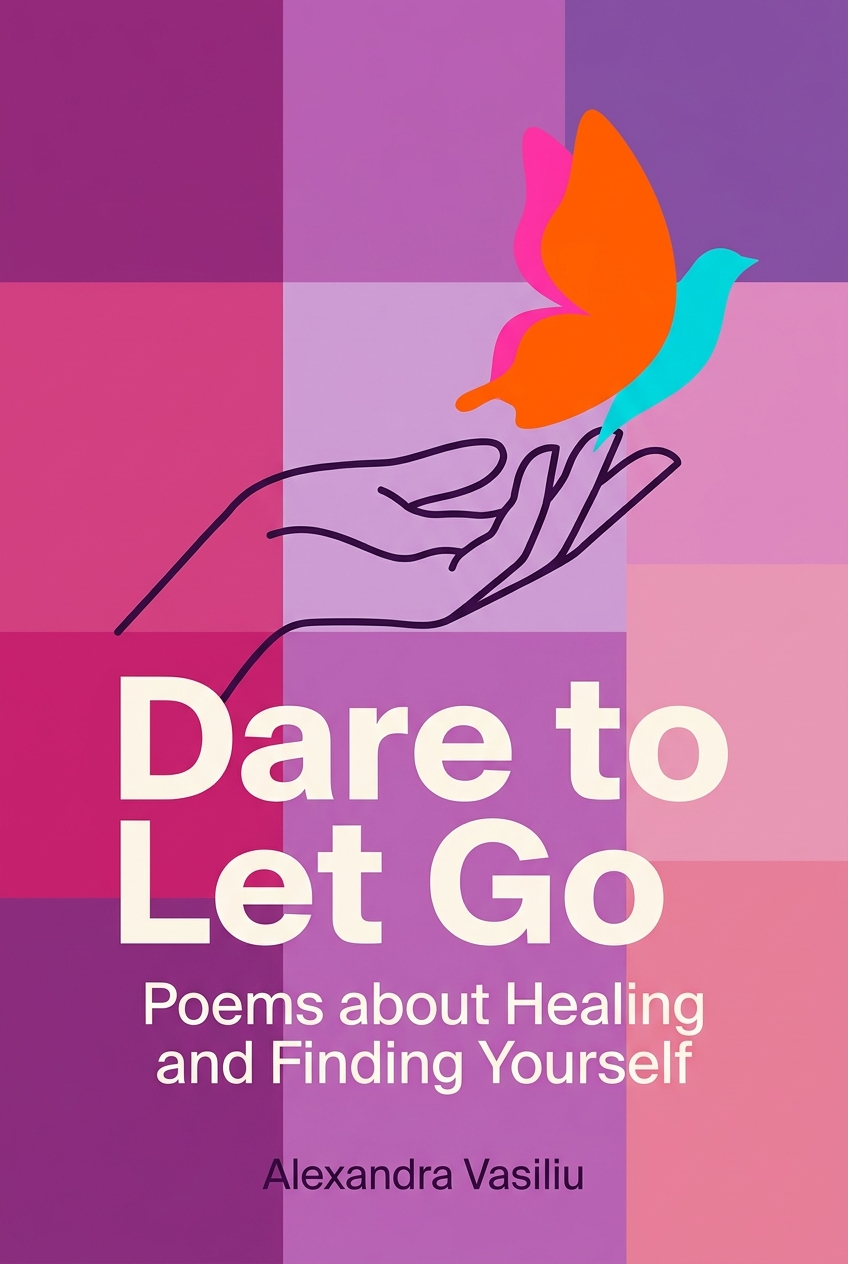
Dare to Let Go
Poems about Healing and Finding Yourself
What's it about
Are you ready to finally heal from past wounds and embrace the person you were always meant to be? This collection of poetry is your guide to letting go of pain, toxic relationships, and self-doubt, empowering you to step into a future filled with self-love and confidence. Through a journey of raw, honest, and uplifting poems, you'll discover how to navigate heartbreak, find strength in solitude, and reconnect with your true self. Learn to celebrate your own resilience and build a life defined not by your scars, but by your courage to heal.
Meet the author
With over 200,000 copies sold, Alexandra Vasiliu has become a leading voice in modern poetry, guiding readers on their journey toward healing and self-discovery. Her bestselling collection, Dare to Let Go, was born from her own experiences with heartbreak and her subsequent path to finding inner strength. Alexandra's background in both literature and psychology allows her to artfully capture the complex emotions of letting go and inspire readers to embrace their own resilience and authenticity.
The Script
In a quiet workshop, a master restorer is given two porcelain birds, shattered by the same fall. They are identical in design, from the same kiln, broken into a similar number of pieces. For the first bird, she meticulously gathers every shard, no matter how small or sharp. She uses a powerful, quick-setting adhesive, forcing the pieces back into their original shape. The bird is reassembled, but the cracks are stark and visible, a network of scars held together by sheer force. The object is whole, but it is a monument to its own breaking, heavy with the effort of its own reconstruction.
For the second bird, she approaches the task differently. She lays out the larger, essential pieces—the wings, the head, the body. She lets the microscopic, jagged slivers fall away. Instead of forcing the pieces together, she uses a gentle, golden lacquer. She illuminates the cracks, tracing the lines of breakage with gold until the bird is transformed. It tells a story of becoming something new and arguably more beautiful because of its history. This delicate act of choosing which pieces to keep and which to release, of turning fractures into features, is the central question Alexandra Vasiliu explores. She found herself holding the shattered pieces of her own life—past heartbreaks, anxieties, and lingering self-doubt—and realized she’d been trying to force them back together. "Dare to Let Go" emerged from her personal journey of learning to use that golden lacquer, of discovering that true healing is about having the courage to release what no longer served her and finding the beauty in what remained.
Module 1: The Clutter Illusion
We often believe that more possessions, more money, and more achievements will bring us more happiness. The author argues this is a dangerous illusion. The accumulation of "stuff" creates a powerful gravity. It pulls on our time, our energy, and our focus.
This brings us to a crucial insight: Physical and psychological clutter obscures your true priorities. Think about those boxes you moved from your last apartment. The ones you haven't opened. The author suggests that if you can't remember what's inside, you probably don't need it. This physical clutter is a direct reflection of mental clutter. It’s the weight of unfinished projects, unfulfilled expectations, and societal pressures. A friend of the author, Jeff, lived this reality. He had the spacious condo, the high-paying job, and all the gadgets. But he was miserable. His life was a monument to external expectations, not internal joy.
So what happens next? You have to make a choice. Intentional simplification creates space for meaningful living. This is a strategic reduction of anything that doesn't serve you. For Jeff, this meant selling his condo and most of his gadgets. He downsized his home but kept his car, because driving was something he genuinely loved. He also streamlined his work to cut his hours. He was curating his life. He was choosing quality over quantity. The result? He paid down his debt, found a meaningful relationship, and felt a sense of purpose for the first time.
And here's the thing. This process of simplification forces you to confront a fundamental question. You must define success for yourself, not by external standards. Society, your company, even your family will offer you a pre-packaged definition of success. It might be a sales target, a promotion, or a certain income level. But these are someone else's goals. The author points out that a corporate sales target serves the company. It doesn't necessarily serve your personal fulfillment. True success is subjective. For Jeff, it was about having the freedom to enjoy his life. For you, it might be something else entirely. The key is to stop chasing external validation and start listening to your own internal compass.