All Books
Self-Growth
Business & Career
Health & Wellness
Society & Culture
Money & Finance
Relationships
Science & Tech
Fiction
Topics
Blog
Download on the App Store

Dark Matter

A Novel

16 minBlake Crouch

What's it about

Have you ever wondered if a different version of your life exists? What if one wrong turn could lead you down an entirely new path, and what if you could see all the lives you might have lived? This is the reality Jason Dessen is violently thrown into. Follow Jason's desperate journey through a maze of alternate realities after he's abducted by a masked man. You'll uncover a mind-bending technology that opens a corridor to every possible choice you've ever made, forcing you to question everything you know about identity, love, and the road not taken.

Meet the author

Blake Crouch is a New York Times bestselling author whose blockbuster novel, Dark Matter, was adapted into a major television series he personally executive produced and wrote. His background in crafting high-concept, reality-bending thrillers stems from a deep curiosity about quantum physics and the paths not taken. Crouch masterfully explores complex scientific ideas through relatable human stories, questioning the very nature of identity and the choices that define a life.
Listen Now

Opens the App Store to download Voxbrief

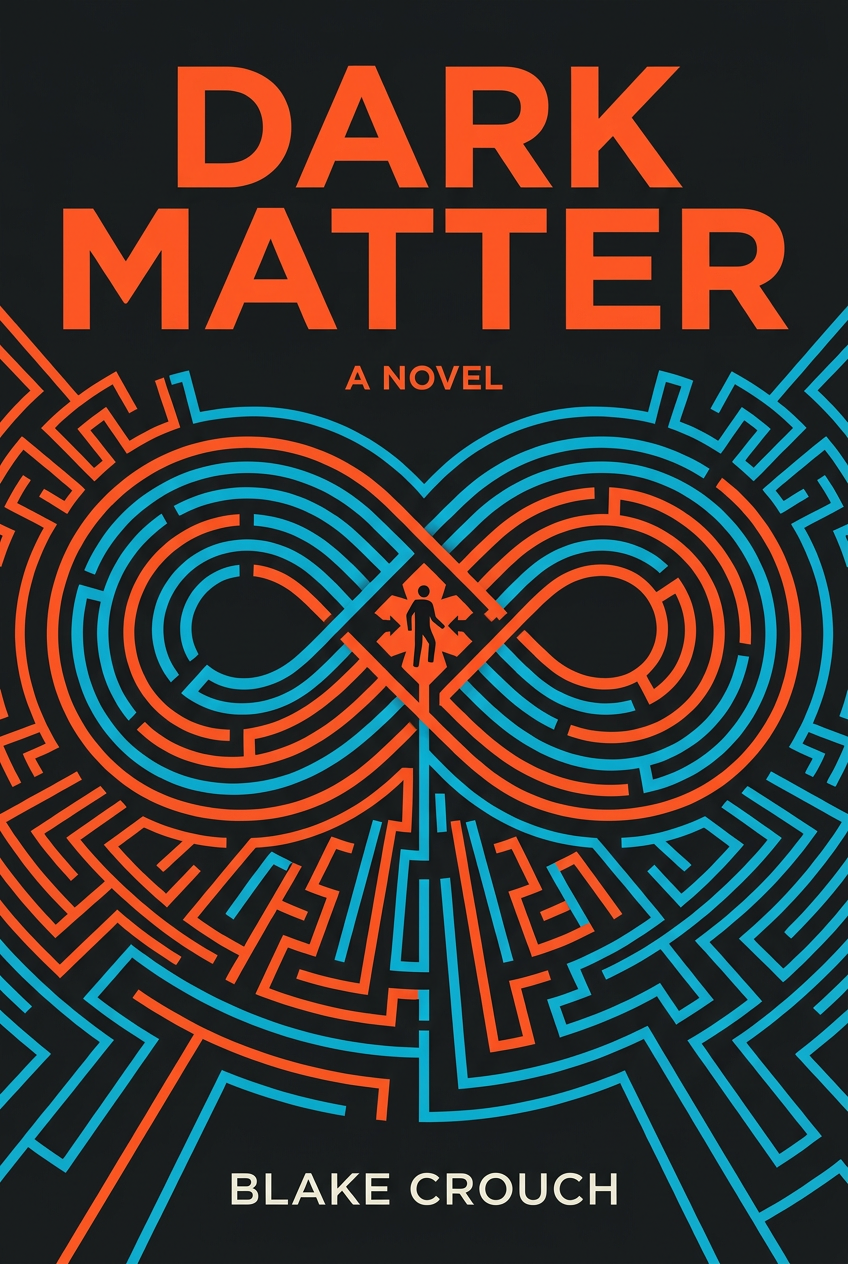
Dark Matter book cover

The Script

The most agonizing form of grief is for a life you were supposed to live. It’s a phantom limb of the soul, an ache for a future that was yours until it suddenly wasn't. This is the violent, disorienting shock of waking up in a life that feels like a stranger’s, where the furniture is all wrong and the photos on the wall show a family you don't recognize. We tell ourselves that regret is about past mistakes, but the most corrosive regrets are for futures we can still vividly picture, futures that feel more real than our present reality. This haunting sense of a stolen destiny, the feeling that you are an imposter in your own home, is a uniquely human torment.

Blake Crouch found himself wrestling with this very feeling after a late-night conversation with a physicist about quantum mechanics. He became obsessed with the idea of a life unlived, not as a poetic metaphor, but as a concrete, terrifying possibility. Crouch, already an established author of thrillers that blend high-concept science with visceral human emotion, channeled this obsession into his work. He wanted to write a story that would make the reader feel the floor drop out from under them, to transform the abstract question of 'what if?' into a desperate, heart-pounding fight for the life—and the love—that defines us. The result was Dark Matter, a novel that takes the quiet, internal ache for a different life and turns it into an external, life-or-death battle.

Module 1: The Sucker Punch of Another Life

The story begins with a question we all ask ourselves. Are we happy with the life we've built? Jason Dessen is a physics professor in Chicago. He has a wife, Daniela, and a teenage son, Charlie. His life is good. It's just not exceptional. He gave up a brilliant research career to raise his family. Now, an old colleague has won a prestigious award for work Jason pioneered. The regret stings. This is the quiet, relatable foundation the book builds on before everything shatters.

The first major insight is that your life can be stolen by the person you might have been. Jason is abducted one night by a masked man. This is a targeted attack. The attacker knows intimate details about his life. He asks about his wife, his son, and his work. Then he drugs Jason and leaves him in a strange, high-tech laboratory. When Jason wakes up, he's in a world that is almost his, but not quite. In this reality, he never married Daniela. He never had a son. Instead, he became a celebrated physicist who achieved the impossible. He built a device that can access the multiverse. The man who abducted him? It was another Jason. A version of himself who chose career over family, achieved greatness, and lived to regret it. This other Jason, let's call him Jason2, has now stolen the life he believes he deserved.

This leads to a brutal truth about identity. The self is a fragile construct built on memory and context. Jason wakes up in a world where everyone calls him a hero. They celebrate his return from a journey he can't remember. The facility, Velocity Labs, is his creation. He is the genius who unlocked the multiverse. But his memories are of being a husband and father. He clings to the image of his family cooking dinner. This memory is his only anchor in a sea of confusion. The staff at the lab, including a psychiatrist named Amanda Lucas, treat him like a traumatized patient. They think he has amnesia. He thinks he's going insane. Every piece of evidence—a driver's license, a work ID, his own scarred body—points to a life he doesn't recognize. He is not the man they think he is.

So what's the next step? He realizes that survival in a hostile reality requires strategic deception. Jason quickly understands that compliance is a trap. The lab is a prison disguised as a research facility. Armed guards and triple-bolted doors tell the real story. To escape, he must pretend to be the person they expect. He fakes exhaustion to get out of an interrogation. He tricks a doctor to get a moment alone. He then makes a desperate, frantic escape from the facility. His scientific mind kicks in. He starts treating his situation as a problem to be solved. He needs data. He needs to find his home, his wife, his son. But when he finally reaches his house, the horror deepens. It's his address, but it's not his home. The furniture is different. The photos are gone. His son's room is an office. And on the wall is the Pavia Prize, the award his friend won in his reality, but here it's his. This is the moment he knows. His life wasn't a dream. It was stolen.

Module 2: The Corridor of Infinite Regret

Jason has been thrown into the deep end of his own alternate reality. The man who put him here, Jason2, is now living his life. The original Jason, our protagonist, is alone and hunted. He finds an ally in Amanda Lucas, the lab psychiatrist who helped him escape. She too is now a fugitive. Together, they must use the very technology that stranded them to find a way back. This technology is a massive, shielded cube. Jason calls it "the box."

Their journey reveals a powerful concept. The multiverse is a state of mind. The box, combined with a powerful psychoactive drug, allows a person to enter a state of quantum superposition. Their consciousness stops collapsing reality into a single outcome. Instead, they perceive all possibilities at once. Their minds render this experience as an infinite, dark corridor. It's lined with millions of identical doors. Each door is a gateway to a different parallel world. A different Chicago. A different life. This corridor is a mental construct, a visualization of the wave function of reality. Opening a door collapses the wave, pulling them into one specific world.

And here's the thing. Your subconscious fears and desires become your compass in the multiverse. The box has no controls. There is no GPS for finding a specific reality. Jason and Amanda quickly learn that the door you open is influenced by your mental state. When they are filled with fear and despair, they open doors to apocalyptic worlds. One Chicago is buried in volcanic ash. Another is a frozen wasteland. Another is ravaged by a deadly pandemic. Jason's deep-seated trauma from his mother's death from cancer leads him to a world where his wife is dying and his son is already dead. He realizes that to navigate, he can't just wish for home. He has to focus his mind with absolute precision. He must let go of fear and anchor himself in specific, sensory memories of his life.

This journey is a brutal lesson in resource management. Navigating infinite choice requires finite discipline. They have a limited supply of the drug, stored in small glass ampoules. Each trip into the corridor uses one ampoule per person. They have a finite amount of food and water. Every world they enter is a gamble. It could be a resource-rich utopia or a barren hellscape that drains their supplies. They learn to be systematic. They time the drug's effects to the minute. They use a compass to find the box, which is buried in the same location in every world, emitting a strong magnetic field. The process becomes a grueling loop. Enter the box. Inject the drug. Face the terrifying corridor. Choose a door. Emerge into a new world. Assess. Survive. Repeat. The sheer scale of the task is crushing. Finding one specific reality among millions feels statistically impossible. Amanda calls it finding a single grain of sand on an infinite beach.

Read More