All Books
Self-Growth
Business & Career
Health & Wellness
Society & Culture
Money & Finance
Relationships
Science & Tech
Fiction
Topics
Blog
Download on the App Store

Discontent and its Civilizations

Dispatches from Lahore, New York, and London

13 minMohsin Hamid

What's it about

Ever feel caught between two worlds, struggling to reconcile your heritage with your modern life? Discover how to navigate the complex terrain of a globalized identity and find your unique place within it, turning cultural friction into a source of strength and self-understanding. In these insightful essays, you'll join author Mohsin Hamid on a journey from Lahore to New York and London. Uncover his personal reflections on love, fatherhood, and politics, and learn how to embrace the "discontent" of a hybrid identity as a powerful tool for creativity and connection in our interconnected world.

Meet the author

Mohsin Hamid is the internationally bestselling, Booker Prize-shortlisted author known for his novels exploring globalization, identity, and migration. His unique perspective was forged by a life lived between Lahore, New York, and London, the very cities he chronicles in these insightful dispatches. This transnational experience provides the foundation for his essays, offering a deeply personal and intellectually rigorous look at the fault lines of our modern, interconnected world and the search for belonging within it.
Listen Now

Opens the App Store to download Voxbrief

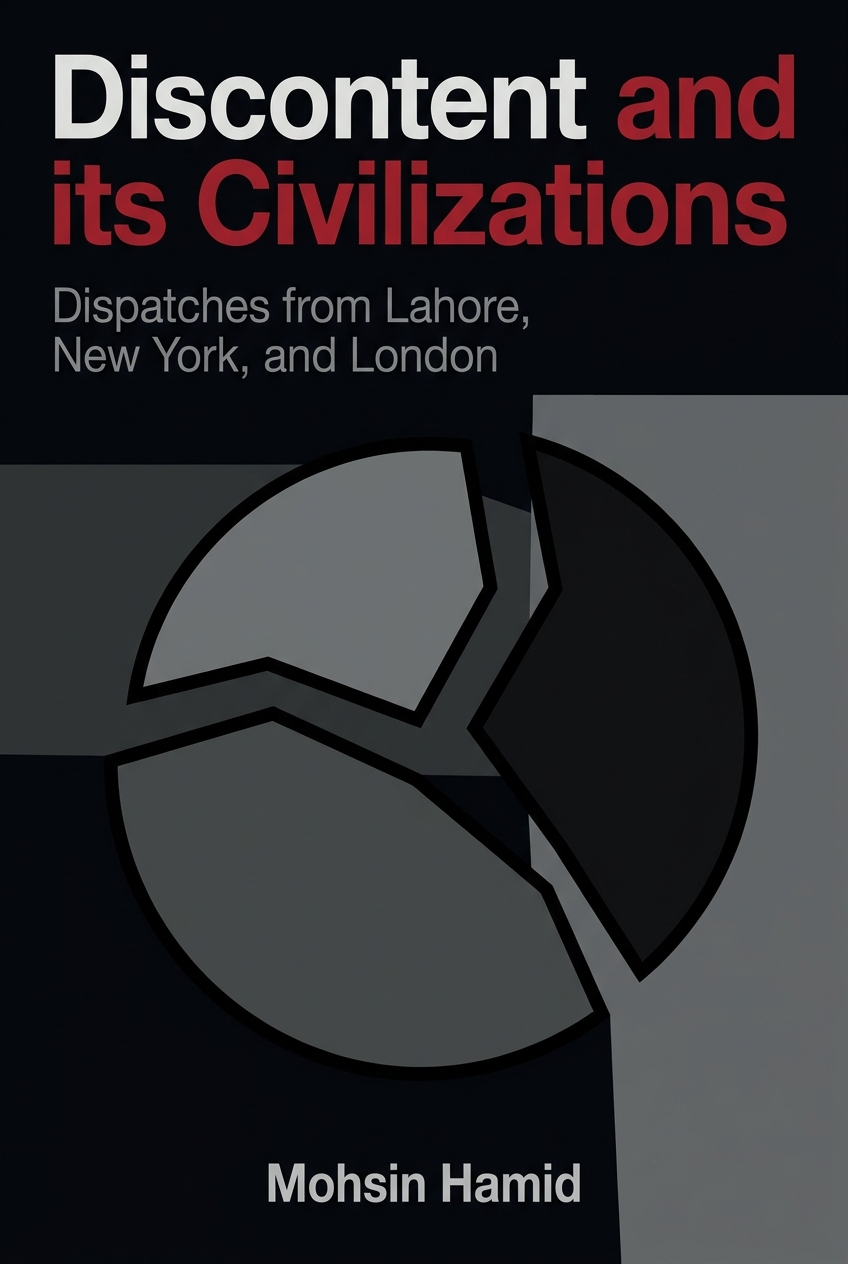
Discontent and its Civilizations book cover

The Script

We treat our lives like a project to be completed, a series of discrete achievements to be unlocked. We collect degrees, job titles, and relationships, arranging them on a shelf like trophies. Yet, the more we accumulate, the more the project feels incomplete, the trophies hollow. This frantic pursuit of a finished self, a stable and defined identity, is the very architecture of our anxiety. It’s a project whose blueprint guarantees its own failure, because the self isn’t a static object to be built and displayed. It is a constant, often messy, negotiation—a conversation between the person we believe we are and the myriad worlds we inhabit.

This tension, this feeling of being perpetually unsettled in one's own life, is the current that runs through the work of Mohsin Hamid. Born in Pakistan, educated in America, and a resident of London, Hamid has spent his life navigating the spaces between cultures, economies, and identities. His novels, like The Reluctant Fundamentalist and Exit West, explore these themes through fiction. In Discontent and its Civilizations, he turns the lens directly on his own experience, compiling two decades of essays, articles, and reflections. The book grew organically, piece by piece, from the urgent need to make sense of a world where the lines between home and abroad, self and other, have become irrevocably blurred.

Module 1: The Self as a Creative Project

We often think of our identity as fixed. Something we're born with. Hamid argues the opposite. He suggests that our sense of self is a story we are constantly writing and rewriting. This leads to his first major insight: Self-invention is a fundamental human freedom. He opens the book with a story about a monk who was once an Olympic sprinter. The monk tells him, "I invented myself." This is a declaration of liberation. The ability to change, to evolve, to choose who we become is a creative blessing. Hamid sees this in his own life, noting how the novelist he is today could not have written the books he wrote years ago. Experience changes us. Time changes us. We are all works in progress.

This idea of a fluid self is especially relevant in our globalized world. So, embrace your hybrid identity as a source of creativity. Hamid describes himself as a "half-outsider" everywhere he lives. He is at home in Lahore, New York, and London, yet never fully belongs to any single one. Instead of seeing this as a loss, he frames it as a unique vantage point. It makes him a "foreign correspondent" in his own life. This perspective allows for deeper empathy and understanding. He even argues that this feeling is becoming universal. An eighty-year-old living in their childhood town is also a migrant through time. The world they grew up in is gone. They too are navigating a foreign land. This shared experience of hybridity connects us.

But here's the thing. This freedom to invent ourselves is under threat. A global backlash against pluralism seeks to force us back into rigid, simple categories. Therefore, you must recognize that concepts like "Western-ness" or "Muslim-ness" are illusory constructs. Hamid calls them arbitrary and porous. They are political tools used to create an "us versus them" mentality. Think of the hypocrisy. We champion the free movement of capital but build walls to stop the free movement of people. These constructs stifle our ability to self-invent. They deny our shared humanity. The so-called "war on terror," he argues, is really a war on pluralism itself—an attack on the very idea that we can be many things at once.

Module 2: Finding Art and Meaning in Unexpected Places

Now, let's turn to how our environment shapes us. Hamid's journey reveals that the conditions for creativity are not what we might expect. We often assume art needs wealth and absolute freedom to flourish. Hamid’s experience in Pakistan shows this isn't true. His insight is that artistic expression thrives in diverse and often difficult social conditions. He grew up in 1980s Pakistan under the repressive regime of General Zia-ul-Haq. Public dance by women was banned. Punitive religious laws were promoted. Yet, art was "bursting" everywhere. It was in vibrant truck art, intricate calligraphy, and massive cinema billboards. It was a current of defiance flowing beneath the surface.

This led him to a powerful realization at Lahore's National College of Arts, a hub of creativity known as the NCA. Here, students from all backgrounds—devout and secular, rich and poor—created art side-by-side. You could find traditional calligraphy in one studio and nude life-drawing in the next. This experience shattered his assumption that great art only grows in the soil of Western-style liberal democracies. Instead, he saw that true creativity often arises from adapting to constraints.

This principle of adaptation extends beyond art to our very senses. In a socially conservative environment like Lahore, where physical touch and overt expression are limited, people learn to read subtle cues. This is a fascinating idea. Heightened sensitivity can be born of necessity. A shared smile, a brief brush of the hand, a carefully chosen word—these small gestures take on immense meaning. Hamid describes a Sufi dance event, an experience akin to a rave. He shares an intense, wordless connection with a woman just by sweating in the same crowded, hot room. In this "reduced-stimulus environment," he writes, a single sidelong glance can feel like a "tsunami." It's a powerful reminder that human connection finds a way, adapting its language to the rules of its environment. Our senses don't just perceive reality; they are trained by it.

Read More