All BooksSelf-GrowthBusiness & CareerHealth & WellnessSociety & CultureMoney & FinanceRelationshipsScience & TechFiction
Download on the App Store

Don Quixote

Annotated

14 minMiguel de Cervantes

What's it about

Ever feel like your grand ambitions are dismissed as madness? This classic tale explores the fine line between idealism and delusion, showing you how unwavering belief in a noble cause can transform your reality, even when the world calls you crazy. Discover the power of seeing giants where others see only windmills. Learn how an ordinary man, Alonso Quijano, reinvents himself as the knight-errant Don Quixote. Through his hilarious and often poignant adventures with his trusty squire, Sancho Panza, you'll uncover timeless truths about friendship, honor, and the courage it takes to live by your own code in a cynical world.

Meet the author

Widely regarded as the father of the modern novel, Miguel de Cervantes created a masterpiece in Don Quixote that has captivated readers for over four centuries. His own life was as adventurous as any knight-errant's tale; he was a soldier, a captive, and a tax collector. These varied experiences, filled with both hardship and humor, gave him a profound understanding of human nature, which he masterfully poured into the unforgettable characters of Don Quixote and Sancho Panza, forever changing literature.
Listen Now
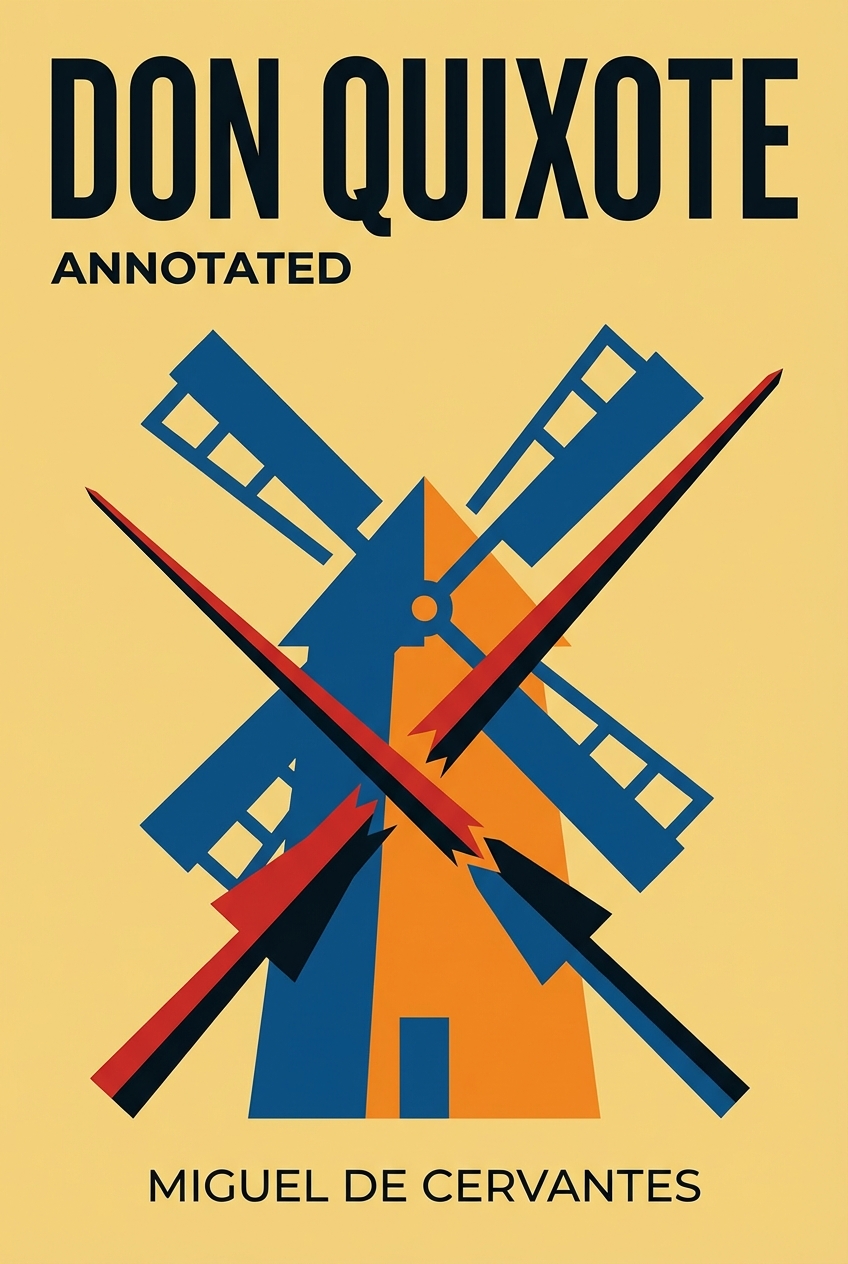
Don Quixote book cover

The Script

In a forgotten corner of a city archives, a meticulous clerk spends his days sorting through brittle, yellowed legal documents: property disputes, unpaid dowries, and petty theft convictions from centuries past. One day, he uncovers a peculiar set of records detailing the case of a man arrested for public disturbance. The defendant, a man of minor nobility, had apparently attacked a series of windmills, believing them to be monstrous giants. The townspeople’s depositions describe him with a mixture of pity and ridicule. He was a fool, they said, a madman who had read too many fanciful books and lost his grip on the world. But as the clerk reads further, through the dry legal language, another picture emerges. The man spoke of chivalry, of righting wrongs, of defending the helpless. His madness, it seemed, was a stubborn, almost heroic attempt to impose a beautiful, imaginary order onto a harsh and disappointing reality. He was desperately trying to live in a world where giants could be fought and vanquished.

This gap—between the world as it is and the world as we wish it were—is the very space where Miguel de Cervantes lived and wrote. A soldier who lost the use of his left hand in a glorious naval battle, a captive of pirates for five years, and a repeatedly failed playwright, Cervantes knew disappointment intimately. He even worked for a time as a tax collector, a job that landed him in prison over accounting irregularities. It was there, surrounded by the gritty, un-romantic reality of criminals and debtors, that he conceived of a character who would do the opposite: a man who would reject reality entirely in favor of a nobler, more exciting one he’d read about in books. Cervantes was exploring the profound human need to believe in something better, even at the cost of being called a madman. He wrote Don Quixote as a deeply personal reflection on the thin line between idealism and insanity, a theme he understood from a lifetime of his own grand ambitions and crushing defeats.

Module 1: The Operating System of Delusion

At its core, Don Quixote is an analysis of how a powerful, idealized narrative can completely overwrite a person’s perception of reality. The protagonist, a country gentleman named Alonso Quixano, reads so many chivalric romances that his brain, as Cervantes puts it, "dries up." He decides to become a knight-errant, a protector of the weak and a righter of wrongs. This is where the book's central engine kicks in. Don Quixote perceives. He sees the world as it should be according to his books.

This creates a constant, comedic, and often painful clash. A rundown country inn is a castle with four silver turrets. Two prostitutes are highborn maidens. A flock of sheep is a clashing army of fantastically named warriors. This is a reality for Don Quixote, and his commitment is absolute. He even rebrands himself and everything around him. His old nag of a horse becomes "Rocinante," a name he finds lofty and significant. A local farm girl he's seen a few times, Aldonza Lorenzo, is transformed in his mind into the peerless princess "Dulcinea del Toboso," the noble lady to whom he dedicates all his deeds.

The first major insight here is that a sufficiently powerful internal narrative can transform the mundane into the epic. Don Quixote’s delusion is a creative act. He is the CEO of his own heroic saga, and every data point is interpreted to fit his story. This is a powerful and dangerous idea for any founder or leader. We all build narratives to motivate our teams and ourselves. We tell stories about changing the world and disrupting industries. But Cervantes shows the peril of becoming so invested in the story that you can no longer see the sheep for the army. The lesson is to stay tethered to reality while pursuing a vision.

So how does this system sustain itself when reality constantly pushes back? This leads to the second insight. When faced with contradictory evidence, a strong delusion will invent a secondary narrative to explain the discrepancy. For Don Quixote, this secondary narrative is "enchantment." When he charges the windmills, believing them to be giants, and is unceremoniously knocked to the ground, he concludes that his arch-nemesis, the sage Frestón, must have magically transformed the giants into windmills at the last second to rob him of his glory. This is a brilliant psychological defense mechanism. The core belief—"I am a knight fighting giants"—remains intact. The failure is externalized. He was not wrong; a powerful enemy is actively working against him. It’s a cognitive model that allows the user to be right, even when they are demonstrably, painfully wrong.

Read More