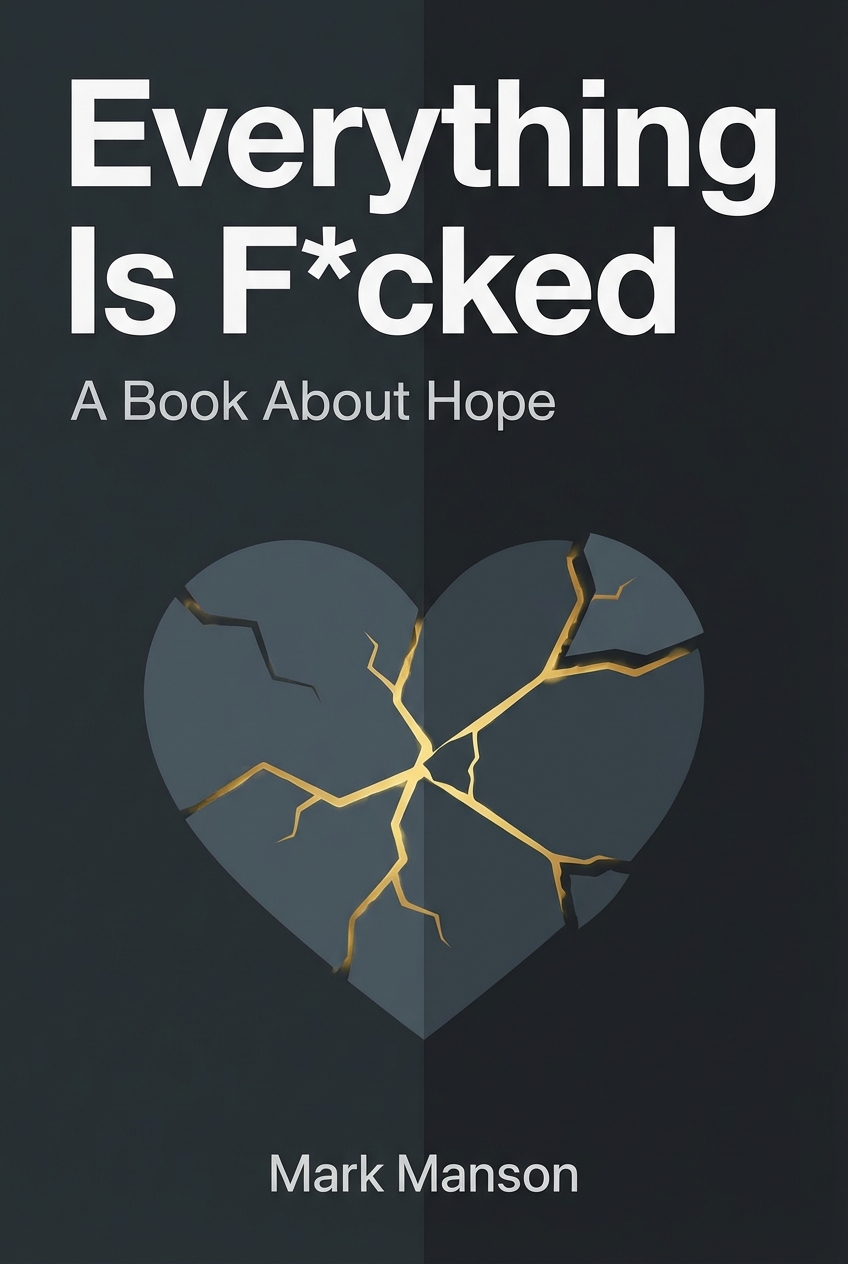
Everything Is F*cked
A Book About Hope
What's it about
Ever feel like the more you try to be happy, the more everything seems to fall apart? If a better life, endless positivity, and constant self-improvement are leaving you feeling empty and anxious, you're not alone. Discover why our pursuit of happiness is the very thing making us miserable. Learn how to stop chasing a pain-free life and instead build true, resilient hope. Manson reveals why you need to embrace pain, choose your struggles wisely, and accept the uncomfortable truths of the world. It's time to find meaning not by avoiding what's broken, but by learning how to live with it.
Meet the author
Mark Manson is the two-time 1 New York Times bestselling author whose work has sold over twenty million copies and been translated into more than sixty-five languages. Starting as a blogger in 2007, he spent over a decade writing for a massive online audience, exploring the uncomfortable truths of modern life and human psychology. This direct, unfiltered engagement with millions of readers helped him develop the counterintuitive, no-nonsense philosophy that challenges conventional notions of happiness and hope in his groundbreaking books.
The Script
We've built a world designed to eliminate pain and maximize comfort. We have instant entertainment, on-demand food, and algorithms that predict our desires before we even feel them. Yet, for all our material progress and technological insulation from hardship, a strange anxiety hums beneath the surface. We've become emotionally fragile, easily offended, and paradoxically, more hopeless than ever. It seems the more we try to engineer happiness and security, the more we feel like something is fundamentally broken. This is a feature of the human condition we've tried to ignore. Our relentless pursuit of a pain-free existence has created a new, more profound kind of suffering: the agony of a life without meaningful struggle.
The person who diagnosed this modern ailment wasn't a tenured academic or a spiritual guru, but a blogger who became an unlikely philosophical voice for millions. Mark Manson, following the massive, unexpected success of his first book, found himself with everything he thought he wanted: money, freedom, and global recognition. Yet, he felt a creeping sense of emptiness. He realized the same problem he saw in the world—that achieving goals doesn't solve our underlying emotional needs—was playing out in his own life. This personal paradox, of getting everything and feeling nothing, drove him to investigate the deeper crisis of hope affecting us all, leading directly to his second major work.
Module 1: The Consciousness Car and the Illusion of Self-Control
We like to believe we are rational beings. We think our logical mind is in charge. Manson argues this is a powerful and damaging illusion. He introduces a simple but profound model of the mind. It’s called the Consciousness Car.
Inside this car, there are two characters. The first is the Thinking Brain. This is your conscious, logical mind. It can analyze data. It can make plans. It can weigh pros and cons. The Thinking Brain is the navigator. It holds the map and suggests directions.
But the Thinking Brain isn't driving.
The driver is the Feeling Brain. This is your emotional, impulsive, intuitive self. It runs on instinct, desire, and pain. The Feeling Brain provides all the motivation. It’s the engine that moves the car. You only act because you feel something. Fear makes you run. Desire makes you pursue. The Thinking Brain can shout suggestions from the passenger seat. But if the Feeling Brain wants to drive straight into a donut shop, that’s where the car is going.
This brings us to a critical insight. Self-control is about the Thinking Brain and Feeling Brain learning to cooperate. You can’t force the Feeling Brain to do anything. You can't logic your way out of anxiety or shame. The classic assumption that reason must dominate passion is flawed. It leads to self-judgment and a cycle of failure. When you try to use sheer willpower to fight a craving, you're setting yourself up for a loss. The Feeling Brain almost always wins a direct fight.
So what’s the alternative? The key is learning to communicate. You manage your emotions by negotiating with them. The Thinking Brain’s job is to be a skilled diplomat. Instead of telling your Feeling Brain, "You're stupid for feeling lazy," you could ask, "Hey, what’s going on? Why don't we feel like hitting the gym today?" Acknowledge the feeling without judgment. Then, you can negotiate. You might appeal to a higher value. "Remember how good we feel after a workout? Let's just do 15 minutes." This approach respects the power of the Feeling Brain while gently guiding it toward a better destination. It’s about building a relationship with yourself.
And here’s the thing. When this relationship breaks down, things get messy. A mind where the Thinking Brain only serves the Feeling Brain’s worst impulses becomes a "Clown Car" of delusion and self-justification. This is when your rational mind exists only to create excuses for your emotional whims. "I deserve this expensive gadget because I had a hard week." "That person is an idiot, which is why it's okay for me to be rude to them." The Thinking Brain becomes a lawyer on retainer for the Feeling Brain’s every bad idea. This leads to addiction, narcissism, and an inability to handle any information that contradicts what you want to believe. True self-management starts with breaking this pattern.
Now, let's turn to the fuel that powers our Feeling Brain: hope.