All Books
Self-Growth
Business & Career
Health & Wellness
Society & Culture
Money & Finance
Relationships
Science & Tech
Fiction
Topics
Blog
Download on the App Store

Chip War

The Quest to Dominate the World's Most Critical Technology

17 minChris Miller

What's it about

Ever wonder what the world's most powerful nations are really fighting over? It’s not oil or land—it’s the tiny microchips inside every device you own. This summary reveals how this invisible battle for chip supremacy is already shaping your future and global stability. You'll trace the explosive history of the semiconductor, from its invention in America to its manufacturing perfection in Asia. Discover the high-stakes strategies of superpowers and the choke points they're fighting to control, giving you a crystal-clear map of the 21st century’s most critical power struggle.

Meet the author

Chris Miller is an Associate Professor of International History at the Fletcher School at Tufts University, specializing in the geopolitics of technology and economics. To write Chip War, he traveled the world to understand the semiconductor industry from the inside, speaking with the people who design and build our digital world. His unique background in economic history provides a powerful lens for understanding how this single technology came to define the new contest between global superpowers.
Listen Now

Opens the App Store to download Voxbrief

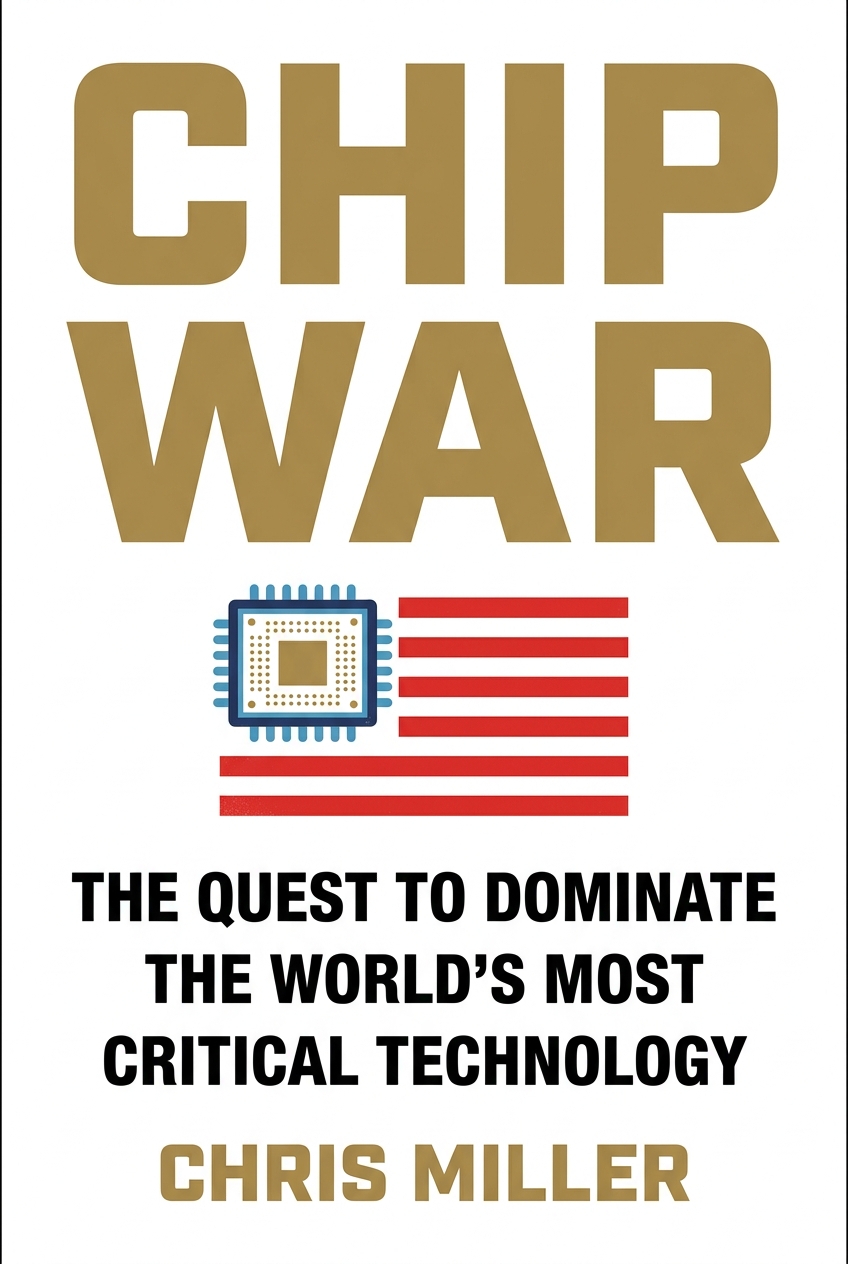
Chip War book cover

The Script

In the world of Formula 1 racing, the celebrity driver gets the spotlight, but the real power belongs to the team principal. This is the strategist in the headset, the one who understands that championships aren’t won by sheer talent alone; they’re won by marginal gains measured in thousandths of a second and fractions of a gram. Their genius lies in orchestrating a symphony of extreme precision, where a single, almost invisible component can be the difference between victory and catastrophic failure. They place billion-dollar bets on engineering concepts that won’t hit the track for years, knowing that the most critical battles are fought in sterile clean rooms and design labs where technological supremacy is forged. Their focus is relentless and absolute: find the microscopic edge that no one else can see, and leverage it for total dominance. It's a world where the smallest things hold the most power.

This obsession with winning through microscopic, technological supremacy isn't unique to the racetrack; it’s the defining feature of the modern global power struggle. Here, the prize is economic and military dominance for the next century. Chris Miller didn't set out to write a book about technology. As an economic historian studying the grand strategies of nations, he kept finding the same, tiny object at the heart of every major story: the semiconductor. He realized that the narrative of global competition was no longer just about armies or currencies. The real story was being etched onto silicon wafers in a handful of hyper-specialized facilities scattered across the globe. His work as a professor of international history at Tufts University gave him the unique perspective to see how these slivers of engineered sand became the world’s most critical resource, leading him to document the escalating, high-stakes conflict to control their production.

Module 1: The Pentagon's Startup

The story of Silicon Valley is often told as a tale of garage inventors and venture capitalists. That story is incomplete. The truth is, the chip industry was born from the Cold War. It was funded by the American taxpayer.

The first integrated circuits were wildly expensive. They were unreliable. No commercial market would touch them. But the US military had a problem. Its new intercontinental ballistic missiles needed guidance computers. These computers had to be small, light, and tough enough to survive a launch. Vacuum tubes were too big and fragile. The US government became the first and most important venture capitalist in Silicon Valley. The Apollo space program and the Minuteman missile project created the initial, high-volume demand for chips. They paid top dollar. They tolerated failures. This funding allowed companies like Texas Instruments and Fairchild Semiconductor to scale production. It drove down costs until chips were cheap enough for the civilian market.

This brings us to the culture of the place. The industry wasn't just built on government contracts. Early innovation was driven by a handful of brilliant, rebellious engineers. The founders of Fairchild, known as the "traitorous eight," abandoned their Nobel laureate boss William Shockley. They left because he was a terrible manager. They went on to create a company that became the seedbed for dozens of other startups, including Intel. This established the iconic Silicon Valley culture. It was a culture of stock options, ambition, and a relentless drive to innovate.

But an invention is not a product. An idea is not an industry. The real war was won on the factory floor. Manufacturing know-how ultimately determined success. The process of photolithography, using light to etch circuits onto silicon, was the key. It required insane precision. Engineers like Andy Grove at Intel and Morris Chang at Texas Instruments became legends for perfecting the manufacturing process. They ran thousands of experiments. They methodically eliminated errors. They drove yields up and costs down. This relentless focus on manufacturing is what turned a scientific curiosity into the engine of the global economy.

Module 2: The First Chip War

By the 1980s, Silicon Valley was dominant. But a new challenger emerged from the east. Japan, once a maker of cheap toys, was now a manufacturing powerhouse. And it set its sights on the chip industry.

What happened next was a brutal lesson in global competition. Japan weaponized manufacturing quality and cheap capital to dominate a key market. Japanese companies like NEC and Hitachi focused on one type of chip: DRAM, the memory chips used in computers. They produced them with far fewer defects than American firms. They were also backed by a financial system that offered patient, low-cost capital. They could afford to invest heavily and endure market downturns. By the mid-1980s, they had driven most American companies, including Intel, out of the memory business.

This triggered panic in Washington. Silicon Valley's leaders, once libertarian cowboys, went to the government for help. They argued that this was a national security crisis. The US response framed semiconductors as a strategic national asset. AMD’s CEO Jerry Sanders famously declared that chips were the "crude oil of the 1980s." The Pentagon agreed. It feared becoming dependent on a foreign rival for the electronics in its advanced weapons. This led to trade agreements and the creation of Sematech, a government-industry consortium designed to revive American manufacturing.

However, the story of this era is also about America's self-inflicted wounds. Consider the case of GCA, a US company that once dominated the market for lithography machines, the essential tools for making chips. Internal mismanagement can kill a market leader faster than any foreign competitor. GCA had the best technology in the world. But it was arrogant. Its customer service was terrible. Its management was unfocused. It failed to master mass production. A Japanese camera company, Nikon, saw an opening. It reverse-engineered GCA’s machine and built a more reliable one. Soon, Nikon and its rival Canon owned the market. GCA went bankrupt. The US had lost control of a critical manufacturing technology because it failed to execute.

Module 3: The Foundry Revolution

The US chip industry survived the war with Japan. It pivoted. Intel, under Andy Grove, abandoned memory chips and bet the company on a new product: the microprocessor. This bet, combined with its partnership with Microsoft, created the "Wintel" duopoly that dominated the personal computer era. But another, quieter revolution was happening in Taiwan. It would reshape the entire industry.

This revolution was led by one man: Morris Chang. After a legendary career at Texas Instruments, he was recruited by the Taiwanese government to build its chip industry. He had a radical idea. He saw that designing chips and manufacturing them were two different businesses. And they shouldn't be in the same company. Separating chip design from manufacturing unlocked a new wave of innovation. Chang created TSMC, the Taiwan Semiconductor Manufacturing Company. It was a "pure-play" foundry. It would exclusively manufacture chips for other companies. This was a game-changer. It meant a startup with a great idea didn't need billions of dollars to build a factory, or a fab. It just needed a designer and a contract with TSMC.

So what happened next? An explosion of creativity. The fabless model allowed startups to compete with giants by focusing on one thing: design. Companies like Nvidia could focus all their energy on creating revolutionary graphics processors, or GPUs. Qualcomm could focus on the complex chips that powered mobile phones. Apple could design its own custom processors for the iPhone. They didn't worry about manufacturing. They outsourced it to TSMC. This lowered the barrier to entry. It democratized chip design. It unleashed the talent of Silicon Valley in a new way.

Building on that idea, this new model created an incredibly efficient global system. But it also created a massive vulnerability. This disaggregation created an incredibly efficient but geographically concentrated supply chain. As manufacturing became more complex and expensive, only a few companies could compete at the cutting edge. TSMC in Taiwan and Samsung in South Korea pulled away from the pack. They invested hundreds of billions of dollars. They mastered the complex physics of shrinking transistors. Today, over 90 percent of the world's most advanced logic chips are made in one place: Taiwan. The world's digital infrastructure is built on a single, tiny island.

Read More