All BooksSelf-GrowthBusiness & CareerHealth & WellnessSociety & CultureMoney & FinanceRelationshipsScience & TechFiction
Download on the App Store

Flow My Tears, The Policeman Said

12 minPhilip K Dick

What's it about

What if you woke up one day and no one knew who you were? Imagine losing your fame, your fortune, and even your identity overnight. This is the terrifying reality for superstar Jason Taverner in a world under constant surveillance. This mind-bending classic explores the fragility of identity and the nature of reality itself. You'll follow Taverner's desperate journey through a dystopian America as he scrambles to prove he exists, confronting the terrifying power of a state where personal history can be erased in an instant.

Meet the author

A visionary master of science fiction, Philip K. Dick won the prestigious John W. Campbell Memorial Award for his novel Flow My Tears, the Policeman Said. Grappling with his own intense, transformative mystical experiences in the early 1970s, Dick channeled his profound questions about identity, reality, and authority into this haunting narrative. He used his fiction as a philosophical laboratory to explore the fragile nature of the human condition, making his work both deeply personal and universally resonant.
Listen Now
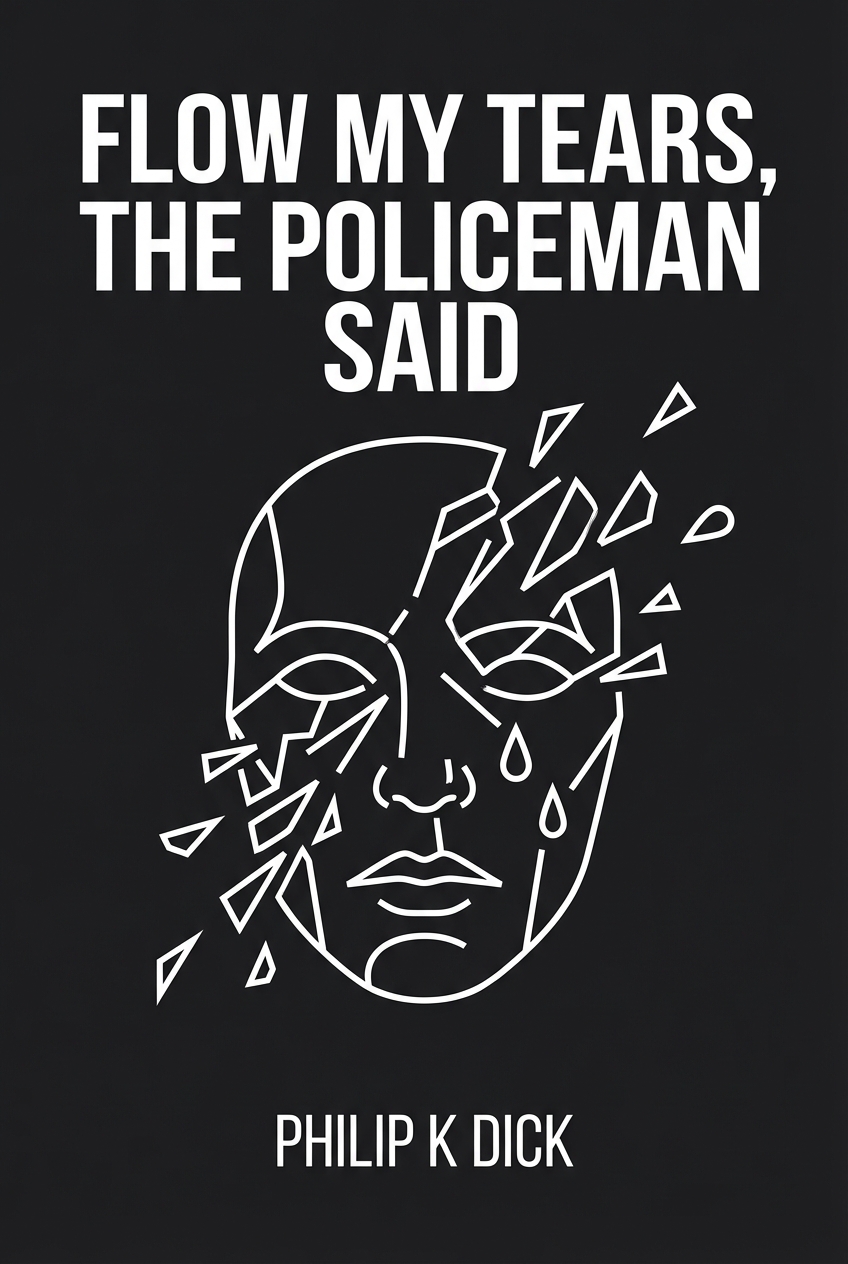
Flow My Tears, The Policeman Said book cover

The Script

We believe our identities are forged in the quiet moments of self-reflection, in the choices we make and the values we hold. But what if identity isn't an internal creation at all, but an external consensus? What if your name, your job, your memories, and your entire social standing exist only because a critical mass of other people agree that they do? This suggests a terrifyingly fragile foundation for reality. If that consensus were to abruptly vanish—if the databases that validate your existence were to suddenly return a null result—you would not simply be forgotten. You would cease to be. The person you believe yourself to be is a public performance, one that can be cancelled without notice, leaving not even a ghost behind.

This chilling premise—that our reality is a shared agreement, easily broken—was the fertile, paranoid ground from which Philip K. Dick's work grew. In the late 1960s, a period of immense personal and creative turmoil, Dick experienced a profound, mystical vision that felt like an information download from a higher intelligence. This event, which he would later codify in his sprawling philosophical work, the Exegesis, shattered his own sense of a stable, singular reality. He became obsessed with the line between the authentic human and the artificial construct, and the forces that could erase that line in an instant. Flow My Tears, The Policeman Said, written in this intensely volatile period, was an attempt to dramatize his deepest existential fear: the sudden, inexplicable deletion of the self from the world's memory.

Module 1: The Fragility of Identity

The novel opens by establishing a world where identity is a fragile, socially constructed commodity. We meet Jason Taverner, a TV host with 30 million viewers, and Heather Hart, a fellow star. They are "sixes," a genetically engineered elite, blessed with charisma and resilience. They live a life of privilege, looking down on the "ordinaries" who adore them. But this world is built on sand.

The central crisis begins when Jason wakes up in a shabby hotel room. He has no memory of how he got there. His ID cards are gone. Suddenly, he is an "unperson." He makes a series of frantic calls. His agent of nineteen years doesn't know him. His lawyer has never heard of him. The birth-registration center has no record of a Jason Taverner. In this society, your legal existence is defined entirely by state-issued documentation. Without it, you are subject to arrest and internment in a forced-labor camp. His fame, his history, his very existence have been wiped from the official record.

This leads to a critical insight. Identity is a performance backed by external validation. Jason still feels like a celebrity. He carries himself with the same polished confidence. He expects to be recognized. But when he tries to use his fame as currency, it fails. A document forger named Kathy has never heard of him or his show. She sees his glowing, phony charisma and concludes he must have a split personality. His internal self-image is now completely disconnected from his external reality. He retains a certain "allure," a magnetic quality that is his only remaining asset, but it’s not enough to restore his world.

So here's what that means for us. We often think of our identity as something stable and internal. But Dick suggests it’s more like a shared agreement. It exists because our friends, our colleagues, and our digital records say it does. Jason's situation is an extreme version of what happens when that agreement breaks down. When your external reality is erased, you are forced to confront the core of who you are without social proof. He clings to the fact that he is a "six," a genetically superior being, believing this innate quality will help him survive. It’s a desperate attempt to find an anchor when everything else has been washed away. The rules of his world have changed, and his old identity is now a liability, not an asset.

Read More