All Books
Self-Growth
Business & Career
Health & Wellness
Society & Culture
Money & Finance
Relationships
Science & Tech
Fiction
Topics
Blog
Download on the App Store

Free Will

14 minSam Harris

What's it about

Do you really choose what you do next, or is free will just an illusion? This summary challenges everything you think you know about your own choices, revealing the powerful, hidden forces that shape your decisions and actions before you're even aware of them. You'll explore the groundbreaking neuroscience and philosophical arguments that dismantle the concept of free will. Discover how understanding this illusion can actually empower you to live a more compassionate, effective, and fulfilling life by changing how you view blame, success, and personal responsibility.

Meet the author

Sam Harris is a neuroscientist, philosopher, and New York Times best-selling author known for his rigorous, evidence-based analysis of belief, ethics, and the human mind. His unique background, combining deep study in both contemplative traditions and the brain sciences, provides a powerful and distinctive lens through which he examines complex questions. This interdisciplinary expertise allows him to dissect the illusion of free will, bridging the gap between ancient philosophical debates and modern neuroscience to reveal profound insights about our lives.
Listen Now

Opens the App Store to download Voxbrief

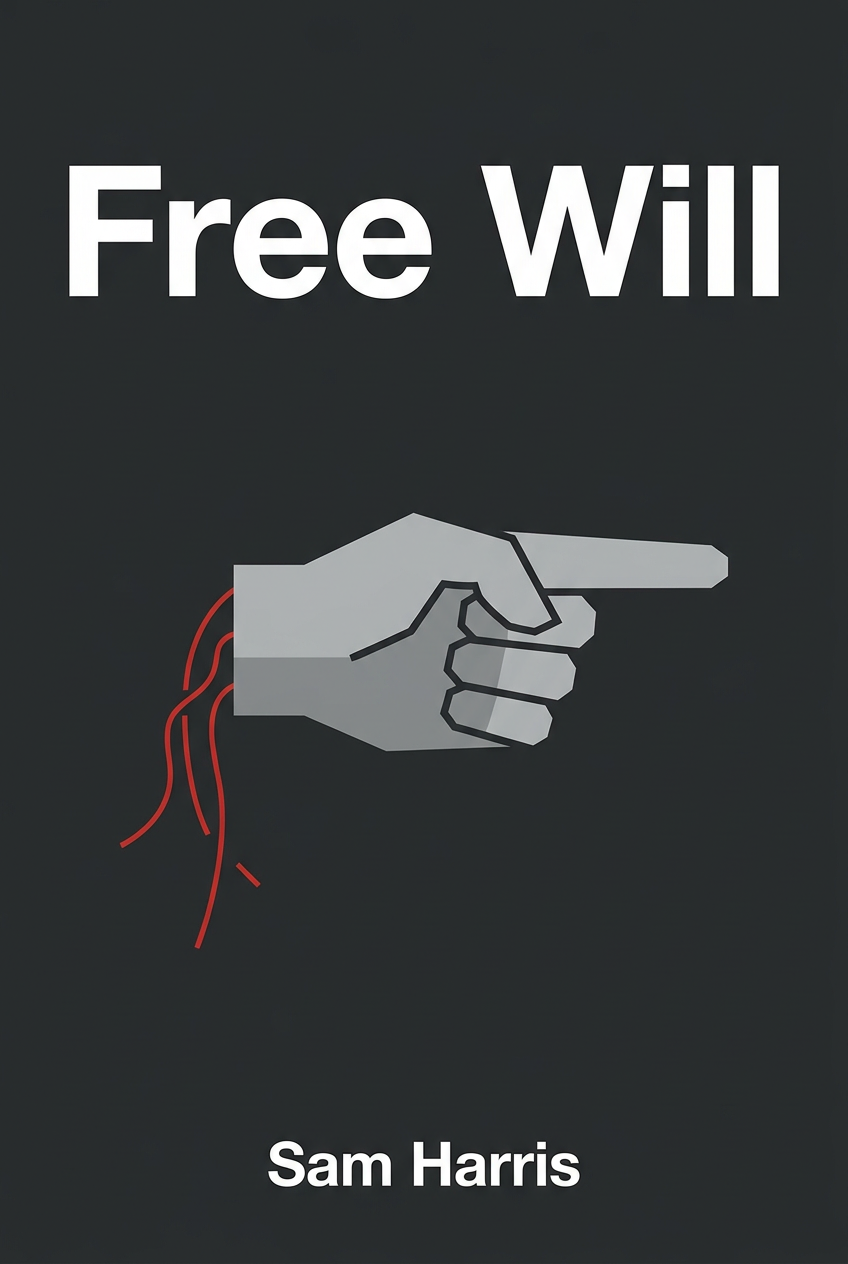
Free Will book cover

The Script

We experience our lives as a series of deliberate choices. From the monumental decision to accept a job offer to the trivial one of inselecting pasta sauce at the grocery store, we feel like the authors of our actions. This feeling is the bedrock of our entire moral and legal system—the very reason we praise heroes and punish criminals. We assume a conscious, thinking self, a little CEO sitting behind our eyes, pulling the levers of thought and intention. But what if this internal director is just a ghost? What if the feeling of having authored a thought is itself just another thought, arriving unbidden from the darkness, a split second after the neural machinery has already set the action in motion?

This unsettling possibility—that the entire sensation of conscious will is a grand illusion—is precisely what neuroscientist and philosopher Sam Harris set out to explore. Having spent years studying the brain and the nature of consciousness, Harris became increasingly convinced that the popular understanding of human agency was not just wrong, but dangerously misleading. He saw how the belief in absolute free will fueled needless blame, shame, and a flawed sense of justice. Harris wrote Free Will as a concise, powerful argument to dismantle this illusion. He aimed to show that understanding the true springs of human action—the complex interplay of genetics, prior experience, and unconscious neural events—could lead to a more compassionate and rational way of living.

Module 1: The Unconscious Origin of Choice

We all feel like we are the authors of our thoughts and actions. This feeling is the bedrock of free will. But what if this feeling is wrong? Harris opens by asserting that this subjective experience, however powerful, is a profound illusion.

The core argument is this: Your thoughts and intentions emerge from unconscious causes over which you have no control. Think about your very next thought. You don't know what it will be. When it appears, it will simply arrive. You did not decide it into existence. Harris uses a simple example. He's deciding between coffee and tea. The preference for coffee just appears. He doesn't know why. Even if he tried to rebel and choose tea, that rebellious impulse would also just appear, unbidden. The "I" that we identify with—our conscious self—is more of a witness than a creator.

This brings us to a critical piece of evidence. Neuroscience shows that your brain decides to act seconds before you become consciously aware of the decision. This is based on landmark experiments. In one study using fMRI, researchers could predict which button a person would press with high accuracy up to 10 seconds before the person felt they had made a choice. The brain activity was already there. The conscious feeling of "I will press the left button" came much later. It was an after-the-fact report on the action. Benjamin Libet's earlier EEG experiments showed a similar pattern. A burst of brain activity called the "readiness potential" occurred about 300 milliseconds before a subject felt the conscious urge to move. Your brain initiates the action. Your conscious mind gets the news bulletin a moment later.

So what does this mean for our sense of agency? It means the feeling of "choosing" is a story your brain constructs to make sense of its own unconscious operations. We are not the conscious source of our actions. Imagine a perfect brain scanner. It could watch your neural activity and tell you what you are about to think or do before you know it yourself. It could predict that you'll suddenly remember an old friend's name, or decide to pick up a magazine. You would still feel free. But the experimenter would see a clear, predictable chain of cause and effect playing out in your neurons. Your feeling of freedom arises simply from your ignorance of these prior causes.

But here's the thing. This argument doesn't depend on a purely physical, materialist view of the mind. Even with a non-physical soul, you still wouldn't have free will. Harris asks us to imagine our mind is made of "soul-stuff." Are you in control of this soul's operations? If your soul makes you gay, or prone to anxiety, or bored by prayer, you didn't choose those traits. The impulses and thoughts originating from this soul would be just as mysterious and uncontrollable as impulses originating from your brain chemistry. The problem is the lack of conscious authorship over the processes that create our mental lives, whatever their substance.

Module 2: The Incoherence of the Concept

Now that we've seen the neurological evidence, let's look at the logic. Harris argues that the idea of free will isn't just scientifically wrong; it's philosophically incoherent. It can't be squared with reality, no matter how you define it.

Philosophers have three main positions. Determinism, libertarianism, and compatibilism. Determinists believe every event is caused by prior events, so free will is impossible. Libertarians believe humans are special. They think we can somehow make choices that are independent of the causal chain, often invoking a metaphysical soul. Harris dismisses this as magical thinking with no evidence. The most popular view among modern philosophers is compatibilism.

Compatibilists try to have their cake and eat it too. They agree that the universe is deterministic. But they argue we can still be "free." How? They redefine freedom. For a compatibilist, you are free as long as you can act on your desires without coercion. If you want to eat ice cream and no one is stopping you, you have freely chosen to eat it. This is where Harris levels his most direct critique.

He argues that compatibilism is a semantic game that changes the subject. It completely sidesteps the real question. Sure, you can act on your desires. But where did the desire come from? You didn't choose to want ice cream. The desire simply appeared in your consciousness, a product of your genetics, your mood, your blood sugar, and a million other prior causes you didn't control. A man who wants to murder is different from a man who is forced to murder. But the man who wants to murder is still a victim of his own mind. He didn't create the desires that drive him. The compatibilist definition of freedom, Harris says, fails to capture the freedom most people feel they have. It's not the freedom that underpins our ideas of praise and blame.

This leads to a paradox. Neither determinism nor indeterminism gives you free will. This is a crucial point. If our actions are determined by a chain of prior causes, we aren't free. That seems clear. But what if there's some randomness or chance in the universe? What if quantum mechanics introduces some wiggle room? Some thinkers have hoped this could save free will. Harris says it makes the problem worse. A decision resulting from a random quantum event in your brain is just a chance occurrence. You can't take credit for it. You are not responsible for a random firing of a neuron any more than you are for a determined one. Whether our actions are determined or random, we are not their ultimate author. There is no third option.

Furthermore, the feeling of conscious agency is demonstrably unreliable. We often feel responsible for things we didn't cause and fail to recognize the true causes of our behavior. In hypnosis studies, subjects can be instructed to perform an absurd act, like crawling on the floor. When asked why they did it, they don't say "Because you told me to." They invent a plausible reason, a process called confabulation. They might say, "I was looking for my lost contact lens." They genuinely believe this story. Their brain creates a narrative of conscious intention to explain an action that was caused by something else entirely. This shows how easily the feeling of authorship can be created or misattributed.

This entire line of reasoning forces a difficult conclusion. The concept of moral responsibility, as we usually understand it, collapses under scrutiny. If a man's choice to commit a crime is the result of his bad genes, his abusive childhood, his brain tumor, or even just a random neural event, how can we say he is truly responsible? To say he "could have done otherwise" is to assume he could have rewritten his own biology and history. When you trace the causal chain back, responsibility seems to evaporate.

Read More