All Books
Self-Growth
Business & Career
Health & Wellness
Society & Culture
Money & Finance
Relationships
Science & Tech
Fiction
Topics
Blog
Download on the App Store

Greek Lessons

A Novel

13 minHan Kang

What's it about

Have you ever felt a profound disconnect, a silence that separates you from the world and even from yourself? Explore a story about two souls adrift in Seoul—a woman who has lost her voice and a man who is losing his sight—and discover how silence can speak volumes. You'll follow their journey as they find an unexpected connection in a Greek language class. This novel reveals how shared vulnerability and the quiet spaces between words can forge a bond more powerful than speech, offering a poignant look at loss, language, and the possibility of human connection.

Meet the author

Han Kang is the internationally acclaimed, Man Booker International Prize-winning author of The Vegetarian, celebrated for her profound explorations of the human body and spirit. A former creative writing professor in Seoul, her work often stems from a fascination with language's limits and its power to connect us. Greek Lessons continues this inquiry, drawing on her deep personal interest in ancient languages and the silent spaces between words to explore sensation, loss, and the fragile means of communication.
Listen Now

Opens the App Store to download Voxbrief

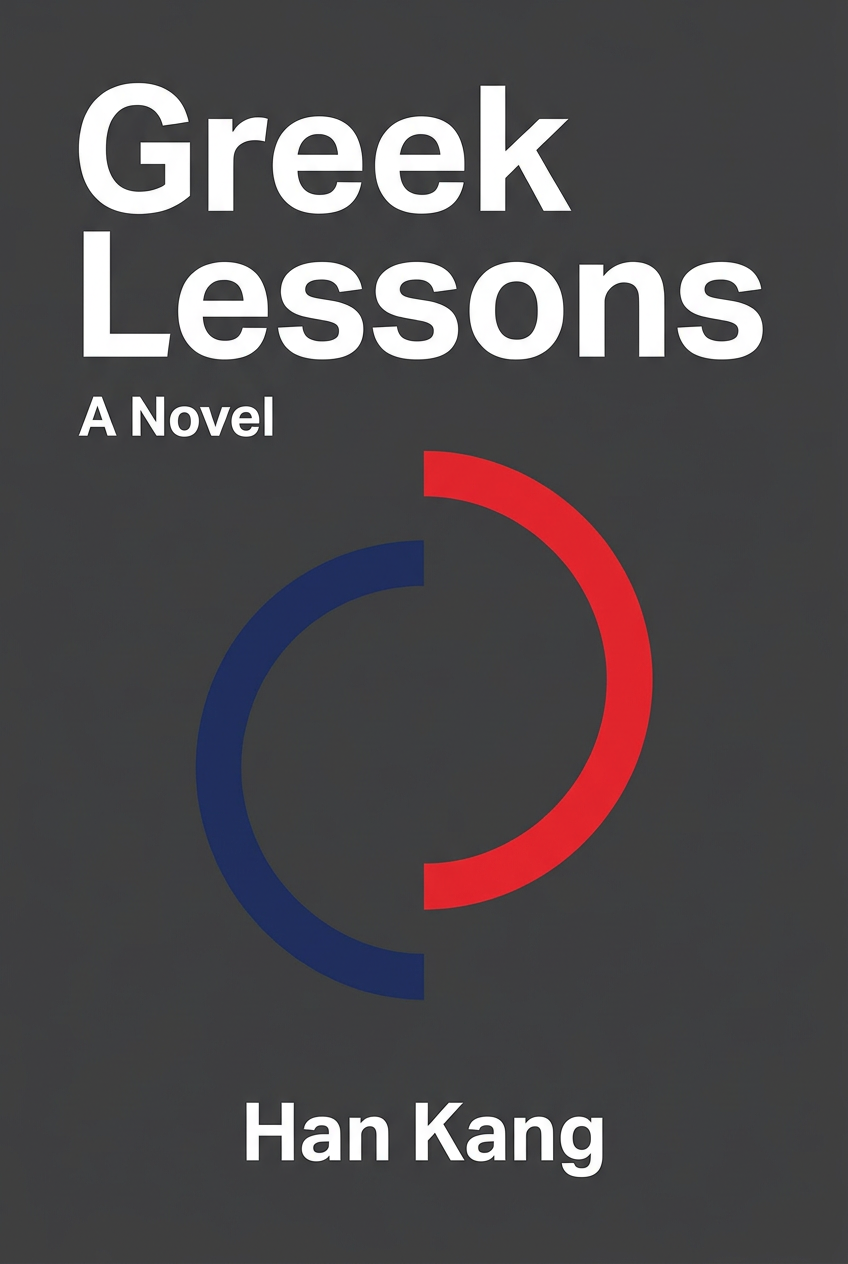
Greek Lessons book cover

The Script

Think of a time you were in a foreign country, holding a menu printed in a script you couldn't decipher. The waiter stands patiently, but the shapes on the page remain inert, refusing to connect to the smells wafting from the kitchen. You can point, you can gesture, but the specific, nuanced thing you want to express—a question about an ingredient, a memory of a similar dish—is trapped. It’s a temporary, frustrating island of isolation. Now, what if that feeling wasn’t temporary? What if the language you lost wasn't foreign, but your own? One day, you simply open your mouth and no words come out. The connection between thought and sound is severed. The world continues its noisy conversation, but you are sealed in a sudden, profound silence, able to hear everything but say nothing.

This is the silent world a woman finds herself in, a world where language has become a locked room. At the same time, a man is experiencing his own quiet retreat; the world around him is slowly dissolving into a blur as he loses his sight. They meet in a classroom, where they are both trying to learn Ancient Greek—a language that is dead, silent, and exists only in written form. It's a language no one speaks, yet for them, it becomes the only possible bridge. This exploration of what we lose when our senses fail us, and what we might find in that space of loss, comes from the mind of Han Kang. A South Korean writer known for delving into the fragile, often brutal, realities of the human body and spirit, Kang has always been fascinated by the limits of communication. She wrote "Greek Lessons" to explore a fundamental question: when the familiar ways of connecting to the world and to each other are stripped away, can we build a new kind of language from the fragments that remain?

Module 1: Language as Both Prison and Escape

The novel presents a challenging idea. Language isn't always a gift. For some, it can be a source of trauma, a cage of meaning that feels both restrictive and shameful.

The female protagonist embodies this struggle. Her relationship with her native Korean is painful. She feels that spoken words create rigid, cold boundaries. They define truth and lies with a clarity that feels violent. This forces a profound realization: sometimes, the most authentic expression is silence. For her, muteness is a retreat. It's a physical rejection of a system that has caused her pain. Her silence is an active, overwhelming force. It’s a "foggy" buffer that protects her from the sharp edges of her own language.

But here’s the interesting part. While fleeing one language, she runs toward another. She enrolls in a class to learn Ancient Greek. Why? Not for poetry or history. She chooses it precisely because it is dead. It's a structured, cold, and logical system. It’s a language that makes no emotional demands. This reveals a powerful strategy for regaining control: seek structure in unfamiliar systems. For example, she finds comfort in its intricate grammatical rules. A single Greek word like apēgxato can contain a full, self-sufficient sentence: "He had at one time tried to kill himself." This precision, this lack of emotional ambiguity, offers her a sense of agency. She is voluntarily reclaiming language on her own terms, choosing a system that feels safe because it is detached from her personal history.

This brings us to a critical insight about communication. When your own words fail you, the structure of another's can provide a lifeline. The man, her Greek lecturer, is also losing his connection to the world. His sight is progressively failing. For him, the rigid logic of Ancient Greek is a "safe, quiet room." It's a world of order and reason that stands in contrast to the slow, cruel chaos of his own body's decline. He finds solace in Plato’s philosophy, in the beauty of a system that promises eternal forms beyond the decaying physical world. He and his student are both using this ancient language as a raft. They are navigating their own internal storms by clinging to its logical, predictable structure.

So what does this mean for us? When a project is failing or a team is in conflict, we often double down on our existing ways of communicating. We talk more. We explain more. The book suggests a different path. Sometimes, the solution is to step outside our familiar vocabulary. It might mean adopting a new framework, a new methodology, or even just a new set_of_rules for a meeting. By engaging with an external, logical system, we can find a new perspective. We can find a way to communicate that bypasses the emotional baggage of our old one.

Module 2: The Body as the Final Record

In a world obsessed with data and digital records, Greek Lessons makes a compelling case for the body as the ultimate archive of experience. It argues that our deepest traumas and most profound connections are etched into our very physicality.

The woman’s silence is a full-body experience. It is a somatic state. When she tries to speak, her lips twitch, her hands become restless, and she holds her breath. The inability to form words originates "somewhere deeper than her tongue and throat." Her body has taken over, manifesting her psychological pain as a physical reality. This shows us that trauma is physically embodied. Her posture—back and shoulders permanently drawn in—is a constant, silent scream of withdrawal. She dresses in all black, as if perpetually attending a funeral for the person she used to be. Her body tells the story her voice cannot.

On the other side of this, the man’s progressive blindness rewires his entire sensory apparatus. As his sight fades, his other senses become hyper-attuned. He becomes a master of non-visual cues. The loss of a primary sense forces the development of a richer, multi-sensory reality. He navigates his apartment through careful movements and auditory signals. He learns to read the emotional temperature of a room through the quality of its silence. He even begins to see the appeal of Braille as a superior form of connection. He imagines the tactile act of reading each letter as a way to truly touch another person's thoughts.

This leads to the novel’s most powerful moments of connection, which are almost entirely non-verbal. When the two characters finally interact, their communication is purely physical. She guides him through the dark by the hand. She writes urgent messages on his palm. He learns to trust her presence through the faint scent of apples and the rhythm of her breathing. In a taxi, she answers his question by briefly laying her hand on his arm. The most profound understanding occurs through shared physical presence, transcending language. Their connection is built on a foundation of mutual vulnerability. Each one's disability becomes the key that unlocks the other's cage. He cannot see. She cannot speak. Together, they can navigate the world.

What's the actionable insight here? In our remote-first, text-heavy world, we often forget the power of physical presence and non-verbal cues. We try to solve complex emotional problems over Slack or email. Greek Lessons reminds us that some things can only be communicated in person. The subtle shift in someone's posture, the shared silence in a room, the simple act of putting a hand on a shoulder—these are all data points. And they are often more meaningful than a thousand words in a document. The book challenges us to recognize the limits of purely verbal communication and to value the rich, unspoken data our bodies are constantly transmitting.

Read More