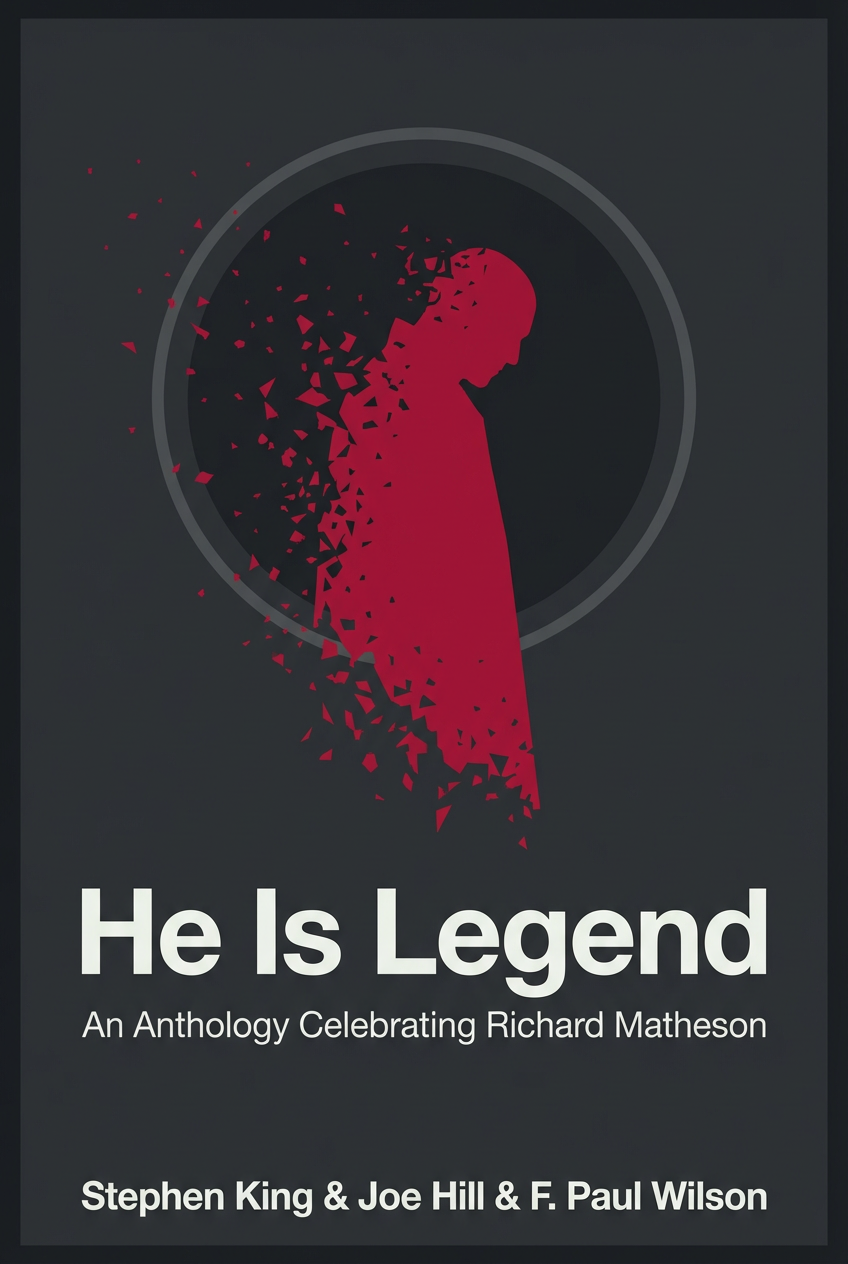
He Is Legend
An Anthology Celebrating Richard Matheson
What's it about
Ever wonder how one writer could inspire an entire generation of horror and sci-fi masters? Discover the electrifying legacy of Richard Matheson, the genius behind I Am Legend, and see how his chilling tales shaped the nightmares of Stephen King, Joe Hill, and many more. This collection isn't just a tribute; it's a masterclass in suspense and storytelling. You'll get to explore original stories from today's greatest authors, all inspired by Matheson's iconic work. Uncover the techniques that made him a legend and see how his influence continues to define the stories that keep you up at night.
Meet the author
Stephen King, Joe Hill, and F. Paul Wilson are three of the most celebrated and influential authors in modern horror and dark fantasy. As titans of the genre, they were uniquely positioned to curate this tribute, each having been profoundly inspired by Richard Matheson's groundbreaking work. This anthology is not just a collection of stories but a personal homage from masters of the craft to the legend who paved the way for them, offering a rare glimpse into the lineage of speculative fiction.
Opens the App Store to download Voxbrief

The Script
A master chef spends a lifetime perfecting a single dish, the one that defines their restaurant. Then, one day, a young cook in the kitchen—perhaps their own child—takes the base ingredients of that legendary recipe and creates something entirely new. It's a conversation, not a copy. The salt, the heat, the timing—all the foundational elements are there, recognizable and respected. But the final plate is different. It carries the echo of the original, yet sings in a new key, flavored with a different generation's palate and perspective. This is how a culinary tradition stays alive: by being constantly re-inspired, re-interpreted, and re-plated by those who loved the original the most.
This is the very heart of He Is Legend, an anthology born from that same impulse of loving re-interpretation. The book was conceived as a living conversation with the legendary author Richard Matheson's work. Editor Christopher Conlon gathered a roster of modern masters of the dark and fantastic—writers like Stephen King, Joe Hill, and F. Paul Wilson, many of whom consider Matheson a foundational influence, the one who taught them the core ingredients of storytelling. They weren't asked to merely praise Matheson's legacy; they were invited into his kitchen, handed his most famous recipes, and encouraged to cook. The result is a collection where each story takes a classic Matheson concept and reimagines it, creating a powerful testament to how a master's work can echo, evolve, and inspire long after the original has been served.
Module 1: The Architecture of Terror
The first thing you notice about Matheson's work, and the stories in this collection, is the meticulous construction of fear. It’s about building a world with its own relentless, terrifying logic. This anthology dives deep into that architecture.
One of the most powerful examples comes from the story "Return to Hell House," a sequel to Matheson's masterpiece. The story reinforces a key principle: a haunted place is an active, malevolent intelligence. Hell House isn't just filled with residual energy. It is a conscious entity, the lingering will of its depraved creator, Emeric Belasco. It watches. It learns. It customizes its attacks. When a team of investigators enters, one medium describes the feeling as being observed by a predator. The house isn't just spooky; it's hunting.
This leads to a chilling realization. The entity exploits personal history and guilt to psychologically break its victims. The haunting is bespoke. A mental medium is tormented with visions of her ex-fiancé, who died horribly in the house decades earlier. A powerful physical medium is confronted by an apparition of his own mother, who mocks him for his deepest adolescent insecurities. The house doesn't just throw things. It excavates your most private shame and weaponizes it against you. It's a deeply personal form of psychological warfare.
And here's the thing. This kind of focused malevolence makes traditional tools useless. Scientific skepticism and psychic ability are equally dangerous liabilities. The scientists in the story try to explain events with theories of energy fields. Their reductionism blinds them to the conscious, personal nature of the threat. It leaves them unprepared and vulnerable. Meanwhile, the psychics act as open doors. Their sensitivity makes them perfect conduits for the house's power, turning them into puppets or victims. In Hell House, being a skeptic is arrogant. Being a psychic is a death sentence.
Module 2: The Monster's Point of View
Now, let's turn to one of the most famous horror concepts ever created. We've all seen the movies and read the books about the lone survivor in a world of monsters. But what does that survivor look like from the other side? This anthology brilliantly flips the script on Matheson's most iconic novel.
The prequel story "I Am Legend, Too" retells the origin of the outbreak from the perspective of Ben Cortman. You might remember him as Robert Neville's vampire neighbor in the original book. Here, we see him as a man consumed by jealousy. He resents Neville for his looks, his success, and his charming wife. This story shows how envy and resentment poison a life, leading to obsession. Cortman’s hatred for Neville becomes the defining feature of his existence, even before the plague hits.
Then, the transformation happens. It’s not elegant or romantic. The change from human to vampire represents a sudden, grotesque loss of humanity. The story describes it in brutal, visceral terms. Cortman is attacked, his throat is ripped out, and his consciousness is reduced to a primal, instinctual state. He becomes what the story calls "Animal Ben." His brain is stripped of reason, memory, and complex emotion. All that remains are two things: hunger and a burning, atavistic hatred for one man.
And this is where the genius of the story lies. It completely inverts the original narrative. From the vampire's perspective, the human survivor is the true monster. When Robert Neville stakes the vampiric body of Cortman's wife, Cortman’s decaying mind interprets it as the ultimate violation. He sees Neville not as a hero fighting for survival, but as a murderer and a rapist who has stolen and destroyed his wife. In this new world of the dead, Neville's relentless campaign of extermination makes him the terrifying legend. Cortman’s nightly quest to destroy Neville becomes his own legend, a singular purpose born from a monster's point of view.