All Books
Self-Growth
Business & Career
Health & Wellness
Society & Culture
Money & Finance
Relationships
Science & Tech
Fiction
Topics
Blog
Download on the App Store

How Can I Help?

Stories and Reflections on Service

14 minRam Dass

What's it about

Ever wonder if your efforts to help are actually doing more harm than good? Discover how to transform your desire to serve into a powerful, positive force. Learn to navigate the hidden pitfalls of altruism and find genuine fulfillment in helping others without burning out or feeling resentful. This summary unpacks Ram Dass's timeless wisdom on compassionate service. You'll explore the crucial difference between fixing and serving, how to set healthy boundaries, and why self-care is the foundation of effective help. Find your unique path to making a meaningful difference in the world.

Meet the author

Ram Dass was a preeminent spiritual teacher and Harvard psychology professor who became a counter-culture icon after his transformative journey to India in the 1960s. His life's work, rooted in Eastern wisdom and Western psychology, explored consciousness, compassion, and the nature of selfless service. This unique synthesis of academic rigor and profound spiritual experience allowed him to articulate the deep, transformative power of helping others, providing a guiding light for generations of seekers on the path of compassionate action.
Listen Now

Opens the App Store to download Voxbrief

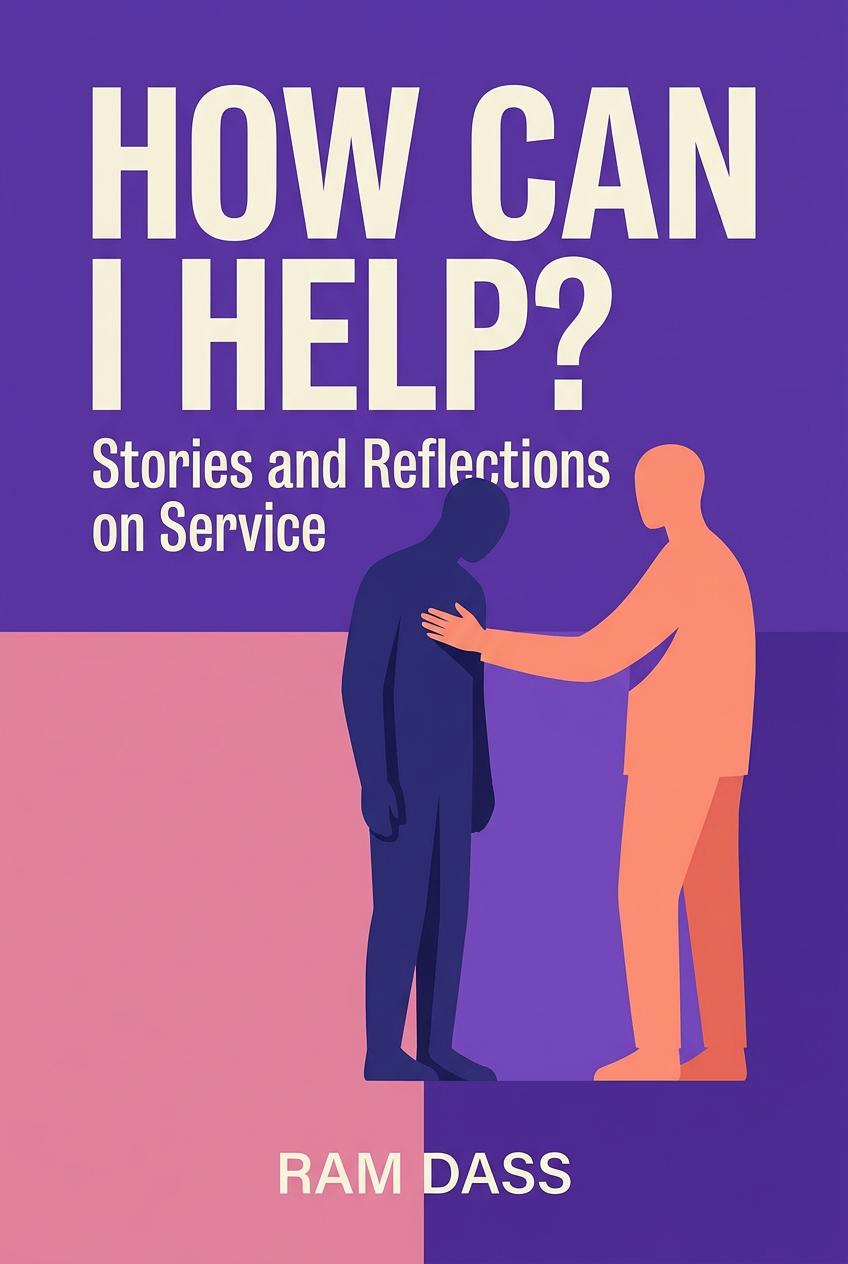
How Can I Help? book cover

The Script

Imagine you’re walking down a city street and see an elderly woman trip, her bag of groceries spilling across the sidewalk. Oranges roll into the gutter, a carton of eggs cracks open, a glass jar shatters. In that instant, a dozen impulses might flash through your mind. One part of you might rush to help, driven by a genuine, uncomplicated urge to ease her distress. Another part might hesitate, worried about doing it wrong, about the awkwardness of the interaction, or even about being late for your own appointment. A more calculating part might see an opportunity to be a hero, to be seen by others as a good person. And a quieter, more anxious part might feel a wave of her pain and fragility so acutely that it becomes overwhelming, making you want to turn away just to escape the feeling.

This single, fleeting moment on a sidewalk holds the entire complex drama of what it means to help. It’s a space filled with our best intentions and our deepest insecurities, our desire for connection and our fear of entanglement. The act itself—picking up groceries—is simple. But the inner world behind that act is a tangled ecosystem of ego, compassion, agenda, and burnout. We often believe that the desire to help is purely noble, but what happens when our help is really about us? When it’s driven by a need to fix, to feel competent, or to relieve our own discomfort rather than the other person’s? This subtle, often unconscious confusion is the source of so much exhaustion and disillusionment for people in caring professions, for volunteers, and for anyone simply trying to be a good friend or family member. What if the most powerful way to help another person required us to first untangle the knots within ourselves?

That question became the central mission for Ram Dass, a figure who had already lived several lifetimes in one. After his famous journey from being a prominent Harvard psychology professor named Dr. Richard Alpert to a renowned spiritual teacher, he found himself surrounded by people who wanted his help. He also found himself on the receiving end of help after suffering a massive stroke. This dual perspective—as both giver and receiver of care—gave him a profound insight into the mechanics of compassion. He saw how easily the ego could disguise itself as altruism, turning acts of service into subtle power plays. In collaboration with Paul Gorman, he wrote “How Can I Help?” as a series of stories and reflections to explore the inner landscape of service, guiding us away from the burnout of ‘fixing’ and toward the sustainable, shared grace of simply ‘being with’ another’s reality.

Module 1: The Trap of Roles and the Separate Self

We enter the world of helping with a set of identities. We are a manager, a parent, a mentor, or a friend. These roles are useful. They help us function. But they can also become prisons. Ram Dass argues that over-identifying with a role creates distance and limits compassion. Think of a doctor who is so caught in the "doctor" persona that they can't connect with a patient's fear. Or a daughter who is so trapped in being a "daughter" that she can't see her dying father as a fellow human being on a difficult journey. The role gets in the way of the relationship.

This attachment to roles is part of what the book calls the "separate self." It's the ego-identity we build from our jobs, relationships, and beliefs. A person might say, "I'm just not the kind of person who signs petitions." This fixed self-image creates inertia. It cuts us off from simple, helpful actions. The problem intensifies when we project this onto others. When we see ourselves as incomplete, we see others as incomplete too. A therapist who only sees themself as a "therapist" will inevitably see the other person only as a "patient." This reinforces dependency. It subtly communicates, "You are broken, and I am here to fix you." A chronically ill man in the book shares this frustration. After years of rehabilitation, he says he never met a helper who saw him as whole. They only saw his broken body.

So what's the way out? The book suggests finding perspective through humor and awareness. One powerful story involves a young medical intern. A patient asks him a simple question: "Who you?" The question short-circuits his automatic "Doctor..." response. It opens him to a more expansive sense of being. He is a doctor, yes, but he is also much more. This is the key. True service begins when we see our roles as temporary costumes that reveal our essential identity. We can wear the costume of "manager" or "mentor" lightly. We can perform its duties. But we never forget the shared humanity underneath. This allows us to connect with others from a place of shared being, rather than a position of authority.

Module 2: The Battle Between the Heart and the Mind

When we witness suffering, our first instinct is often compassion. An open heart feels an immediate, natural pull to connect and to soothe. But almost instantly, a second voice chimes in. It’s the voice of the mind, and its primary job is self-protection. This creates a powerful internal conflict. The heart says, "Help." The mind says, "Wait. Is this safe? Will I get overwhelmed? Do I know what to do?" This tension is the source of much of our anxiety around helping.

Ram Dass explains that the mind develops defensive strategies to manage this discomfort. Fear of being overwhelmed leads to mental defenses like denial, abstraction, and pity. Denial is simply ignoring the problem. We walk past the homeless person on the street and pretend we don't see them. Abstraction is turning a person into a label. We stop seeing a human being and start seeing a "schizophrenic" or an "addict." This creates a safe, analytical distance. Pity is another form of distance. We feel sorrow for someone, which reinforces our separateness and their victimhood. It’s a way of feeling good about our compassion without actually getting our hands dirty.

A more active defense is the compulsive need to "fix" things. This is the "we gotta do something" syndrome. It's often driven more by our own discomfort with the situation than by the other person's actual need. The book distinguishes between two crucial concepts. There is pain, the unpleasant sensation or circumstance. Then there is suffering. Suffering is the mental and emotional resistance to the pain. Two women can experience the same pain of childbirth. One sees it as part of a joyful process and feels minimal suffering. The other resists it with fear and experiences immense suffering. The pain is the same; the relationship to it is different.

The path forward is to face the mind's fear. The book offers a stunning example. A volunteer is working with severely burned children. He is horrified and repulsed by one child's appearance. He can't even make eye contact. Then, another child bluntly yells at the burned child, "YOU UGLY!" The raw honesty of the moment shatters the volunteer's defenses. He finally looks the child in the eye. In that instant of genuine human connection, the physical damage "dissolves," and he sees the person within. This is the work. Effective help requires the courage to sit with our own discomfort. We must be willing to feel our own fear and horror without letting it control our actions. Only then can we offer our genuine presence.

Read More