Hyperion
What's it about
What if the fate of humanity rested on the shoulders of seven strangers, each carrying a dark secret? On the eve of an interstellar war, these pilgrims journey to the mysterious world of Hyperion to confront the Shrike, a terrifying creature that guards the enigmatic Time Tombs—and can grant a single wish. You'll uncover the haunting tales of each pilgrim: a priest, a soldier, a poet, a scholar, a detective, a diplomat, and a captain. Their stories intertwine to reveal a universe of complex politics, faith, and technology, forcing you to question the very nature of pain, love, and sacrifice as they race toward a destiny that will change the galaxy forever.
Meet the author
Hugo Award-winning author Dan Simmons is a master of genre-blending, celebrated for crafting one of science fiction's most ambitious and profound epics, the Hyperion Cantos. A former elementary school teacher, Simmons's deep knowledge of classic literature and poetry informs the rich, complex universe he builds. His vision is brought to life by Marc Vietor, an Audie Award-winning narrator and veteran actor whose commanding performance captures the saga's immense scope and intimate character drama, making him the definitive voice of this literary masterpiece.
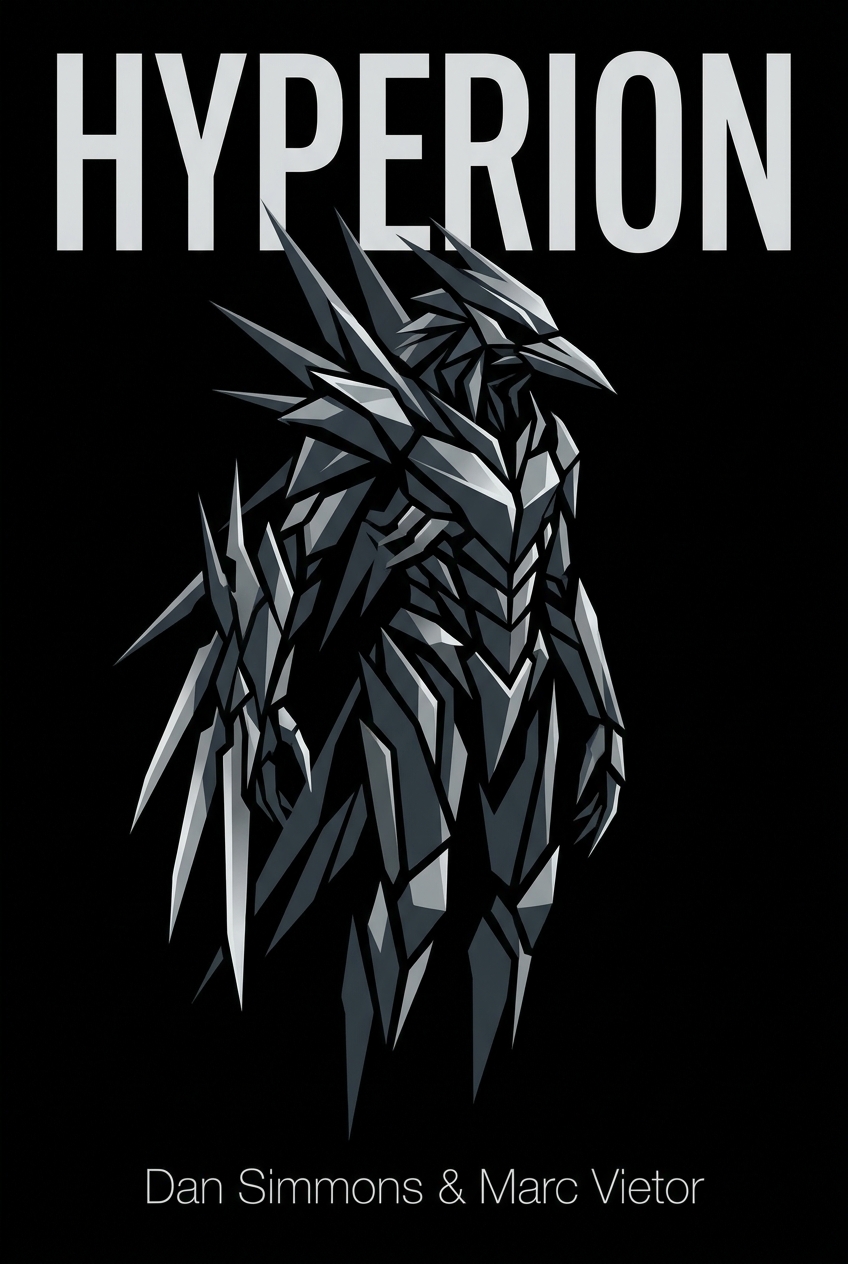
The Script
Seven travelers are summoned to a remote planet, each carrying a desperate plea and a dark secret. They are pilgrims, chosen for a final journey to the world of Hyperion, a place where the laws of physics and time have begun to unravel. Their destination is the Time Tombs, ancient, enigmatic structures moving backward through time, and their shared object of dread and worship is the Shrike—a terrifying creature of chrome and blades, part god, part monster, that is said to grant one pilgrim’s wish while brutally killing the rest. Each traveler believes their personal crisis is the most urgent, their reason for being there the most righteous. A poet seeks his lost muse, a soldier his mortal enemy, a detective a murder victim who is not yet dead. They are strangers, bound only by a summons they couldn't refuse and the shared, horrifying certainty that most of them will not survive.
As they travel together, they share their stories, each tale a universe unto itself, weaving together threads of faith, despair, technology, and art. The structure of their shared journey—a pilgrimage of storytelling toward a final, unknowable judgment—was a deliberate choice by author Dan Simmons. A former elementary school teacher with a deep love for classic literature, Simmons wanted to write a grand-scale space opera that felt as timeless and structurally ambitious as Chaucer's The Canterbury Tales. He wondered if he could build a futuristic epic around the most fundamentally human act: telling stories to make sense of the incomprehensible. Hyperion became his answer, a novel born from a desire to fuse the intimate, character-driven narratives of literary fiction with the vast, imaginative scope of science fiction, creating a pilgrimage for the reader as much as for the characters themselves.
Module 1: The Doomed Pilgrimage
The story kicks off with a simple, terrifying premise. Seven people are chosen for a final pilgrimage. Their destination is the planet Hyperion. It’s a backwater world, famous for one thing. The Time Tombs. These are mysterious structures moving backward through time. And they are guarded by a creature called the Shrike. It’s a three-meter-tall monster of metal thorns and blades. It kills without reason. It communicates only through death.
Now, the Time Tombs are opening. This event coincides with a massive fleet of Ousters, nomadic spacefarers, approaching the planet. The Hegemony of Man, the ruling galactic government, is on the brink of war. So they sanction one last pilgrimage. Seven people, each with a desperate reason to face the Shrike, are sent on a one-way trip. The hope is that one of them holds the key to Hyperion's secrets. The reality is that they are probably being sent to their deaths.
This setup introduces a core idea. Your personal crisis is often a reflection of a larger, systemic breakdown. The pilgrims aren't just random individuals. Their personal tragedies are directly linked to the galactic conflict. We meet Sol Weintraub, a scholar. His daughter is aging backward, a victim of the Time Tombs' strange energies. Then there's Colonel Fedmahn Kassad. He's a soldier haunted by visions of a beautiful woman and the Shrike on ancient battlefields. Each pilgrim’s "unsolved riddle" is a microcosm of the galaxy's existential dread. Their journey is about confronting the forces that have broken their world.
Here's the thing. The pilgrimage itself is an exercise in escalating isolation. The pilgrims travel on a Templar treeship, a living vessel of immense beauty and rarity. But this ship is destroyed in a space battle, a stark visual of their lifeline being severed. They are stranded. Then they travel by barge, then by an automated windwagon across a deadly sea of grass. All communication with the outside world is cut. They are completely alone. This forces them to rely on one another. And it creates the perfect stage for their stories to unfold. In a crisis, stripping away external support reveals true character and forces collaboration. They have no government, no army, and no escape plan. They only have each other, and the stories they carry. This forced intimacy becomes the engine of the plot.
Finally, the book establishes that every participant in a high-stakes game has a hidden ace. Het Masteen, the Templar captain, suggests each pilgrim has brought a secret "weapon." It might be a physical object, like Kassad's arsenal or the Consul's hidden ship. It could be knowledge, like the poet Martin Silenus's unfinished manuscript. They are all playing a desperate hand. They all believe they have one last move that could change the outcome. This injects a layer of suspense and strategy into their interactions. They are allies of circumstance, but also competitors in a deadly contest where the rules are unknown.