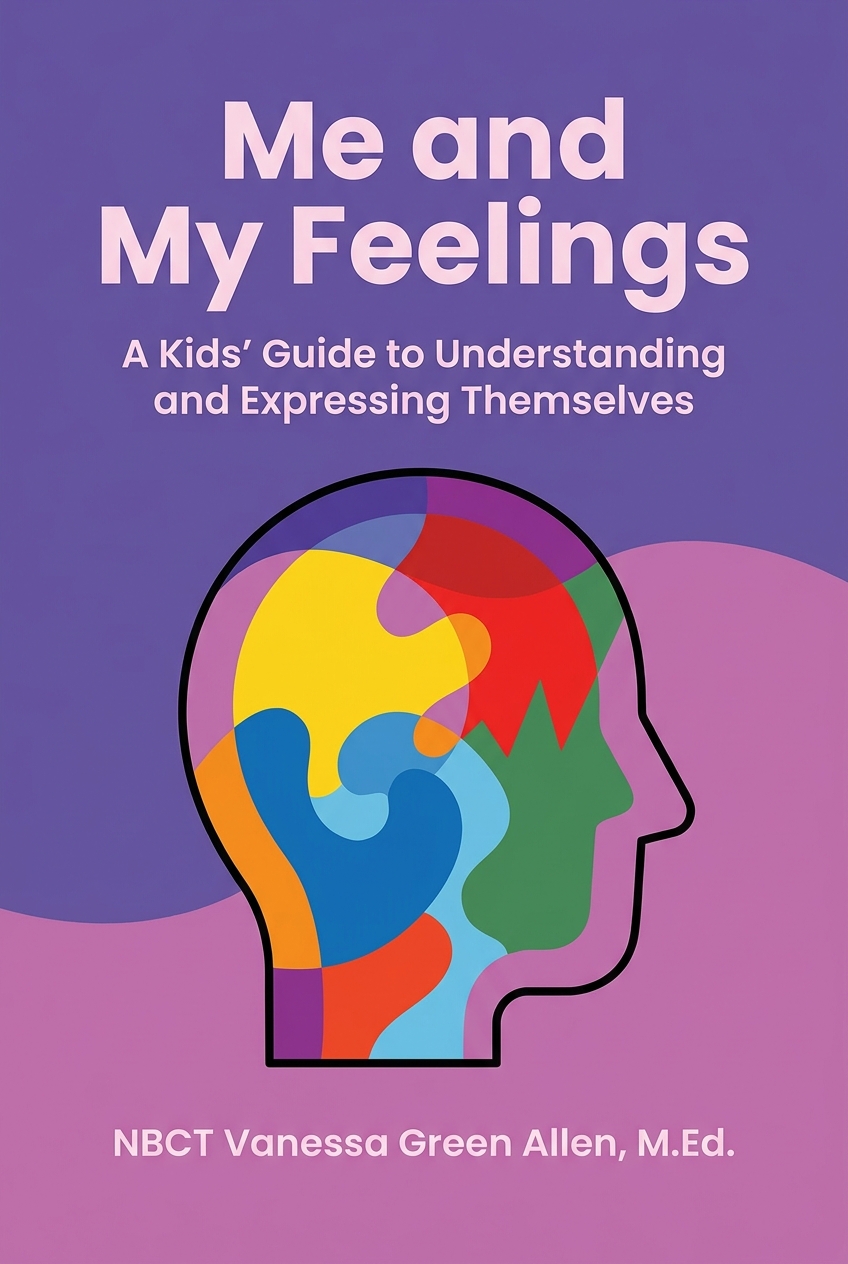
Me and My Feelings
A Kids' Guide to Understanding and Expressing Themselves
What's it about
Ever wonder why it's so hard for kids to say what they're feeling? This guide gives you the tools to help them move beyond "I'm fine" and start naming their emotions, from anger and sadness to happiness and excitement, building a foundation for lifelong emotional intelligence. You'll discover simple, interactive exercises and conversation starters designed to make talking about feelings a normal, everyday activity. Learn how to create a safe space for expression, understand the science behind big emotions, and empower your child to manage their feelings with confidence and calm.
Meet the author
Vanessa Green Allen, M.Ed., is a National Board Certified Teacher with over two decades of experience helping children navigate their emotional and academic worlds. Her passion for fostering social-emotional learning in the classroom directly inspired her to create this guide for families everywhere. Vanessa believes that giving children the language to understand their feelings is the foundation for a happy and resilient life, a mission she now extends from her students to young readers and their parents.
Opens the App Store to download Voxbrief

The Script
Think about the last time you saw a toddler build a tower of blocks. It’s an exercise in pure, uninhibited creation. One block goes on top of another, guided by instinct and imagination. They might stack them high until they teeter and fall, or they might build a long, winding wall across the floor. Now, watch an adult try to do the same thing. The process changes. Suddenly, there are rules. Anxious thoughts creep in: Is the foundation stable? Are the colors balanced? Will it look right? That effortless, joyful construction is replaced by a careful, often hesitant, assembly. The blocks are the same, but the internal experience of building is completely different. One is a fluid expression of the moment; the other is a negotiation with a dozen invisible worries and expectations.
This simple contrast reveals a powerful truth about how we learn to handle our inner worlds. As children, our feelings often tumble out just like those blocks—messy, spontaneous, and honest. But as we grow, we learn to manage them, often by building walls, creating rigid structures, and second-guessing our own emotional instincts. Vanessa Green Allen saw this pattern over and over again. As a National Board Certified Teacher with a Master's in Education, she spent years in classrooms watching children navigate the complex world of their emotions. She realized that kids needed a way to understand their feelings that was as intuitive and accepting as playing with blocks. She wanted to give them—and the adults who care for them—a shared language to name what’s happening inside and simply understand it. That desire to help children build a healthy relationship with their inner selves from the very beginning is what led her to create Me and My Feelings.
Module 1: The Emotional Operating System
Let's start with the basics. The author argues that emotional literacy begins with a simple, powerful idea. All feelings are valid and perfectly natural. There are no "good" or "bad" emotions. There are only emotions. Anger, sadness, and fear are data points. They are natural human responses to our environment. Accepting this is the first step toward managing them. When you stop judging yourself for feeling anxious before a presentation, you can start asking why you feel anxious. This shifts the focus from shame to strategy.
From this foundation, we can build a more sophisticated understanding. The author makes a critical distinction. Emotions and feelings are two different things. An emotion is the body's immediate, physical reaction to an event. Someone jumps out and yells "Boo!" Your body reacts instantly. That's the emotion. The feeling comes next. It's your conscious interpretation of that physical event. You might feel angry because the surprise made you spill your coffee. Or you might feel amused. The emotion is the raw data. The feeling is the story you tell yourself about it. This separation is key. It creates a space between stimulus and response where you can choose how to react.
So what are these core emotions? The book identifies six fundamental states. They are happiness, sadness, fear, anger, surprise, and disgust. Think of these as primary colors. They can mix and combine to create a vast spectrum of more nuanced feelings. You might feel jealousy, which is a blend of anger, fear, and sadness. You might feel excitement, a mix of happiness and anticipation. The point is to recognize that complex feelings often have simpler roots. By identifying the core emotion, you can address the root cause more effectively.
And here’s the thing. This internal landscape is constantly changing. Your feelings are temporary states, not your permanent identity. You are a person experiencing anger. This linguistic shift is a powerful tool for psychological distancing. Saying "I am feeling anxious" instead of "I am anxious" reminds you that the feeling is a transient visitor. It doesn't own you. It doesn't define you. You have the power to observe it, understand its message, and decide how long it gets to stay. This separation is the core of emotional regulation. It allows you to build a stable sense of self, one that isn't rocked by every emotional wave.