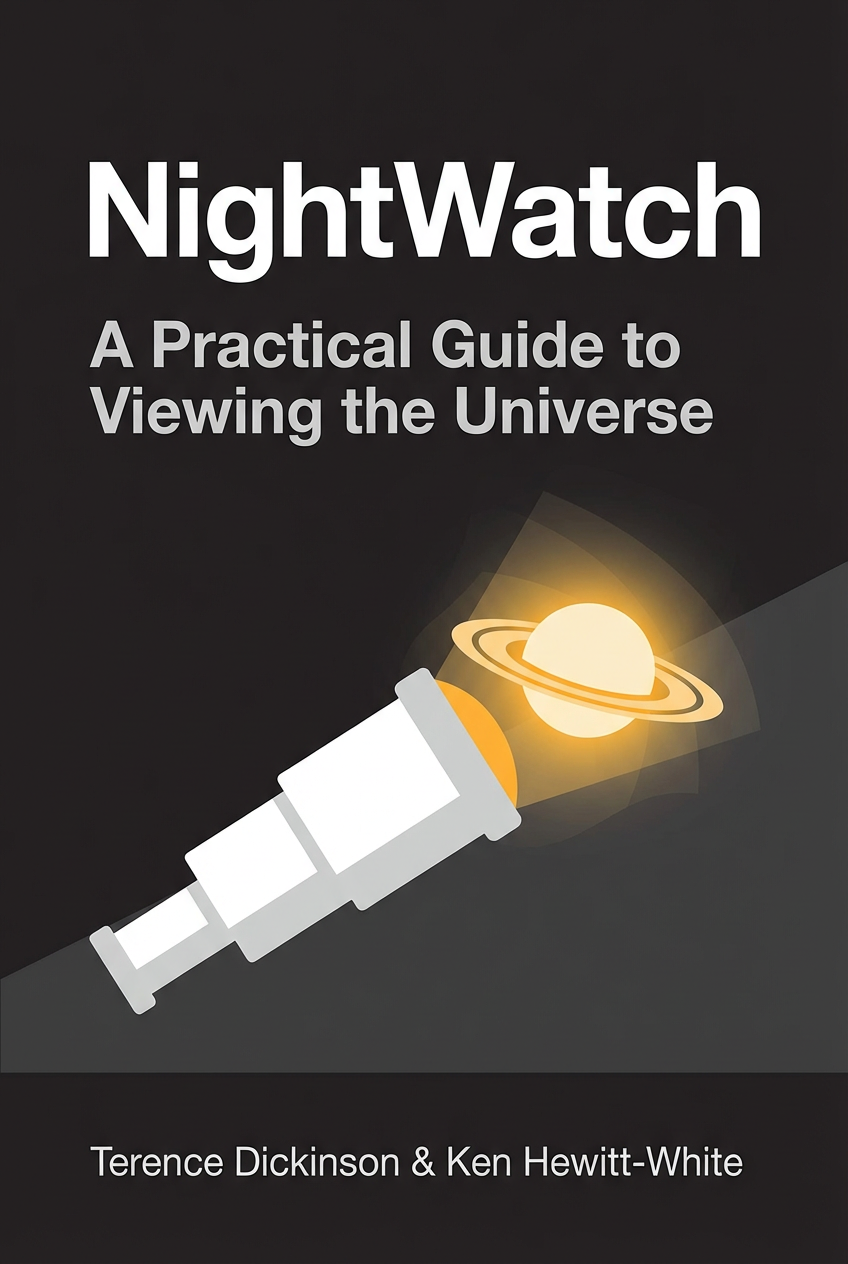
NightWatch
A Practical Guide to Viewing the Universe
What's it about
Ever felt overwhelmed by the vast night sky, unsure where to even begin? NightWatch is your friendly, practical guide to the cosmos. It cuts through the complexity, showing you how to find stunning celestial objects with just your eyes or a simple pair of binoculars. You'll learn the secrets to identifying constellations, planets, and even distant galaxies from your own backyard. Discover which telescopes are worth your money, master easy-to-use star charts, and get a season-by-season tour of the universe's most spectacular sights, turning your curiosity into a lifelong passion.
Meet the author
Terence Dickinson is Canada's most acclaimed astronomy writer, renowned for making the complexities of the universe accessible to everyone for over four decades. His passion for stargazing began as a childhood hobby, evolving into a celebrated career dedicated to helping amateur astronomers navigate the night sky. With co-author and veteran educator Ken Hewitt-White, Dickinson crafted NightWatch to share their combined lifetime of practical knowledge, ensuring every reader can experience the wonders of the cosmos firsthand from their own backyard.
Opens the App Store to download Voxbrief

The Script
Two people stand in a field on a clear, moonless night. One has a brand-new, expensive telescope, its sleek tube pointed toward the heavens. They spend an hour wrestling with knobs, consulting charts, and trying to align the finder scope. Frustration mounts as the eyepiece reveals only fuzzy blurs and bewildering star fields. They pack it in, defeated by the complexity, the vastness feeling more like a taunt than an invitation. The other person arrives with only a pair of binoculars and a simple folding chair. Within minutes, they are tracing the ghostly arms of the Andromeda Galaxy, watching Jupiter’s moons dance in a neat line, and hopping from one stellar landmark to another as if following a familiar path. They see a neighborhood of wonders, accessible and welcoming.
The difference is the guide. For decades, countless budding astronomers experienced that exact frustration, their passion for the cosmos extinguished by an overwhelming learning curve. Terence Dickinson, a lifelong astronomer and acclaimed science writer, saw this happen again and again. He realized the problem was a lack of connection—a way to bridge the gap between human curiosity and the sky's intimidating scale. He teamed up with fellow astronomer and educator Ken Hewitt-White to create a book that felt like a friendly, knowledgeable companion for those first nights under the stars, turning a bewildering starscape into a celestial backyard.
Module 1: The Backyard Universe is for Everyone
The core message of "NightWatch" is that astronomy is a deeply rewarding personal exploration accessible to anyone. The authors dismantle the idea that you need a PhD or a massive budget to experience the universe. The cosmos is right above you, waiting to be discovered.
A key idea here is that meaningful observation blends seeing with understanding. The book gives an example of the author viewing a galaxy 70 million light-years away. He was seeing light that began its journey during the age of the dinosaurs. This connection between the visual and the conceptual is what transforms stargazing from a technical hobby into a profound experience.
So, how do you start? The book argues that you can begin your cosmic journey with no equipment at all. Your own eyes are powerful enough. From a reasonably dark location, you can see the Andromeda Galaxy, the most distant object visible to the naked eye. You can watch planetary alignments. You can witness the aurora. The authors want you to become a "naturalist of the night," learning the patterns of the sky just as a hiker learns the trails of a forest.
Next, the book emphasizes that modern amateur astronomy is empowered by high-quality, affordable equipment. This is a golden age for the hobby. In the past, a decent telescope was a luxury. Today, excellent instruments are within reach. The authors note that a typical 6- or 8-inch amateur telescope can reveal details on the Moon that are equivalent to the view from a spacecraft just a few hundred kilometers away. This is about recognizing that the right tools can unlock spectacular views, turning faint fuzzies into detailed star clusters and distant planets into worlds with visible features.
Module 2: Navigating the Night Sky
Once you're ready to look up, where do you begin? The sky can feel like an overwhelming, chaotic dome of stars. "NightWatch" provides a simple, practical system for navigation. It focuses on a few core principles.
First, effective sky navigation starts with bright, obvious guideposts. You don't need to learn all 88 constellations at once. You just need to find one or two key patterns. For the Northern Hemisphere, these are the Big Dipper and Orion. These asterisms are your anchors. From the Big Dipper, you can draw imaginary lines to find Polaris, the North Star. You can follow its curved handle to "arc to Arcturus." From Orion's belt, you can find Sirius, the brightest star in the sky. These guideposts turn the sky from a random collection of dots into a structured, interconnected map.
Building on that idea, the book introduces a simple but powerful technique. You can measure the sky using your own hand. This feels almost too simple to be true, but it works. Held at arm's length, your fist covers about 10 degrees of the sky. Your three middle fingers cover about 5 degrees. The tip of your pinky finger is about 1 degree. This allows you to follow directions like "go 20 degrees south of that bright star." You have a reliable measurement device attached to your arm.
But here's the thing. The sky is not static. It moves. This leads to the next insight: understanding the sky's motion is key to finding your way. The book explains two primary movements. First, the daily motion caused by Earth's rotation, which makes stars appear to rise in the east and set in the west. Second, the seasonal motion caused by Earth's orbit around the Sun. This is why you see different constellations in winter than you do in summer. "NightWatch" provides seasonal star charts designed for evening viewing, so you always know which guideposts to look for at any given time of year.
Finally, the authors stress that visual astronomy is a skill that improves with practice. Your first look through a telescope at a faint galaxy might be underwhelming. But as you train your eye and brain, you'll start to perceive more detail. The book introduces a technique called averted vision. This involves looking slightly to the side of a faint object. This uses the more light-sensitive peripheral cells in your retina, making the object appear brighter and more detailed. It's a small trick that makes a huge difference.