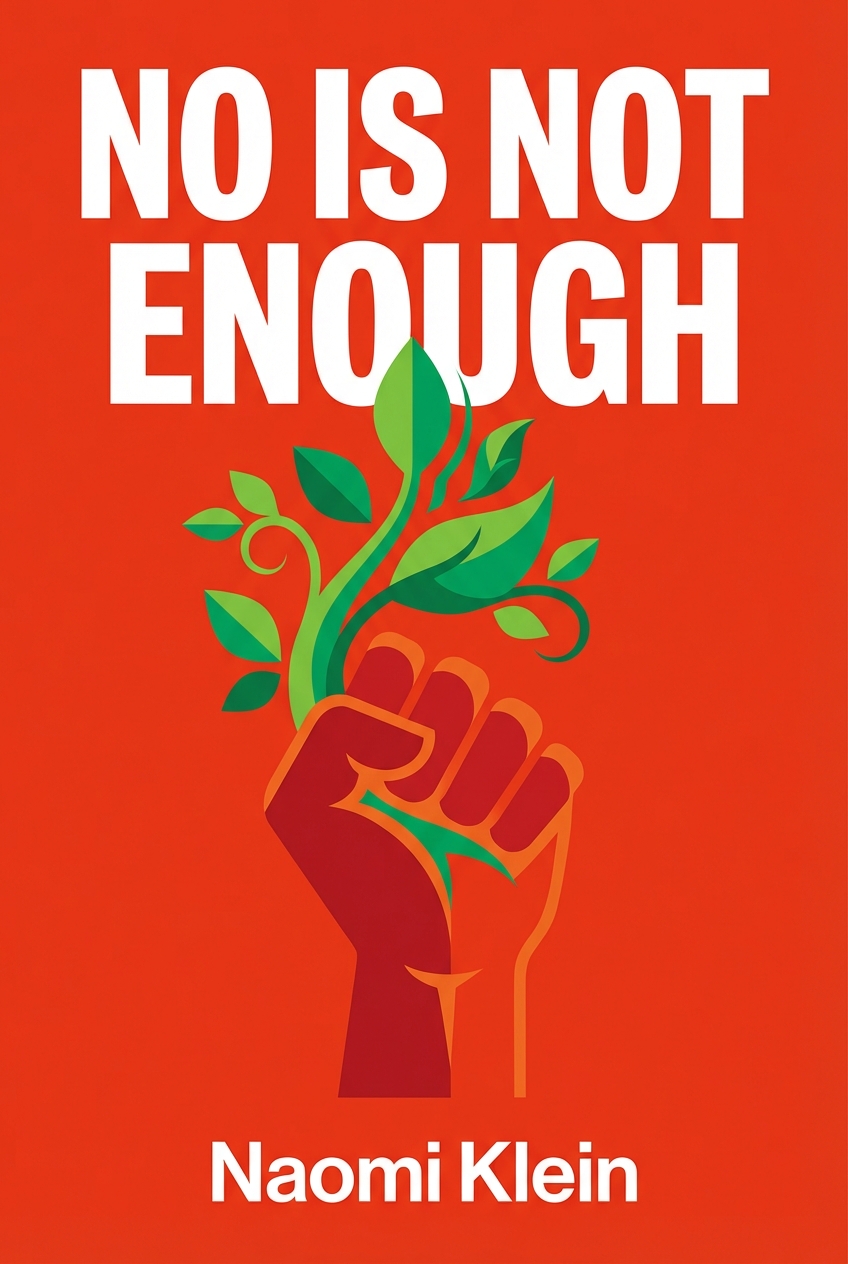
No Is Not Enough
Resisting the New Shock Politics and Winning the World We Need
What's it about
Feeling overwhelmed by the constant chaos of today's politics and wondering how to fight back effectively? Discover how to move beyond simple opposition and start building a positive, inspiring vision for the future. This is your guide to turning outrage into meaningful action. You'll learn Naomi Klein's "shock politics" strategy, which reveals how crises are deliberately used to push through unpopular policies. Uncover the playbook used by the powerful and gain the tools to not only resist their agenda but also to unite and champion a bold, alternative path forward.
Meet the author
Naomi Klein is an award-winning journalist and the bestselling author of international blockbusters like The Shock Doctrine and No Logo, making her one of the world's leading critics of corporate globalization. Her decades of reporting from the front lines of social and environmental movements have given her a unique lens on how crises are exploited for profit. This firsthand experience investigating disaster capitalism and resistance movements directly informs her urgent call to action in No Is Not Enough.
The Script
Have you ever tried to win an argument by presenting a perfect, logical case, only to find the other person unmoved, even doubling down on their original position? We often assume that the most persuasive tool we have is a well-reasoned argument, a fortress of facts. But what if this assumption is fundamentally wrong? What if the most powerful forces shaping our world aren't driven by logic or policy debates, but by the same principles that sell us sneakers and smartphones? This is about responding to something primal: a masterfully constructed brand. The most potent ideas don't win on merit alone; they win because they tell a simple, compelling story that feels complete, a story that makes us feel like we're part of something bigger, something triumphant.
This realization—that a political movement could function like a blockbuster brand launch—is what compelled Naomi Klein to write this book. An award-winning journalist and author known for her deep investigations into corporate globalization and branding, Klein witnessed the 2016 U.S. election not as a political anomaly, but as the culmination of trends she had been tracking for decades. She saw how a lifetime of building a personal brand, centered on wealth, power, and decisiveness, created a story so powerful it could withstand any factual assault. For her, simply saying “no” to the man was like boycotting a single product while ignoring the massive, global corporation that made it. The only way to truly counter it, she argued, was to understand the strategy behind the spectacle and build a more compelling story in its place.
Module 1: The Shock Doctrine in Action
Klein's analysis starts with a powerful concept she calls the "shock doctrine." This is a political strategy that exploits major crises. Think of wars, terrorist attacks, economic collapses, or even natural disasters. During these events, the public is understandably disoriented, fearful, and distracted. The shock doctrine describes how savvy political and corporate actors use this window of confusion to ram through radical, pro-corporate policies. These are policies that would never pass under normal democratic circumstances.
A key insight here is that crises are deliberately used to suspend democratic norms and fast-track a corporate wish list. For example, after Hurricane Katrina devastated New Orleans, the city was in chaos. Policymakers used the shock to privatize the public school system, demolish public housing, and suspend labor regulations. These were long-sought goals of free-market ideologues. The crisis provided the perfect cover.
This brings us to the next point. The strategy relies on speed and fear to overwhelm opposition. The goal is to move so fast that people can't keep up. Klein describes the first week of the Trump administration as a "tsunami of executive orders." This rapid-fire approach left opponents reeling, scrambling to react to one fire while another was being set. It's a tactic designed to exhaust and demoralize resistance before it can even get organized.
And here's the thing. The book argues that certain political agendas actively create the conditions for future shocks. Klein points to financial deregulation as a prime example. Rolling back rules designed to prevent another 2008-style crash makes another crash more likely. From a shock doctrine perspective, this creates a strategic advantage. A future financial meltdown could become the pretext for even more radical changes, like deeper cuts to social safety nets. This creates a self-perpetuating cycle of crisis and corporate capture. It’s a playbook for turning public pain into private profit.