All Books
Self-Growth
Business & Career
Health & Wellness
Society & Culture
Money & Finance
Relationships
Science & Tech
Fiction
Topics
Blog
Download on the App Store

Noor

15 minNnedi Okorafor

What's it about

What if the technology meant to enhance your life turned you into a monster in society's eyes? In a near-future Nigeria, a young woman named AO must confront this reality when her cybernetic augmentations, designed to help her survive, instead make her a target. This gripping afrofuturist tale explores the blurred lines between humanity and technology. You'll follow AO's desperate flight across the desert with a Fulani herdsman, as they are hunted by corporations and mobs. Discover a powerful story about identity, corporate greed, and what it truly means to be human in a world that fears what it doesn't understand.

Meet the author

Nnedi Okorafor is a multi-award-winning, international bestselling author of Africanfuturism and Africanjujuism for children and adults, holding a PhD in English from the University of Illinois. A first-generation Nigerian-American, she draws on her dual heritage to weave together technology, spirituality, and culture in her visionary storytelling. Her work, including the novel Noor, explores complex themes of identity, disability, and what it means to be human in a rapidly changing world, challenging and expanding the boundaries of science fiction.
Listen Now

Opens the App Store to download Voxbrief

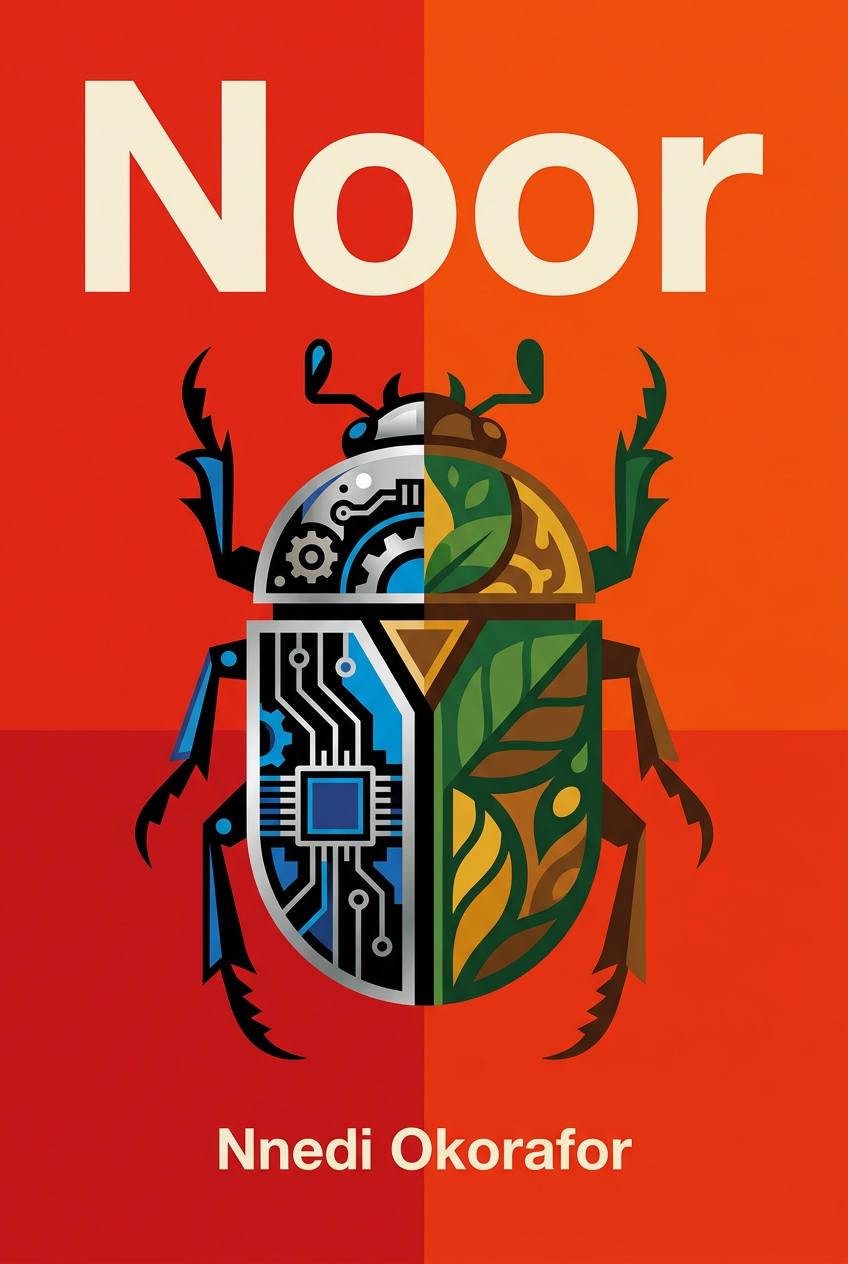
Noor book cover

The Script

You are walking down a crowded market street, the air thick with the scent of spices and exhaust. A vendor calls out, offering you a piece of fruit. A child runs past, bumping your leg. Your phone buzzes in your pocket. Each of these things—the smell, the sound, the touch, the vibration—is a piece of information. Your mind sorts it all instantly: fruit is a polite refusal, the bump is an accident, the buzz is a notification to check later. This seamless integration is the quiet miracle of being human. But what happens when the information comes from a source that isn't you? What if one of your arms, the one that can hack an ATM with a gesture, isn't the one you were born with? What if your legs, augmented for speed, send you data streams about wind resistance and terrain stability? At what point does the incoming flood of information stop being a part of you and start feeling like an invasion? When your own body becomes a network of organic and artificial inputs, who gets to decide what is a signal and what is just noise?

This question of where the self begins and technology ends is a landscape Nnedi Okorafor has been exploring her entire life. Growing up as a Nigerian-American, she navigated the space between two distinct cultures, learning to integrate different worlds. This feeling was amplified by her own physical transformation. A talented athlete, Okorafor suffered a spinal injury during surgery that left her paralyzed from the waist down. During her recovery, she began to write, channeling her experience of a body that suddenly felt alien and technologically mediated into stories. Her work, including the novel "Noor," is a deeply personal inquiry born from her journey of rebuilding a self from both biological and mechanical parts. She writes from the perspective of someone who has lived the fusion, exploring the messy, painful, and sometimes beautiful reality of becoming more than just one thing.

Module 1: The Augmented Self and the Unaugmented World

In "Noor," the line between human and machine is a battleground. The protagonist, AO, is an Autobionic Organism. She was born with severe physical defects. Cybernetic limbs, a 3D-printed lung, and neural implants gave her a functional life. Yet, this very functionality marks her as an outsider.

The first core idea is that societal acceptance of technology has a hard, unspoken limit. People accept a pacemaker. They accept a prosthetic limb. But AO has crossed an invisible threshold. She is "more machine than human." Religious leaders label her a demon. A friendly market vendor mutters curses about her under his breath. This is a daily reality backed by the threat of "jungle justice," where augmented people are attacked or killed on sight. Familiarity doesn't guarantee safety. Acceptance can vanish in an instant.

And here's the thing. AO's augmentations are a necessity. This brings us to a critical insight: True agency lies in defining your own identity, not conforming to others' expectations. When offered a "humanizing" skin-like covering for her robotic arm, AO refuses. She says, "I am part machine. I am proud to be part machine." She sees her body through the practical lens of a mechanic. If a part is broken, you replace it with something that works better. Her augmentations are an affirmation of her will to live, to function, to thrive. She refuses to apologize for the technology that keeps her alive.

This fierce independence sets the stage for the novel's central conflict. One day, in the market where she has worked for years, a group of men, agitated by anti-augmentation rhetoric, attack her. No one helps. The social contract she thought she had is instantly voided. In this moment, she makes a choice. This leads to our final point in this module: In the face of oppression, survival demands rejecting victimhood and asserting your right to exist. AO fights back with lethal force. This act shatters her personal code of "do no harm" but solidifies her will to live. She is no longer just a mechanic or a woman with augmentations. She is a survivor on the run, a fugitive from a world that fears what she represents.

We've just seen how personal identity clashes with social reality. Now, let's explore the massive forces that shape that reality.

Module 2: The Unholy Trinity of Nature, Technology, and Corporate Power

"Noor" presents a world shaped by three immense, interlocking forces. First, the natural world, embodied by a massive, perpetual sandstorm called the Red Eye. Second, technology, represented by the colossal wind turbines called Noor. Third, corporate power, in the form of the omnipresent Ultimate Corp.

The environment itself is a paradox. The same force that destroys can also be a source of immense power. The Red Eye is a killer. It's a storm so vast and violent it can clog your lungs and kill you in minutes. Yet, it's also where Ultimate Corp places its Noor turbines. These towering helical structures harvest the storm's fury, turning a natural disaster into a source of clean energy. The author calls this a "poetic but monstrous irony." People have even adapted to live inside the storm's belly, using their own tech to survive. It's a powerful metaphor for how humanity persists, even in the most hostile conditions.

But who controls this power? This introduces the next major theme. Unchecked corporate power exploits both people and the environment under the guise of progress. The locals call the Noor turbines "evil things." They generate energy for an "evil corporation." Ultimate Corp is everywhere and nowhere. No one knows where it's based. It provides cheap goods, sponsors education, and owns vast tracts of land. It has made itself indispensable. AO herself admits she relied on them for cheap parts. The corporation's public face is one of benevolence and family. But its hidden reality is one of exploitation. It pushes people off their ancestral lands by declaring them "useless" and then monetizes them. It creates a dependency so deep that even those who hate it continue to work for it and buy from it.

So what happens next? A crisis forces our protagonist to flee into the heart of this system. After the market violence, AO drives north, straight toward the Red Eye. Her journey is both a physical escape and a psychological reckoning. Here we see that a journey into a harsh landscape mirrors the internal journey toward self-discovery. The roads are crumbling. The landscape is arid and desolate. Her car, her technology, eventually fails her. She is left to walk into the desert on her bionic legs, a perfect fusion of human will and technological endurance. It is in this desolate space, stripped of everything, that she finally confronts the trauma she has caused and endured. Her escape is from the person she used to be and the law itself.

We have established the individual and the systemic pressures. The next module explores how these forces collide to create a new form of existence.

Read More