All Books
Self-Growth
Business & Career
Health & Wellness
Society & Culture
Money & Finance
Relationships
Science & Tech
Fiction
Topics
Blog
Download on the App Store

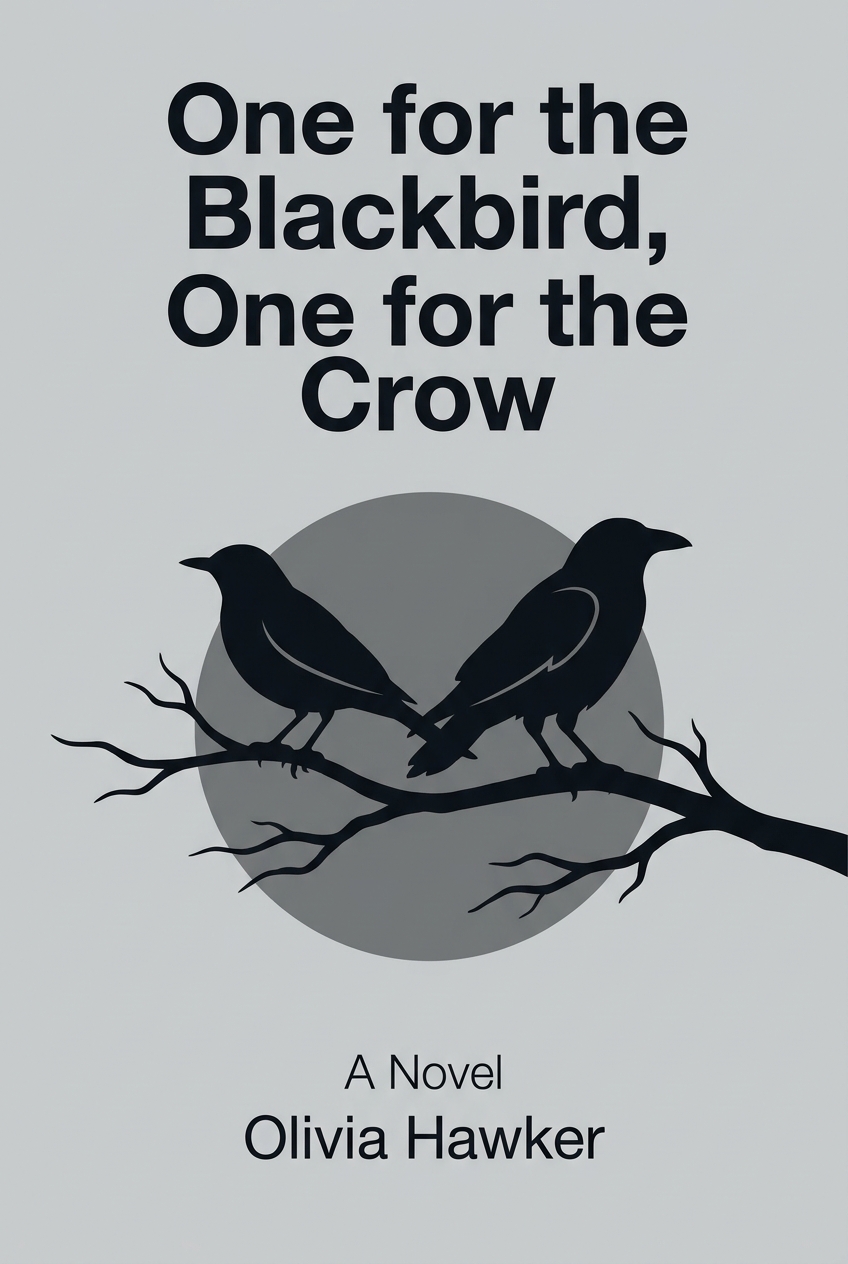
One for the Blackbird, One for the Crow

A Novel

16 minOlivia Hawker

What's it about

Can you forgive the unforgivable? In the harsh Wyoming wilderness of 1876, two families are torn apart by a terrible crime. Now, with their husbands gone, two rival women must find a way to survive the brutal winter together, forcing an unlikely and dangerous alliance. Discover how these isolated women—one a grieving widow, the other an outcast wife—navigate the complexities of mercy, survival, and motherhood. You'll explore their fragile truce as they confront shared hardship, buried secrets, and the unexpected bonds that form in the face of profound loss.

Meet the author

Olivia Hawker is a Washington Post bestselling author and a finalist for the Washington State Book Award and the Willa Literary Award for Historical Fiction. Residing in the San Juan Islands, she is deeply inspired by the rugged beauty and pioneer history of the American West. This connection to the landscape and its past inhabitants infuses her novels, including One for the Blackbird, One for the Crow, with a profound sense of place, resilience, and the enduring strength of the human spirit.
Listen Now

Opens the App Store to download Voxbrief

One for the Blackbird, One for the Crow book cover

The Script

In the vast, unforgiving landscapes of the American West, a fence line wasn't just a boundary; it was a declaration. On one side lived your world—your family, your livestock, your future. On the other side lived everyone else. But what happens when that line is violently erased? What happens when a man from one side of the fence commits an unforgivable act against the family on the other, and then vanishes, leaving his own wife and children to face the consequences? The two families, now bound by a terrible crime, are left with an impossible choice. They can either retreat into their separate griefs and starve through the coming winter, or they can cross the blood-stained boundary and forge a fragile, terrifying alliance for survival.

This is a story of necessity, of two women—one a new widow, the other the wife of a murderer—forced to share a single hearth, a single harvest, a single roof against the brutal Wyoming winter. Every shared meal is a reminder of the life that was stolen. Every chore done together is an act of gritted-teeth cooperation. Can a community of two be built from the ashes of such a profound wrong? Can human connection take root in soil salted by betrayal and loss, out of the sheer, stubborn will to live until spring?

This exploration of survival in the wake of tragedy comes from a writer who is intimately familiar with the landscapes of the American West. Olivia Hawker, a resident of the San Juan Islands, has built her career on excavating the human heart from the annals of history. She was drawn to this particular story by a fascination with the small, unrecorded histories of women on the frontier—the stories that don't appear in official records but were lived in the quiet, desperate moments between planting and harvest, birth and death. For Hawker, the question centered on the emotional truth of what it takes to survive the unsurvivable, and how human beings might find a way forward by being forced to live with the past's consequences every single day.

Module 1: The Weight of Unchosen Responsibility

The story opens with a gunshot. It’s an event that cracks the world open for two families. For the children, especially, it marks the end of childhood. They are immediately saddled with duties far beyond their years. It's a sudden, brutal thrust into adulthood.

The first core insight is that tragedy accelerates maturity, forcing children into adult roles. We see this most clearly with thirteen-year-old Beulah Bemis. The moment she hears the shot that kills Substance Webber, she acts. She doesn't cry. She doesn't panic. She secures her younger siblings. She prepares the horse for her father's escape. She understands instinctively that survival now depends on practicality, not emotion. Her father reinforces this, giving her a rifle and the responsibility to care for the family. In a single afternoon, she becomes the anchor.

Similarly, on the other side of the conflict, sixteen-year-old Clyde Webber faces his own trial. After his father is killed, there is no one to bury him. The nearest neighbor is twenty miles away. The sheriff is days away. So Clyde, a boy of sixteen, must dig his father's grave and bury the body himself. He fights back tears, feeling the shame of a grief he believes a man shouldn't show. The weight of his father's body is more than a physical burden. It’s the weight of premature manhood.

This brings us to a critical point. In extreme hardship, survival demands action, not emotional processing. Both Beulah and Clyde suppress their grief. They have to. The farm must run. The animals need tending. The seasons don't stop for human sorrow. Clyde knows the corn must be harvested, even if it’s on the land of the man who killed his father. He shows up to help Beulah out of a shared, unspoken understanding. Waste is a sin the prairie does not forgive. Their parents are paralyzed by grief and rage, but the children understand that the land demands work.

And here’s where we see the true cost. This forced maturity creates a deep, isolating internal conflict. Clyde is haunted by his father’s abusive legacy. He hears his father's voice in his head, mocking any sign of softness or compassion as "womanish." He fears becoming the hard, cruel man his father was. Yet, he also feels the pull of duty. Beulah, meanwhile, carries the family with a quiet competence that unnerves the adults around her. She seems to have an almost mystical connection to the land, an intuitive knowledge that transcends rational thought. But this wisdom sets her apart. It makes her seem strange, "unnatural" to those who don't understand it. These children are carrying the emotional weight for everyone, and it isolates them completely.

Module 2: The War of the Matriarchs

With the men gone—one dead, one jailed—the conflict shifts to the two women left behind. Nettie Mae Webber, the grieving widow. And Cora Bemis, the wife of the killer. When winter looms, Cora is forced to do the unthinkable. She walks to Nettie Mae's home and begs for help. This sets the stage for a tense, bitter cohabitation, where two opposing worldviews collide under one roof.

First, we see that in the wake of betrayal, grief hardens into a weapon. Nettie Mae’s anger becomes the engine that drives her. She feels her grief is more legitimate than Cora’s. When Cora cries, Nettie Mae thinks, "It was Nettie Mae who ought to cry—she who had a right to tears." She refuses Cora's apology and initially denies her aid. This resentment is her fuel. She believes she needs its heat to survive. Forgiveness feels like a weakness she cannot afford. It would mean extinguishing the very fire that keeps her moving.

On the other side of this is Cora. She’s not just dealing with the consequences of her husband’s actions, but with her own role in them. Her affair with Substance Webber, Nettie Mae’s husband, was the catalyst for the murder. This leads to the next insight: guilt can be a paralyzing force, leading to complete withdrawal. For days, Cora is catatonic. She wraps herself in a blanket and sits, unable to care for her children or herself. She is trapped in a mental loop, replaying the moment of Substance's death. She knows she ruined multiple lives, as she puts it, "for nothing." Her affair was a desperate escape from the loneliness of prairie life. And the consequences have crushed her.

So what happens when these two women are forced together? A fragile, resentful alliance forms, driven by necessity. Survival on the frontier demands pragmatic cooperation over personal animosity. Nettie Mae, seeing her own son Clyde weakened by illness and overwork, finally agrees to let the Bemis family move in. But it’s on her terms. Her house, her rules. The air crackles with tension. Nettie Mae sees Cora’s attempts at conversation as a sign of weakness. She interprets every action through the lens of moral judgment, even condemning the way Cora’s children are raised.

And this is where the dynamic gets really interesting. Nettie Mae’s bitterness creates an environment of silent, oppressive rules. She forbids Cora from bringing her prized possessions, like her loom or her fine china. It’s a petty assertion of power, a way to continually punish Cora. Cora, in turn, accepts this with a quiet submission that masks a fierce, secret resolve. She endures the humiliation because she has a plan: escape to Saint Louis in the spring. This dynamic of control and submission, of public resentment and private hope, defines their relationship for the long, cold winter. They are two queens ruling over a fractured kingdom, bound together by a shared, miserable fate.

Read More