All Books
Self-Growth
Business & Career
Health & Wellness
Society & Culture
Money & Finance
Relationships
Science & Tech
Fiction
Topics
Blog
Download on the App Store

Origins of The Wheel of Time

The Legends and Mythologies that Inspired Robert Jordan

13 minMichael Livingston

What's it about

Ever wonder how Robert Jordan built one of fantasy's most epic worlds? Go behind the scenes of The Wheel of Time and discover the real-world myths, legends, and historical events that Jordan masterfully wove into his iconic series, from the first spark of an idea to the final turning of the Wheel. You'll explore the fascinating connections between characters like Rand al'Thor and figures from Norse and Arthurian legend. Uncover the ancient philosophies that shaped the Aes Sedai, and see how Jordan transformed familiar stories into a rich, original tapestry that continues to captivate millions.

Meet the author

Michael Livingston is a professor of medieval literature at The Citadel and a consultant handpicked by Robert Jordan’s own team to write this authorized guide. His deep academic expertise in history and mythology, combined with his lifelong passion for The Wheel of Time, gave him the unique perspective needed to uncover the real-world legends woven into the series. Livingston’s work provides a definitive look into the mind and inspirations of a fantasy master, bridging the gap between our world and Jordan’s.
Listen Now

Opens the App Store to download Voxbrief

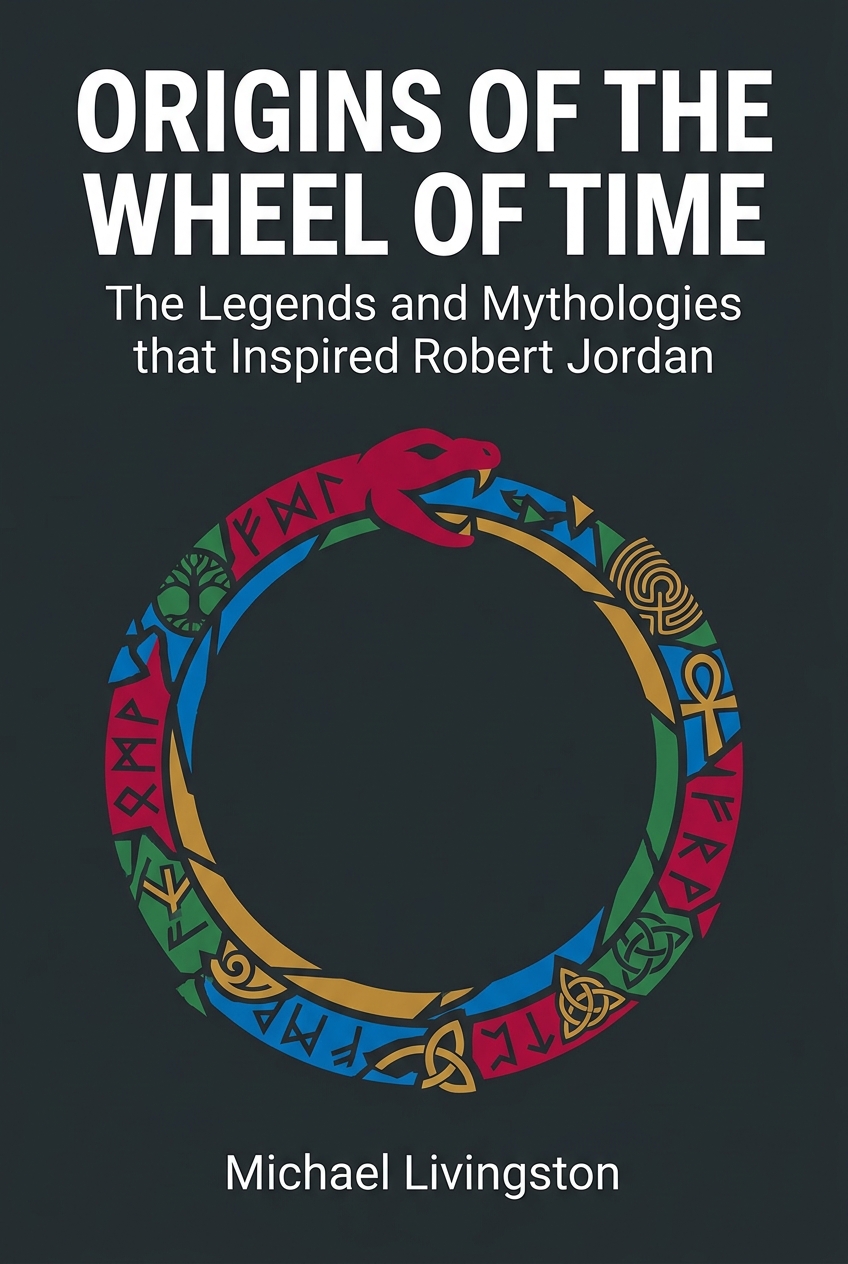
Origins of The Wheel of Time book cover

The Script

A master craftsman stands before a great, unfinished tapestry. The central figures are bold and clear—a shepherd with a heron-marked sword, a young queen, a gleeman with his harp. But around the edges, the threads are a chaotic tangle. One thread, a deep indigo, seems to come from an ancient Irish myth. Another, the color of sun-baked earth, feels drawn from a distant desert legend. A glint of silver might be a piece of Arthurian lore, while a strand of crimson echoes a forgotten battle from the Napoleonic Wars. The craftsman was a weaver, meticulously gathering these disparate threads from history, mythology, and language, spinning them together to create something new, yet profoundly familiar.

For decades, fans of Robert Jordan's The Wheel of Time have tried to untangle these threads, to trace them back to their source. Michael Livingston is one of them, but with a unique advantage. A professor of medieval literature and a military historian, Livingston spent years immersed in the same foundational texts that inspired Jordan. Then, he was granted unprecedented access to Jordan's personal archives—his notes, his drafts, his private letters. This book is the result of that journey. It is the first and only authorized look into the workshop of a master storyteller, revealing precisely how he wove his source threads together to create a world that would capture the imaginations of millions.

Module 1: The Man Behind the Myth

Before Robert Jordan the author, there was James Rigney the man. Understanding his life is the key to unlocking the core themes of The Wheel of Time. His experiences were the raw material he forged into his epic.

First, Jordan’s character was forged by hardship and a powerful moral code. He grew up "real poor" in Charleston, South Carolina. His father was his idol, a man of immense integrity who worked multiple jobs and refused to compromise his ethics. This instilled in Jordan core values that echo throughout his books: honesty, keeping your word, and striving to be the best. His characters constantly grapple with the weight of duty and the cost of power, a direct reflection of the principles he learned as a boy.

Furthermore, his service in the Vietnam War was a crucible that shaped his worldview. Jordan served two tours as a helicopter door gunner. He saw the brutal reality of combat. He knew what it felt like to kill and to be targeted. This experience became a direct source for his writing. There is a haunting scene where the protagonist, Rand, memorizes the face of a woman he has killed. Jordan later revealed this was based on his own experience of shooting a female combatant, an act that violated his personal code and stuck with him for life. This brutal authenticity gives his depiction of war a weight rarely seen in fantasy.

Finally, Jordan’s path to becoming a fantasy author was unconventional and disciplined. After Vietnam, he studied physics and became a nuclear engineer for the U.S. Navy. A career-ending injury forced him to pivot. Frustrated with the books he was reading, he decided to write his own. He approached writing with the same systematic rigor as an engineer. He worked 12-hour days, seven days a week, and maintained tens of thousands of pages of notes on everything from crop cycles to the texture of tree bark. This meticulous process allowed him to build a world of staggering complexity and internal consistency. He was constructing a reality.

Read More