Orlando
What's it about
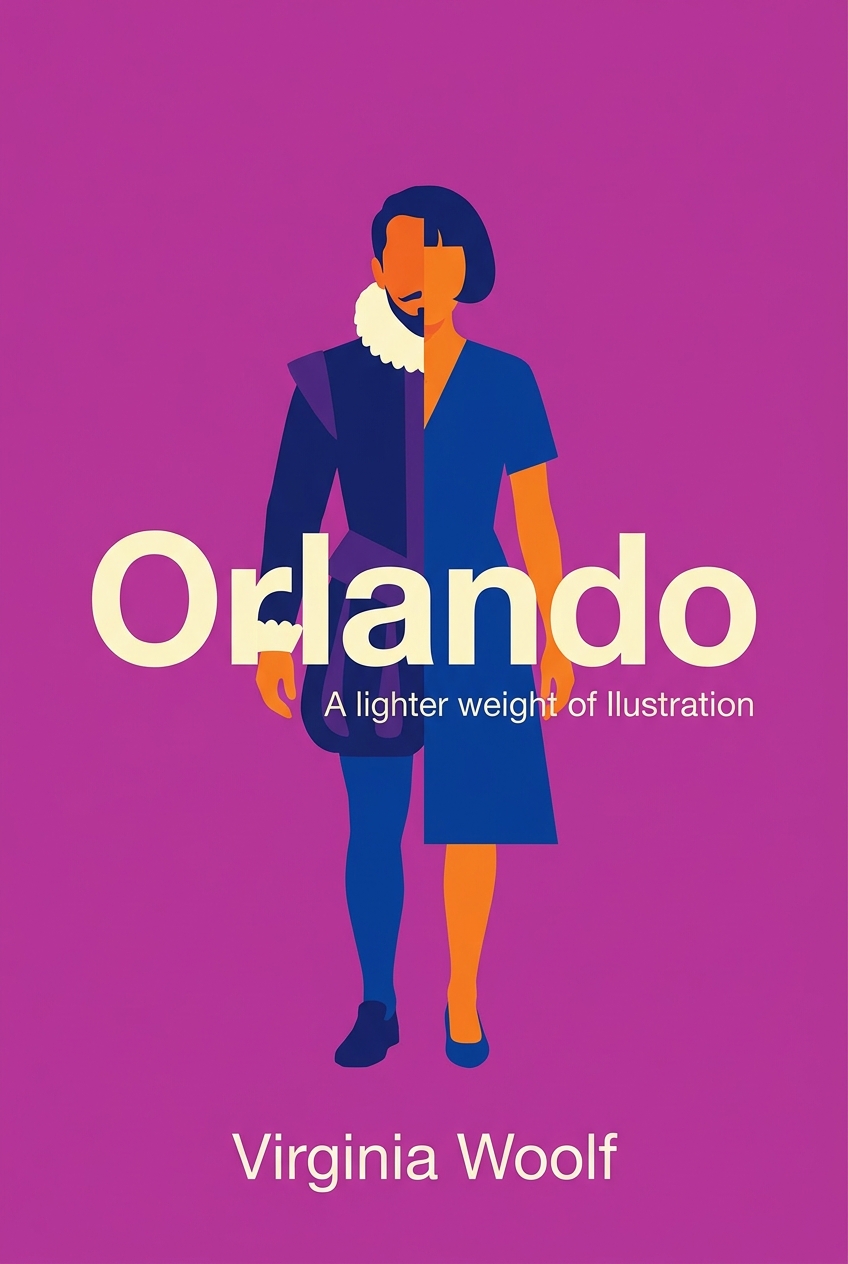
Have you ever felt trapped by the boxes society puts you in? Discover a story that shatters the rules of time, gender, and identity. Follow the incredible journey of a young nobleman who lives for centuries and magically transforms from a man into a woman. This isn't just a fantasy; it's a revolutionary exploration of what it truly means to be you. Through Orlando's adventures as a poet, lover, and diplomat across different eras, you'll uncover timeless insights into how our world shapes who we are and how we can find freedom by embracing every part of ourselves.
Meet the author
Virginia Woolf was a central figure of the Bloomsbury Group and one of the most important modernist writers of the 20th century, pioneering the use of stream of consciousness. Born into a prominent intellectual family, she pushed literary boundaries to explore the inner lives of her characters with profound psychological depth. Her own experiences with societal constraints and personal struggles informed her innovative narrative style, culminating in works like Orlando that challenge conventional ideas of time, gender, and identity with groundbreaking artistry.
Opens the App Store to download Voxbrief

The Script
In 2021, the actor Elliot Page stood on the cover of Time magazine, a cultural landmark moment that felt both revolutionary and deeply personal. It was a public declaration of a private truth, an alignment of his external self with an internal identity that had always been there. The world saw a transformation, but for Page, it was an arrival—a step into the person he was meant to be all along. This kind of public, personal evolution, navigating the complexities of gender, identity, and the story we tell the world about ourselves, is one of the most profound narratives of our time. It forces us to ask: how much of who we are is fixed, and how much is a performance we refine over a lifetime? What does it mean to live through centuries of change while the core of your being remains a constant, searching for its true expression?
This very question—about the fluid, enduring nature of identity across time—was the puzzle that consumed Virginia Woolf in the late 1920s. She was a central figure in the Bloomsbury Group, a circle of intellectuals who lived and loved with a flagrant disregard for the rigid social and gender conventions of their era. Woolf wrote 'Orlando' as a playful, fantastical love letter to her dear friend and lover, Vita Sackville-West, an aristocratic writer whose own life was a tapestry of public roles and private passions, defying easy categorization. By creating a hero who lives for centuries and changes gender halfway through, Woolf was crafting a dazzling, epic fable to explore the very essence of a soul unbound by the constraints of a single life, a single gender, or a single moment in history.
Module 1: The Elusive Self and the Performance of Identity
Our journey begins with a young nobleman in Elizabethan England. His name is Orlando. He's sixteen, passionate, and already wrestling with the world. He loves solitude, vast landscapes, and the feeling of being utterly alone. But he also exists in a world of performance, especially at the court of Queen Elizabeth I. This sets up our first major insight.
Social identity is a performance constructed from fragments. When Orlando kneels before the Queen, he's too shy to look up. He sees only her hand in a bowl of rosewater. From that single hand, he deduces her entire character. He imagines a commanding presence, an old body, a powerful ruler. In return, the Queen sees only his bowed head and curly hair. From this, she invents an entire person. She imagines his fine legs, his loyal heart, his manly charm. Neither sees the whole person. They see a sliver and project a story onto it. This is how society often works. We are perceived in glimpses, and those glimpses become our reputation.
From this foundation, we see how our environment shapes this performance. The Elizabethan age itself was a time of violent extremes. Woolf describes it with incredible force. The sun blazed or there was darkness. The rain fell vehemently or not at all. Love was all-consuming, and heartbreak was absolute. This era of intensity molds Orlando's character. His impulsive actions and passionate declarations are a reflection of the very air he breathes. The spirit of an era dictates the rules of our personal drama. You can’t understand a person without understanding their time.
And here's the thing. This performance of self is most tested in love. Orlando falls for a mysterious Russian princess named Sasha. He is captivated by her foreignness. He can’t quite place her. At first, he even mistakes her for a boy. Their entire romance is built on this ambiguity and exotic allure. They speak French, a private language that isolates them from the English court and fuels scandal. But this mystery is also a wall. He never truly knows her. He senses something hidden, something concealed. Profound attraction is often fueled by the mystery of the other, but this same mystery prevents true connection. His love is based on a projection, an idea of Sasha, not the real person.
This all comes crashing down during the Great Frost. The frozen River Thames, once a solid playground for a winter carnival, suddenly thaws. The ice breaks. The entire city built upon it collapses into turbulent, yellow water. This physical chaos perfectly mirrors Orlando’s emotional collapse. Sasha fails to show up for their planned elopement. He sees her ship sailing away. His romantic dream is shattered, just as the ice is shattered. Our sense of certainty, whether emotional or social, is incredibly fragile and can collapse in an instant. The solid ground we build our lives on is often just a thin layer of ice. We perform our identities, we live by the rules of our age, and we project stories onto others. But reality can, and will, break through.
Module 2: The Inner World of the Artist
After Sasha's betrayal, Orlando is plunged into a deep, week-long sleep. When he awakens, his memory is blurred. The sharp edges of his pain are gone. This introduces a fascinating idea about how we heal. Woolf suggests that profound trauma can be processed through a psychological reset, a kind of temporary death that dulls the past. This trance-like state is a remedial measure. It allows the mind to brush a dark wing over its most galling memories, softening them and allowing life to continue.
Freed from the immediate pain, Orlando retreats into solitude. And this is where his true artistic journey begins. He becomes obsessed with a new kind of "disease." A deep passion for literature is a consuming infection that detaches you from the material world. When Orlando reads, his vast house, his possessions, his titles—they all turn to mist. They evaporate. The phantom world of words becomes more real than reality itself. This "disease" of reading soon gives way to the "other scourge": the compulsion to write.
Now, let's turn to the creative struggle itself. Orlando vows to become a great poet, to achieve a kind of immortality his warrior ancestors never could. But he quickly learns that this is no easy feat. The creative process is an agonizing internal battle, marked by ecstasy, despair, and constant revision. He writes, and it seems divine. He reads it back, and it seems vile. He tears it up. He starts again. He can't decide if he's a genius or a fool. This vacillation is the true work of the artist. It's a struggle far more arduous than any physical combat.
But flip the coin. What happens when the artist seeks validation from the outside world? Orlando invites a well-known poet, Nick Greene, to his home. He hopes for mentorship, for a connection with a fellow artist. Instead, he gets a bitter, jealous man who complains that the art of poetry is dead. After enjoying Orlando's hospitality, Greene goes home and writes a vicious satire, mocking Orlando and his work. This betrayal leads to a profound realization. Idealized notions of the literary world often shatter upon contact with its petty, human realities. The pursuit of fame can be a trap.
Consequently, Orlando makes a radical choice. He burns most of his manuscripts. He rejects the world of men and public acclaim. True creative freedom is often found in obscurity. He declares that fame constricts the mind, while obscurity wraps around you like a mist, letting your thoughts take their own course. He finds peace in anonymity, in connecting with simple, enduring things like his dog and the nature on his estate. He gives up the desire to be a famous poet and instead focuses on the work itself, for its own sake. This shift from external validation to internal satisfaction is a critical turning point in his four-hundred-year life.