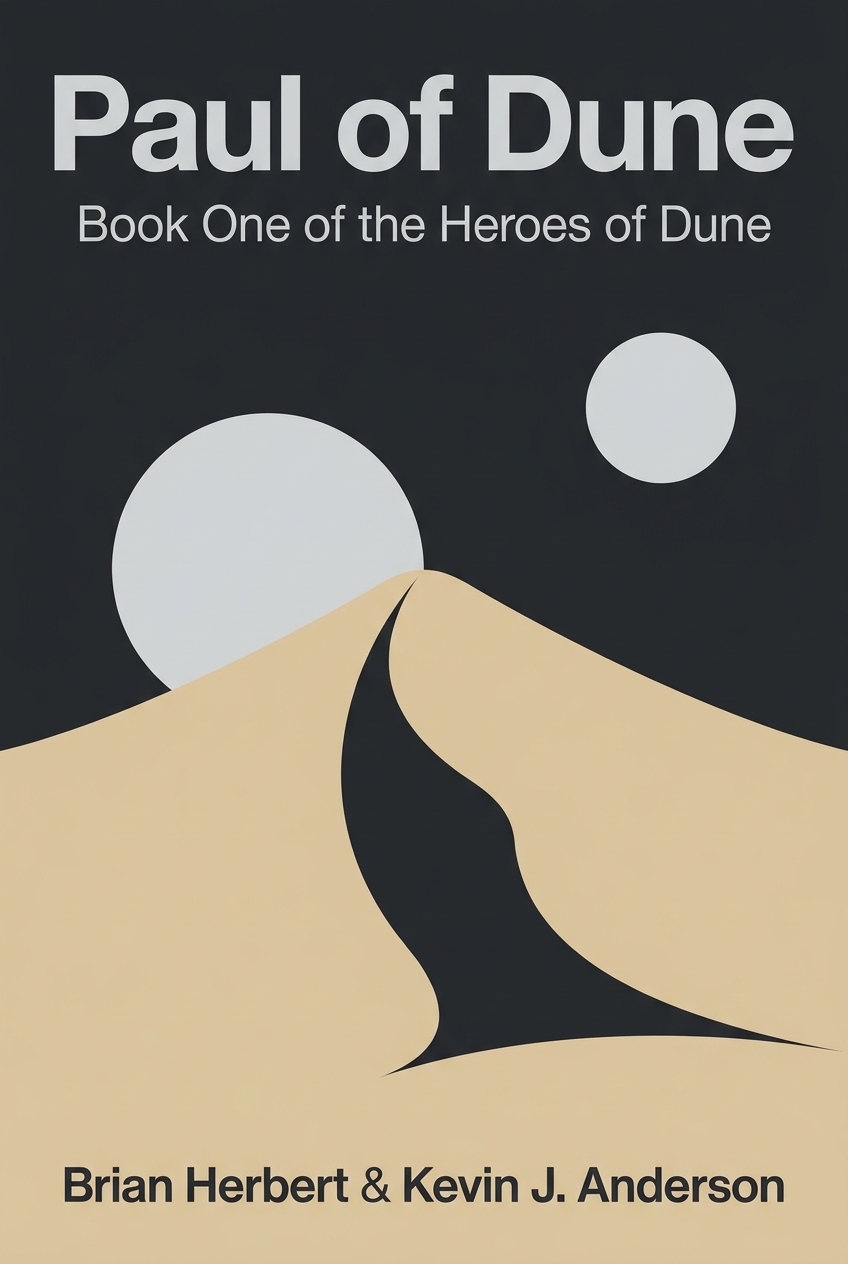
Paul of Dune
Book One of the Heroes of Dune
What's it about
Ever wondered what truly forged Paul Atreides into the messiah, Muad'Dib? Discover the untold story of the years between Dune and Dune Messiah, a time filled with rebellion, holy war, and the immense burdens of godhood that threatened to crush the new Emperor. Uncover the secrets of the Fremen jihad that swept across the galaxy in your name. You'll witness Paul's struggle to control a religious empire spiraling out of his grasp while flashing back to his youth and the vital lessons that shaped his legendary, tragic destiny.
Meet the author
Brian Herbert, the eldest son of legendary science fiction author Frank Herbert, and Kevin J. Anderson, a multiple New York Times bestselling author, have co-authored over a dozen Dune novels. Drawing upon Frank Herbert's own extensive notes left behind after his death, they have meticulously expanded the universe he created. This unique access and deep dedication allow them to authoritatively continue the epic saga, exploring untold stories and pivotal moments within the rich tapestry of the Dune canon.
The Script
The young duke stands on a balcony, the wind carrying the scent of spice and blood. Behind him lies a conquered universe, a throne won through holy war and unimaginable slaughter. Yet, when he looks forward, he sees an endless corridor of terrible purpose, a future he is doomed to fulfill. He is the most powerful man alive, but he is also the most trapped. He has seen the countless futures branching from every choice, and knows that the only path to save humanity from extinction is one paved with his own monstrosity. He has become a god to escape a tyrant, only to find himself wearing a crueler crown.
This is the terrible paradox at the heart of Paul Atreides's victory at the end of Frank Herbert's original masterpiece, Dune. It’s a victory that feels more like a curse, a cliffhanger that leaves the reader wondering how the hero became the villain of his own story. For decades, this twelve-year gap between the end of Dune and the start of Dune Messiah remained a mystery, a dark period filled with unspoken atrocities and impossible choices. Frank Herbert’s own son, Brian Herbert, alongside acclaimed science fiction author Kevin J. Anderson, felt this same burning question. Drawing from Frank Herbert's extensive, unpublished notes for the original series, they embarked on a mission to complete a legacy, meticulously charting the brutal, heartbreaking years of Paul’s jihad and revealing the true cost of becoming the Kwisatz Haderach.
Module 1: The Architecture of Myth
The book’s first major insight is a masterclass in political branding. It reveals how Paul Atreides consciously and deliberately constructs his own legend. He understands that raw facts and logic don't move populations. Narratives do.
This begins with a simple act. Paul builds a shrine to his slain father, Duke Leto. He explicitly states they are "in the business of creating a myth." This is a foundational principle: leaders must actively shape their own public narrative to consolidate power and inspire mass movements. Paul recognizes that to unite a fractured galaxy, he needs more than military might. He needs a religion, and he is its living symbol.
This process, however, quickly spirals beyond his control. Paul's sister, Alia, notes that Paul "creates the legends himself, for his own purposes." But soon, a religious bureaucracy, the Qizarate, co-opts these symbols. A zealous commander named Korba replaces Paul's simple family shrine with a grand, ostentatious monument. The personal act of remembrance is institutionalized, amplified, and turned into a tool of the state. This demonstrates a critical lesson in leadership and scale. Personal symbols, once released into the public sphere, are inevitably co-opted and amplified by institutions. The founder of a movement rarely controls how their story is told by their most fervent followers.
So how can a leader manage this? The book suggests a degree of acceptance. Paul foresees this happening but feels powerless to stop it entirely. Princess Irulan, his political wife and historian, observes this process firsthand. She consciously crafts her official biography, The Life of Muad'Dib, as propaganda. She understands that myths are weapons. Her work, mass-produced and distributed across the empire, becomes the official story, spreading Paul's legend and legitimizing his holy war. Effective leaders leverage propaganda and storytelling as primary tools for unification and motivation. They hire the myth-makers and fund the distribution.