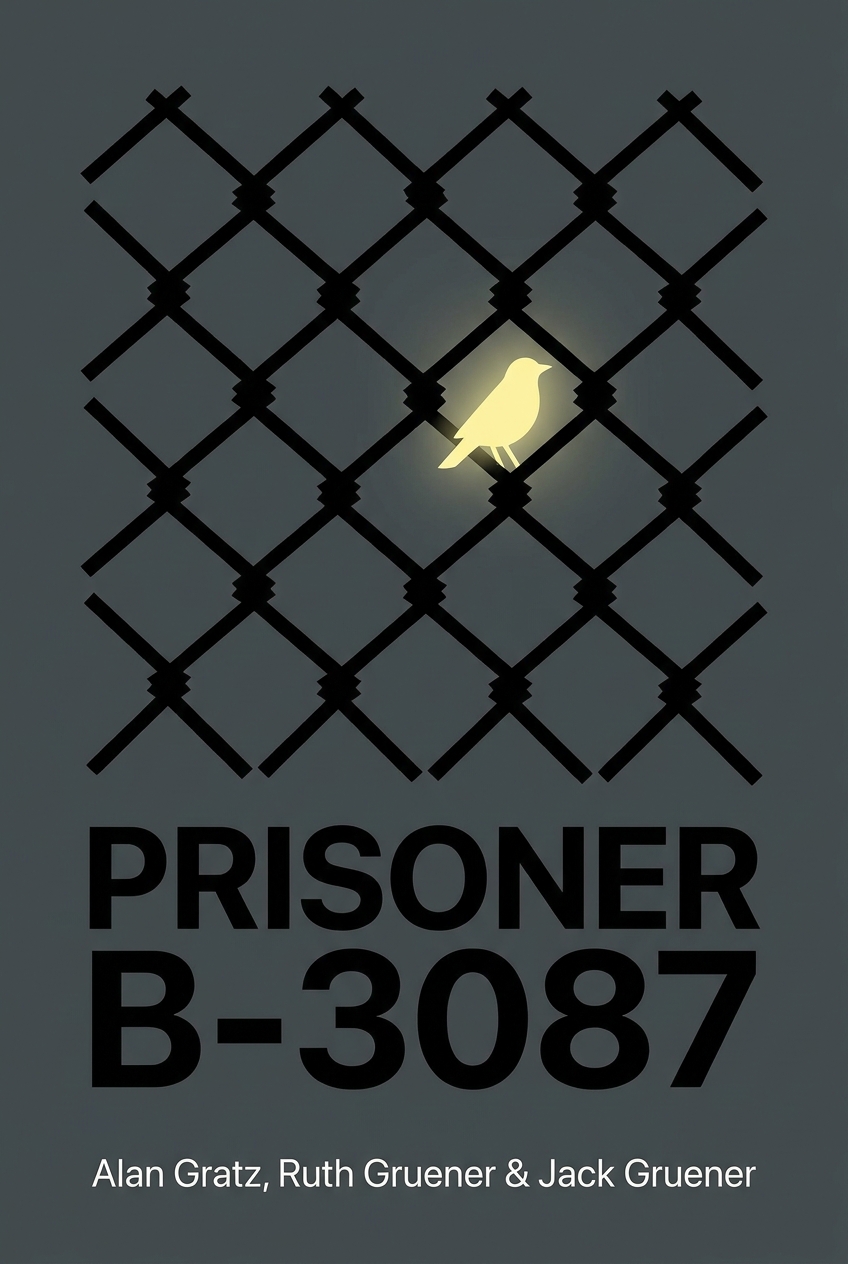
Prisoner B-3087
What's it about
Can you survive the unthinkable? Based on a true story, this summary reveals the harrowing journey of a young Jewish boy, Yanek, who is ripped from his home in Poland and forced to endure the horrors of ten different Nazi concentration camps. Discover the incredible resilience of the human spirit as Yanek faces starvation, brutality, and the constant threat of death. You'll learn how he uses his wits, courage, and a desperate will to live to navigate the unimaginable, holding onto a sliver of hope and his own identity in the face of pure evil.
Meet the author
Alan Gratz is the New York Times bestselling author of over twenty acclaimed books for young readers, celebrated for bringing history to life with gripping intensity. Inspired by the true story of Jack and Ruth Gruener, he collaborated with them to chronicle Jack's harrowing journey of survival through ten different concentration camps during the Holocaust. Their combined effort ensures that Jack's powerful testimony of resilience and hope in the face of unimaginable horror will never be forgotten by a new generation.
Opens the App Store to download Voxbrief

The Script
The human body has an astonishing capacity to heal. A broken bone knits itself back together, stronger at the point of the break. A cut on the skin triggers a complex cascade of cells to close the wound, leaving only a faint scar as a reminder. But what of the wounds that aren't visible? The ones inflicted not on flesh and bone, but on the spirit? Can a person endure an experience so horrific that their very identity is shattered into a thousand pieces, and still find a way to put themselves back together? Is there a limit to what a person can survive before the will to live itself becomes the final casualty?
This is the central, lived reality of Jack Gruener. For decades, the story of his survival through ten different Nazi concentration camps was a private one, a heavy weight carried in silence. His wife, Ruth, knew the fragments, the nightmares, and the quiet resilience of the man she loved. She understood that his experience was a testament to the human spirit that needed to be shared. Together, they decided to preserve this history, eventually collaborating with author Alan Gratz to give Jack’s experience a voice. The result, "Prisoner B-3087," is the careful, painful work of reassembling a life from the fragments left behind by unimaginable trauma, ensuring that the boy who was nearly erased would never be forgotten.
Module 1: The Systematic Erosion of Normalcy
The story begins with rules. Small, seemingly manageable changes that slowly dismantle a life. The protagonist, Yanek, is a boy in Kraków, Poland. He loves movies and dreams of America. Then the German occupation begins. The authors show how oppression starts with ink on paper before it escalates to physical walls.
First, his school is closed for good. Then, the newspaper publishes "New Rules for the Jews." No more parks. No more libraries. A nightly curfew is imposed. Oppression begins by methodically dismantling daily routines and civil rights. Yanek's father, a shoemaker, finds that his Polish and German customers no longer visit his shop. Ration cards are issued, marked with a "J" for Jew. These administrative acts are the first layer of control. They isolate a community, making them vulnerable. For us today, this is a stark reminder of how quickly societal norms can be unwound. It underscores the fragility of the systems we rely on.
Next, the narrative shows how these rules are enforced with brutal, public displays of force. When a synagogue is set on fire, a man runs outside after curfew to help. A German officer shoots him dead in the street. Rules are meaningless without enforcement, and terror is the most efficient enforcer. This single act transforms abstract decrees into a tangible, lethal threat. The message is clear: compliance is not optional. The penalty for defiance is death. This creates a powerful psychological shift. It moves the characters from a state of unease to one of constant, underlying fear.
And here's the thing. Amidst this escalating crisis, many cling to the familiar. Yanek's father insists the war will be over in six months. He tells his family to stay calm, to have faith. They try to live as though nothing has changed. Hope can become a psychological trap when it prevents you from seeing reality. This tension between hope and the grim evidence is a central conflict. While optimism is a powerful human instinct, the book shows its danger. It can delay necessary, difficult decisions. Yanek himself begins to doubt his father, a painful sign that the child is starting to see the world more clearly than the adult.
Finally, the social restrictions become physical. The Nazis construct a three-meter-high brick wall around the Podgórze neighborhood, creating the Kraków ghetto. The wall's caps are shaped like tombstones. Physical confinement is the final step in severing a community from the world. Non-Jewish Poles are forced out. Jewish families from all over the region are forced in. Yanek's family apartment, once home to three people, is now crammed with fourteen. Privacy is gone. Dignity is eroded. The ghetto is a tool of control, designed to concentrate, isolate, and weaken its population before the next, more horrific phase begins.