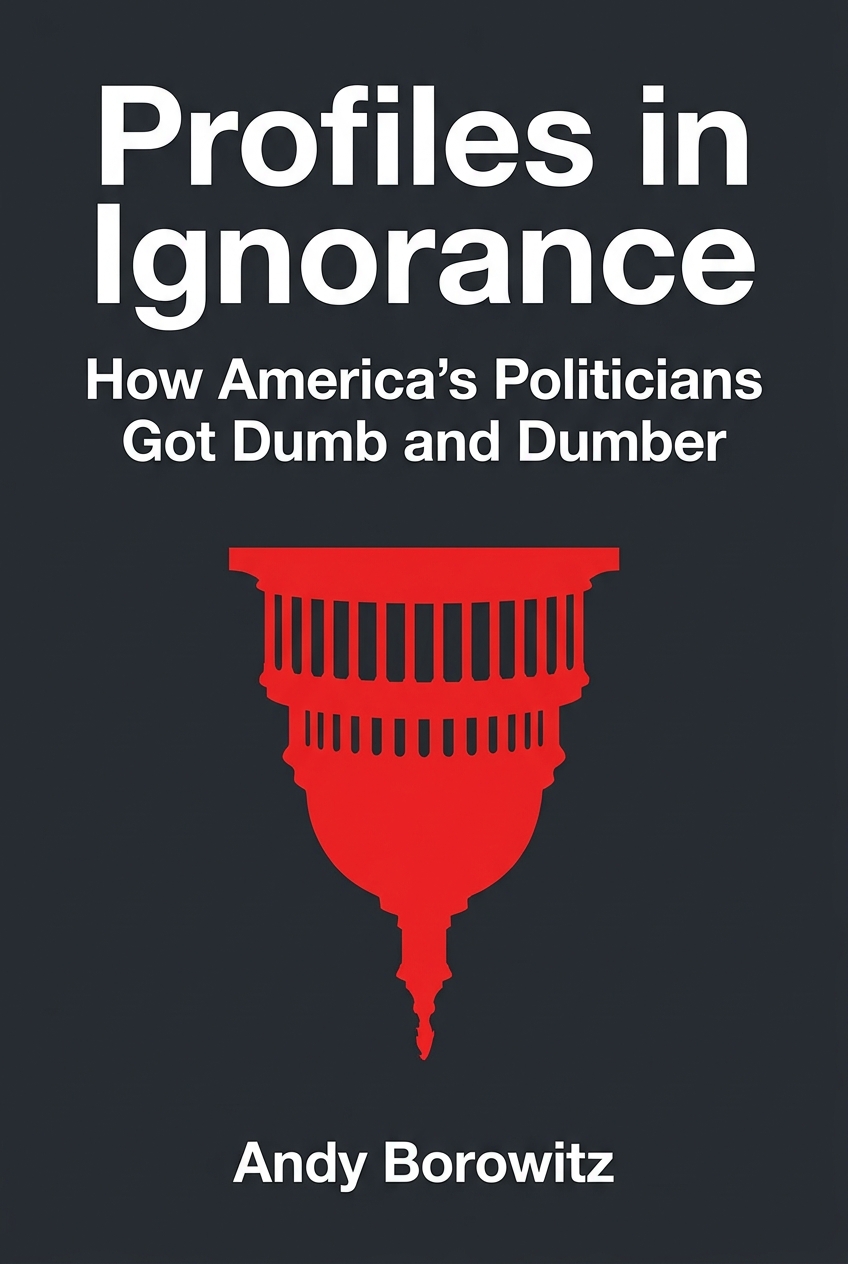
Profiles in Ignorance
How America's Politicians Got Dumb and Dumber
What's it about
Ever wonder why it seems like politicians are getting less and less informed? Get ready to explore how American political leaders went from intellectual powerhouses to celebrating their own ignorance, and what this alarming trend means for the future of the nation. This summary of Andy Borowitz’s sharp-witted analysis reveals the historical shift that made ignorance a political asset. You'll uncover the key moments and figures, from Reagan to Trump, that championed anti-intellectualism as a way to connect with voters. Learn how a nation founded by thinkers began to reward leaders for being proudly uninformed, and discover why this isn't just a punchline—it's a crisis.
Meet the author
Andy Borowitz is the creator of The Borowitz Report, a satirical news column that has been read by millions in The New Yorker since 2012. His unique position as one of America's leading political satirists gave him a front-row seat to the erosion of intelligence in Washington. For decades, he has used humor to chronicle the descent from statesmanship to showmanship, providing the sharp analysis and historical context that culminates in this definitive work on American political ignorance.
Opens the App Store to download Voxbrief

The Script
In the late 1990s, the comedy duo The Farrelly Brothers, fresh off the massive success of 'Dumb and Dumber' and 'There's Something About Mary,' were Hollywood royalty. They had a golden touch for creating characters whose complete lack of self-awareness was their most endearing, and hilarious, quality. Their films celebrated a certain kind of lovable doofus, a person so blissfully unaware of social cues and basic facts that they moved through the world with an odd, unearned confidence. This archetype—the charming simpleton—was a box office guarantee. The public couldn't get enough of watching someone confidently get everything wrong, from mistaking laxatives for breath mints to thinking a ski-lodge bartender in Aspen was named Lloyd Christmas.
The comedy worked because these characters were harmless fictions, confined to the movie screen. Their ineptitude affected only their immediate, farcical circle. But over the next two decades, something shifted. The lovable doofus archetype seemed to escape the multiplex and wander into positions of actual influence. The once-funny trait of proudly knowing nothing, of treating expertise with suspicion and facts as mere suggestions, started to look less like a gag and more like a genuine qualification for leadership. The joke, it turned out, was on us. This alarming migration of cinematic absurdity into public life is precisely what caught the attention of satirist Andy Borowitz. A longtime contributor to The New Yorker and the creator of the wildly popular satirical news column, 'The Borowitz Report,' he had spent years documenting this trend one headline at a time. He realized the phenomenon wasn't just a series of isolated incidents; it was a historical pattern deserving of its own chronicle. 'Profiles in Ignorance' is his effort to trace the lineage of this modern political strategy, showing how the celebration of not knowing became one of America’s most defining, and dangerous, characteristics.
Module 1: The Three Stages of Ignorance
Borowitz proposes a framework for understanding America's descent into ignorance. He calls it the "Three Stages of Ignorance." This is a predictable progression over the last half-century.
The first stage is Ridicule. Here, a politician's lack of knowledge was a liability. It invited mockery and could destroy a career. The quintessential example is Vice President Dan Quayle. His verbal stumbles were legendary. He once told the United Negro College Fund, "what a waste it is to lose one’s mind or not to have a mind is being very wasteful." In a debate, his attempt to compare his experience to John F. Kennedy's was shut down with the iconic line, "Senator, you're no Jack Kennedy." The public and media ridiculed him relentlessly. This mockery, like his infamous "potatoe" spelling error, defined his political life. In the Ridicule Stage, ignorance was a source of shame and political peril.
This brings us to the second stage: Acceptance. Here, the rules changed. Ignorance was no longer a fatal flaw. It was reframed as authenticity. It was proof that a politician was a "regular person," not an out-of-touch elite. George W. Bush mastered this stage. When a reporter stumped him with a pop quiz on foreign leaders, his team didn't apologize. They attacked the quiz. They argued a president shouldn't be a "Jeopardy contestant." The public agreed. Bush’s poll numbers went up. His perceived lack of knowledge made him relatable. Sarah Palin took this even further. She built her brand as a "hockey mom" who was proud of not being a policy wonk. In the Acceptance Stage, being uninformed became a strategic tool for connecting with voters. It was proof you were one of them.
And here's the thing. The final stage is Celebration. In this stage, ignorance is exalted. It becomes a requirement. A politician's rejection of facts, science, and expertise is seen as a sign of strength and defiance. Donald Trump is the book's primary example of this stage. He openly boasted about not reading briefing memos. He trusted his "gut" over the advice of generals and scientists. His supporters didn't just tolerate this; they cheered it. In the Celebration Stage, a leader's ignorance is a litmus test of loyalty. To prove you're part of the movement, you must embrace the "alternative facts." This stage also includes figures who blame wildfires on "Jewish space lasers." Their ill-informed views are a feature, signaling a complete break from the "establishment" and its reliance on reality.