All BooksSelf-GrowthBusiness & CareerHealth & WellnessSociety & CultureMoney & FinanceRelationshipsScience & TechFiction
Download on the App Store

Ringworld

12 minLarry Niven

What's it about

Ever wondered what lies beyond the known universe? Imagine a structure so vast it encircles a star, with more surface area than a million Earths. You're about to join a mission to explore this colossal, mysterious artifact, but you have no idea what dangers await. This journey will test your limits as you unravel the secrets of the Ringworld's forgotten engineers. You'll discover fallen civilizations, bizarre alien species, and the shocking truth behind its creation. Can you survive the unknown and uncover the ultimate cosmic mystery before it’s too late?

Meet the author

Larry Niven is a multiple Hugo and Nebula Award-winning master of hard science fiction, celebrated for his rigorously imaginative world-building in the groundbreaking novel, Ringworld. A trained mathematician, Niven applied his scientific background and boundless curiosity to envision vast, complex futures and alien societies within his "Known Space" universe. His work is defined by its grand scale, intellectual depth, and the seamless fusion of scientific principles with compelling human drama, inspiring a generation of readers and writers.
Listen Now
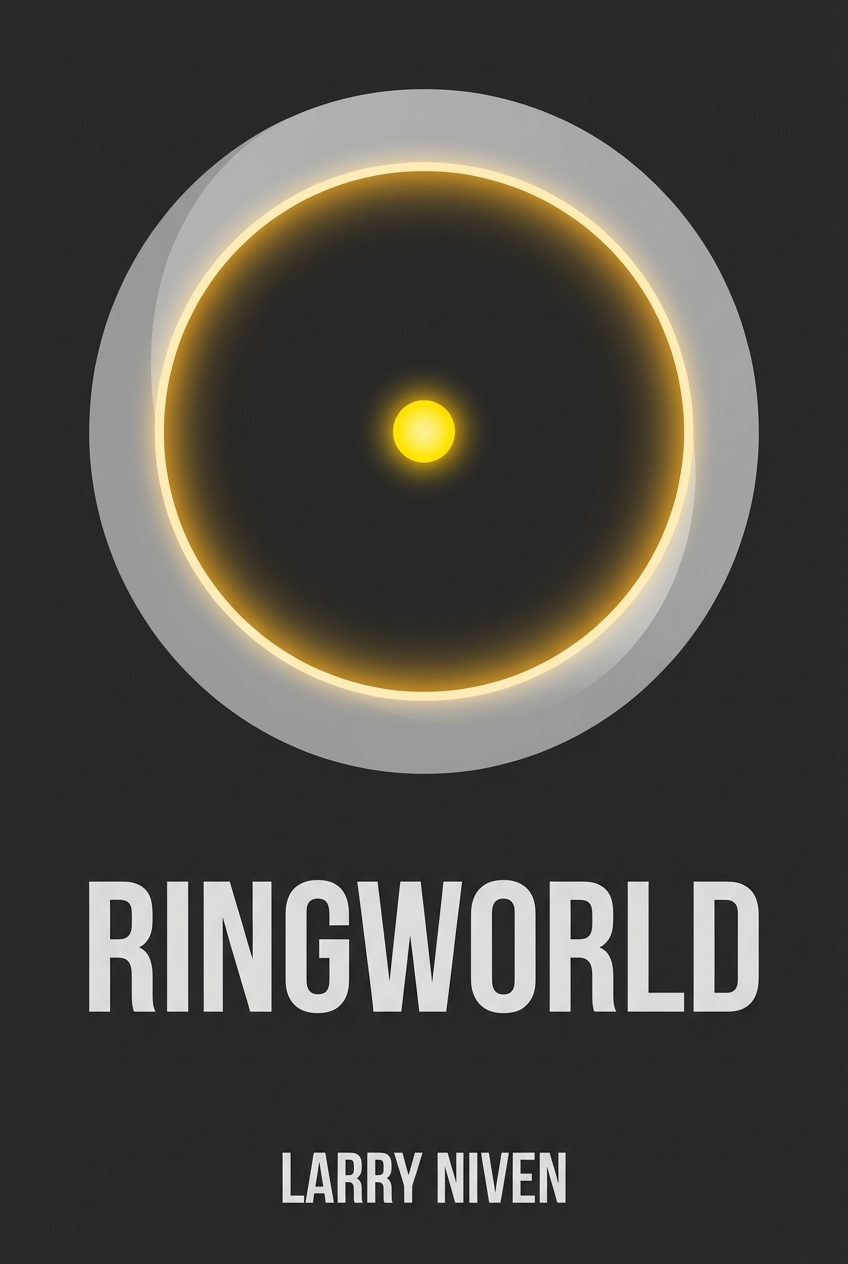
Ringworld book cover

The Script

We have an innate, almost primal, expectation that the universe should be efficient. Nature, we assume, doesn't waste resources. It builds stars, planets, and moons in the most economical shape possible: the sphere. A sphere encloses the most volume for the least surface area, a perfect expression of cosmic thrift. Any deviation from this seems like a flaw, an anomaly, a sign of something gone wrong. So what would it mean if we discovered an object so vast and so contrary to this rule that its very existence felt like an act of cosmic defiance? A structure that sacrifices all known principles of celestial efficiency for the sake of a single, audacious goal: maximizing habitable real estate. It's an idea that forces us to confront a startling possibility—that the universe might be governed by the will of beings who find the laws of physics to be mere suggestions.

This is the exact thought experiment that drove science fiction author Larry Niven. An established writer in the 1960s, known for his meticulously crafted 'Known Space' universe, Niven was fascinated by the concept of Dyson spheres—hypothetical megastructures built around stars to capture their energy. But he felt a full sphere was unstable and impractical. His solution was to take the core idea and re-engineer it. Instead of a sphere, what if you had a ribbon? A colossal ring, spun to create artificial gravity, with a surface area three million times that of Earth, all orbiting a single star. It was a concept born from a persistent engineering puzzle that played out in Niven's mind. He wanted to push the boundaries of 'Big Dumb Objects'—a term for awe-inspiring megastructures in sci-fi—and ground them in plausible, if mind-boggling, physics. The result was a 1970 novel that was a profound meditation on scale, ambition, and the ultimate limits of engineering.

Module 1: The Ultimate Engineering Project and Its Fatal Flaw

The book opens with a proposition. An alien species, the Puppeteers, needs a team for a mission. They assemble a crew of specialists, each an archetype of an extreme trait. Louis Wu is a 200-year-old human, profoundly bored and seeking the ultimate thrill. Nessus is a Puppeteer, a species defined by cowardice, yet he is considered insane by his own kind for taking risks. Speaker-To-Animals is a Kzin, a fearsome cat-like warrior. And Teela Brown is a young woman who possesses, quite literally, all the luck in the world. Their destination is the Ringworld.

The Ringworld itself is an engineering marvel. It's a solid, rotating band built around a star, with a surface area three million times that of Earth. It's a solution to overpopulation on a scale we can barely imagine. This introduces the first major insight: ambitious engineering must solve for fundamental stability, not just initial construction. The Ringworld uses centrifugal force for gravity. It has thousand-mile-high walls to hold in its atmosphere. It even has a system of orbiting "shadow squares" to create a day-night cycle. It seems perfect.

But here’s the problem. The Ringworld is not in a stable orbit. Any small nudge, like a meteor strike, could cause it to drift. Eventually, it would contact its sun and be destroyed. The builders, for all their genius, missed this. This leads to a critical lesson for any system architect. Your design is only as strong as its long-term failure modes. The Ringworld's builders solved for space, gravity, and atmosphere. They did not solve for orbital mechanics over millennia. They built a paradise with a hidden expiration date.

This brings us to a darker implication. What happens when a civilization builds something so grand it can't be maintained? The crew discovers the Ringworld is in a state of decay. Cities are abandoned. Infrastructure is failing. The descendants of the builders live in the ruins, having lost the knowledge of their ancestors. So, technological dependence without generational knowledge transfer leads to irreversible collapse. The Ringworld's inhabitants can't fix their world. They lack the resources and the understanding. The planet-sized artifact has become a planet-sized prison. They are trapped in paradise, a paradise that is slowly falling apart.

Read More