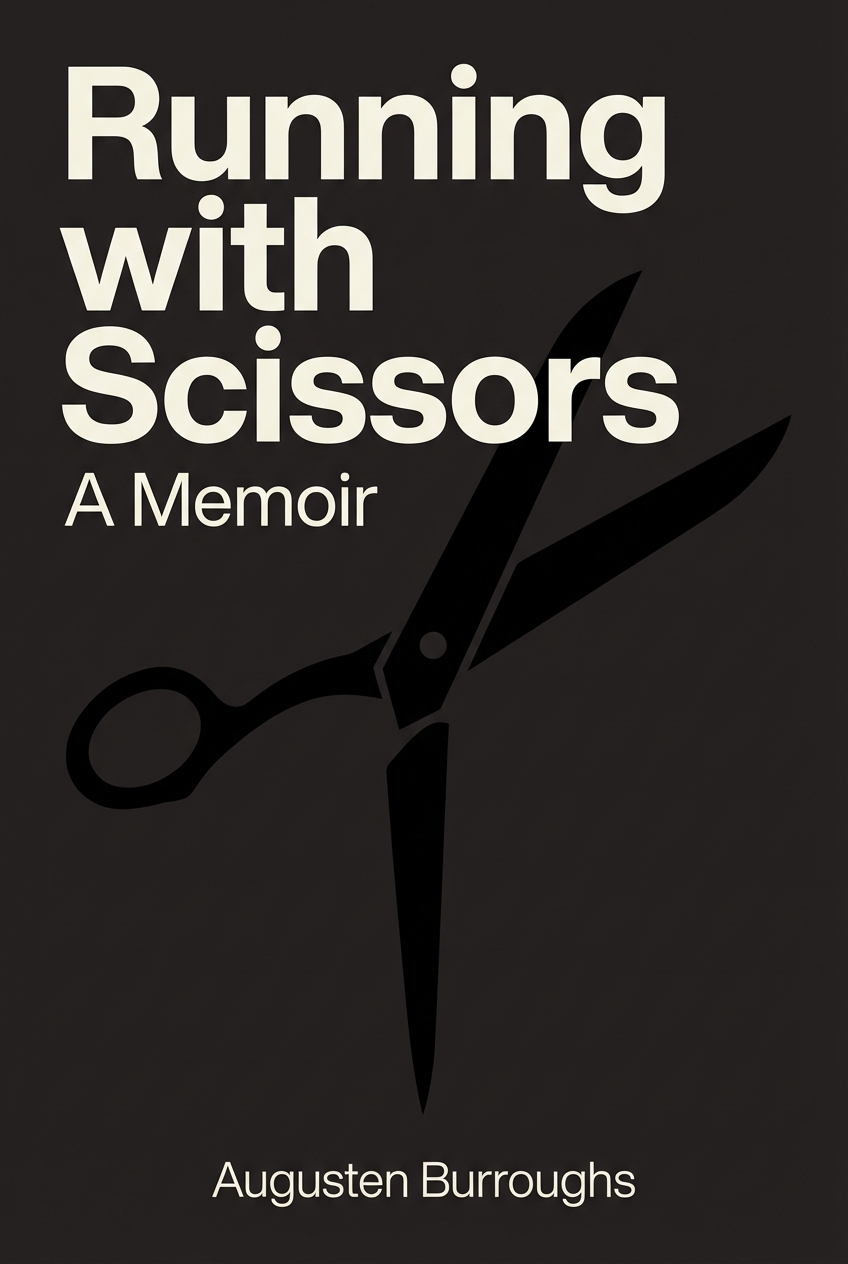
Running with Scissors
A Memoir
What's it about
Have you ever felt like your childhood was anything but normal? Imagine being handed over by your mother to live with her wildly eccentric psychiatrist and his bizarre extended family. This is the unbelievable, yet true, story of a boy's survival in a home where the rules of the real world simply don't apply. You'll discover how Augusten Burroughs navigated a chaotic adolescence filled with shocking neglect, inappropriate relationships, and darkly hilarious situations. This memoir isn't just a story of a dysfunctional upbringing; it's a powerful look at resilience, finding your identity amidst madness, and the strange ways we define family when the traditional version collapses.
Meet the author
Augusten Burroughs is the 1 New York Times bestselling author whose groundbreaking memoir, Running with Scissors, spent over four consecutive years on the bestseller lists. His work is celebrated for its unflinching honesty and dark humor, stemming directly from his unconventional and traumatic childhood spent living with his mother's psychiatrist. This unique personal history provides the raw, authentic, and unforgettable voice that has captivated millions of readers and redefined the modern memoir genre.
The Script
Imagine a child's bedroom, but instead of posters and toys, the walls are lined with a chaotic collage of prescription pill bottles, medical textbooks, and the detritus of a dozen half-finished, manic projects. There are no clear rules for bedtime, no set dinner, no parent asking about homework. Instead, there's a rotating cast of adult patients wandering through the halls, each one a universe of instability. In this house, normalcy is the visitor, and chaos is the permanent resident. It’s a world where the lines between caregiver and patient, adult and child, sanity and madness are erased entirely, leaving a young boy to piece together a sense of self from the fragments of a world that has come completely undone.
This was Augusten Burroughs's teenage reality. His memoir, Running with Scissors, is a story he survived. After his parents' marriage dissolved, Burroughs was sent by his mother to live with her unconventional psychiatrist and the doctor's bizarre extended family in their dilapidated Massachusetts home. The book is his firsthand account of that time—a raw, darkly hilarious, and often shocking chronicle of a childhood that defied all logic. He wrote it as a way to document the unbelievable absurdity he was living through, capturing the events with the unfiltered, immediate perspective of someone trying to make sense of a life that had spun wildly off its axis.
Module 1: The Normalization of Absurdity
When you're a child, your environment defines normal. What happens when that environment is profoundly broken? You adapt. This is the first major theme of the book. Burroughs is dropped into a world that should be terrifying. But he learns to navigate it. The key is that in a dysfunctional system, absurdity becomes the new baseline.
The first insight here is that survival often requires adapting to and even embracing chaos. When Augusten first arrives at the Finch house, his expectations are shattered. He imagines a doctor's pristine home. He finds filth, neglect, and danger. A young child, Poo Bear, defecates on the carpet while his aunts cheer him on. An old electroshock machine is treated as a toy. This is a complete breakdown of societal norms. Yet, Augusten doesn't just recoil. He observes. He recalibrates. He starts to find a perverse comfort in the madness because it distracts from the pain of his parents' abandonment. For a professional navigating a chaotic project or a volatile market, this is a powerful reminder. Sometimes, the first step is to understand the internal logic of the chaos and find your place within it.
Moving on from adaptation, we see how the lines between reality and performance blur. In unstable environments, people adopt theatrical roles to cope and exert influence. Dr. Finch is a performer. He organizes a "World Father's Day" parade, wearing a suit covered in balloons. He uses psychological jargon as a weapon in family arguments. His daughters, Hope and Natalie, learn this behavior. They turn fights into dramatic spectacles, accusing each other of "projection" and "denial." This is theater. It's a way to feel powerful in a powerless situation. Augusten learns this too. He begins to see his own life through a cinematic lens, finding a strange glamour in the dysfunction.
But what happens when the absurd becomes your teacher? The author suggests that eccentric rituals can replace traditional guidance in the absence of stable authority. The Finch family has "bible-dps." They ask a question, open the Bible to a random page, and point. The word they land on is God's answer. Hope uses this method to decide whether to visit a friend or choose a sandwich. Augusten, starved for parental guidance, becomes addicted to this ritual. It gives him answers. It provides a sense of certainty in a world that has none. For us, it's a stark illustration of the human need for frameworks. When reliable leadership is absent, people will create or adopt their own systems, no matter how irrational they seem.