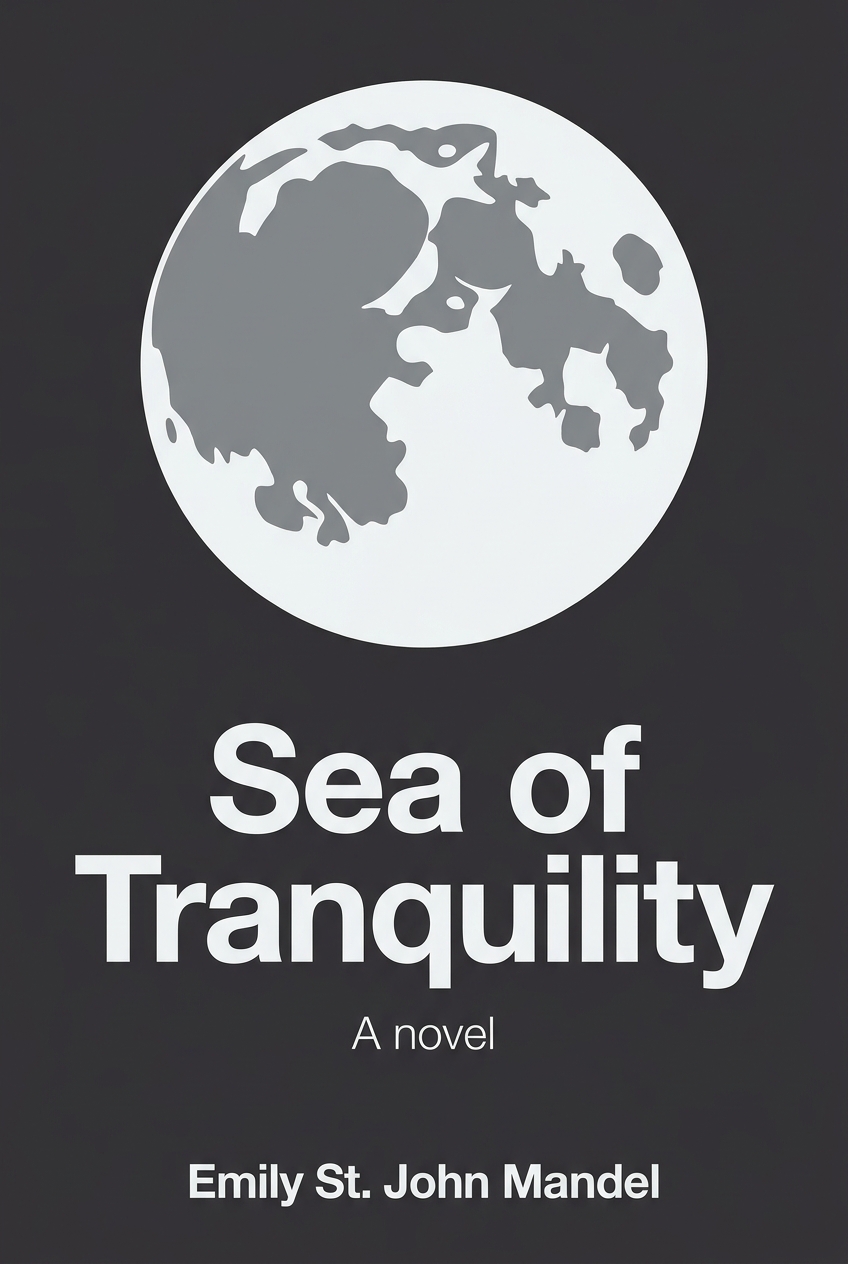
Sea of Tranquility
A novel
What's it about
Have you ever felt like you're just a glitch in a much larger simulation? Discover a sprawling mystery that connects a cursed violinist in 1912, a novelist on a 23rd-century moon colony, and a detective investigating an anomaly that ripples across time itself. This isn't just a story; it's a profound exploration of humanity's biggest questions. You'll uncover how art, love, and plagues echo through centuries. By following the clues, you'll question the very nature of reality and find a surprisingly hopeful answer to whether our lives are truly our own.
Meet the author
Emily St. John Mandel is the award-winning author of six novels, including the global bestseller Station Eleven, which was a finalist for a National Book Award and the PEN/Faulkner Award. A former dancer and conservatory student, Mandel's work often explores the intersections of art, civilization, and human connection across time and space. Her unique background informs her intricate narratives, weaving together disparate lives to question the nature of reality, memory, and our place within the vast tapestry of history.
Opens the App Store to download Voxbrief

The Script
A composer writes a complex sonata, each note precisely placed. A century later, a violinist finds the sheet music. She plays the notes perfectly, but the music feels hollow, a technical exercise. One night, frustrated, she adds a single, dissonant grace note—an almost imperceptible flourish not in the original score. Suddenly, the piece comes alive; the ghost of the composer’s original intent, the feeling he couldn't capture on paper, breathes through the music. Two hundred years in the future, a historian studying early 22nd-century music runs a simulation of the sonata. The algorithm flags the grace note as an anomaly, an error. Yet, when the historian listens to the 'corrected' version, the soul of the piece vanishes. The anomaly was the entire point, a faint, human signal echoing through time.
This exact feeling—of a strange, recurring glitch in the fabric of reality that feels more like a meaningful signal than a random error—is what sparked the creation of Sea of Tranquility. Emily St. John Mandel, an author known for crafting intricate, decade-spanning narratives like Station Eleven, was on a book tour when she began noticing these odd, specific repetitions in her own life. A particular phrase would pop up in three different cities in one week; a specific image would appear in unrelated contexts. Instead of dismissing these as simple coincidence, she started to wonder what it would mean if they were echoes of something else, a resonance across time. Sea of Tranquility became her answer, an exploration of humanity's shared, looping journey, built from a single, haunting note played again and again across the centuries.
Module 1: The Anomaly — A Glitch in the Matrix
The entire novel revolves around a single, baffling phenomenon. It’s a glitch in reality, a moment of "file corruption" where different times and places overlap for a split second.
It first appears with Edwin St. Andrew in 1912. He’s an English gentleman exiled to the Canadian wilderness. One day, deep in the forest, he experiences something impossible. The world goes dark. He hears the notes of a violin. He feels as if he’s suddenly indoors, in a vast, echoing space like a train station. Then it’s over. The experience is so jarring he fears for his sanity. He rationalizes it as a fainting spell, a migraine. But the memory lingers, a deep, unsettling question mark.
Centuries later, the same anomaly surfaces in different forms. A 21st-century video artist named Vincent captures it in her footage of that same forest. Her video glitches, showing a brief flash of darkness accompanied by a strange cacophony: a violin note, the murmur of a crowd, the whoosh of an airship. Her brother, Paul, a composer, incorporates this "technical imperfection" into his work, turning the uncanny into art. Then, in the 23rd century, an author named Olive Llewellyn writes about the exact same experience in her novel, describing a character in an airship terminal who suddenly sees a forest and hears a violin.
Here’s where it gets interesting. These are data points. The novel suggests that reality itself may be a constructed system, and these anomalies are bugs in the code. Zoey, a physicist at the secretive Time Institute in the 25th century, connects these three events. She realizes the sound of the violin in the forest is the same sound heard in the airship terminal. The forest seen from the terminal is the same forest where the sound was heard. The moments are bleeding into one another.
This insight transforms the narrative from a series of strange events into a scientific investigation. The Time Institute is secretly studying these glitches to answer a terrifying question: are we living in a simulation? The anomaly is a philosophical probe. For a professional who builds and debugs complex systems, this concept is instantly familiar. What if the universe itself has bugs? What if those bugs are clues to the true nature of our existence?
Module 2: The Travelers — Agents of Time
To investigate the anomaly, the Time Institute employs time travelers. This is a bureaucratic, high-stakes, and soul-crushing job.
Enter Gaspery-Jacques Roberts. He’s our main guide through this temporal maze. He starts as a hotel security guard on a moon colony, his life defined by "terminal boredom." His sister, Zoey, recruits him into the Institute, seeing his keen sense of observation as a valuable asset. Gaspery’s job is to travel to different centuries and interview the people who experienced the anomaly: Edwin in 1912, Paul in 2020, and Olive in 2203.
The rules of time travel are brutally simple. You are an observer. You must not alter the timeline. The psychological toll is immense. Travelers study dossiers on people, learning their entire life stories, including the exact moment of their death. They must interview someone knowing they will die in a pandemic days later, or that their life will be ruined by a financial collapse, and do nothing. This detachment is "inhuman," as Zoey calls it, and it breaks people. The Institute is littered with the ghosts of agents who couldn't handle the burden.
So what happens next? Gaspery’s journey reveals the true nature of the Institute. Powerful institutions exist primarily to protect themselves, often at the expense of individuals. Talia, a former insider, warns Gaspery that the Institute is a "formidable bureaucracy" that will "throw you away" when you are no longer useful. The penalty for breaking the rules is severe. Rogue travelers are framed for crimes in the past and left to rot in another century’s prison system. The Institute’s prime directive is control.
This presents a classic ethical dilemma for anyone working in a powerful organization. Where do you draw the line between following protocol and doing what is right? Gaspery faces this directly. He knows the author Olive Llewellyn is destined to die in a pandemic just after his interview with her. The protocol is clear: let history run its course. But his conscience screams otherwise. This choice—between institutional loyalty and human empathy—becomes the central conflict of his life.