All Books
Self-Growth
Business & Career
Health & Wellness
Society & Culture
Money & Finance
Relationships
Science & Tech
Fiction
Topics
Blog
Download on the App Store

Seventy-Eight Degrees of Wisdom

A Tarot Journey to Self-Awareness (A New Edition of the Tarot Classic)

14 minRachel Pollack

What's it about

Ready to move beyond simple tarot card meanings and unlock the profound wisdom hidden within the deck? Discover how the tarot can be a powerful tool for self-awareness, helping you navigate life’s challenges and understand your unique journey. This is your guide to a deeper connection with yourself. You'll learn to see the Major and Minor Arcana not as separate entities, but as a complete map of human consciousness and experience. Explore the rich symbolism, archetypes, and psychological insights that have made this book a modern classic, transforming your tarot practice from fortune-telling into a transformative spiritual path.

Meet the author

Rachel Pollack is widely considered the godmother of modern tarot, whose groundbreaking book, Seventy-Eight Degrees of Wisdom, single-handedly elevated tarot from a fortune-telling tool to a system for spiritual and psychological insight. A celebrated novelist, comic book writer, and transgender activist, Pollack drew upon her diverse background in mythology, literature, and esoteric traditions to create this definitive guide. Her work continues to inspire countless readers to embark on their own journeys of self-awareness through the cards.
Listen Now

Opens the App Store to download Voxbrief

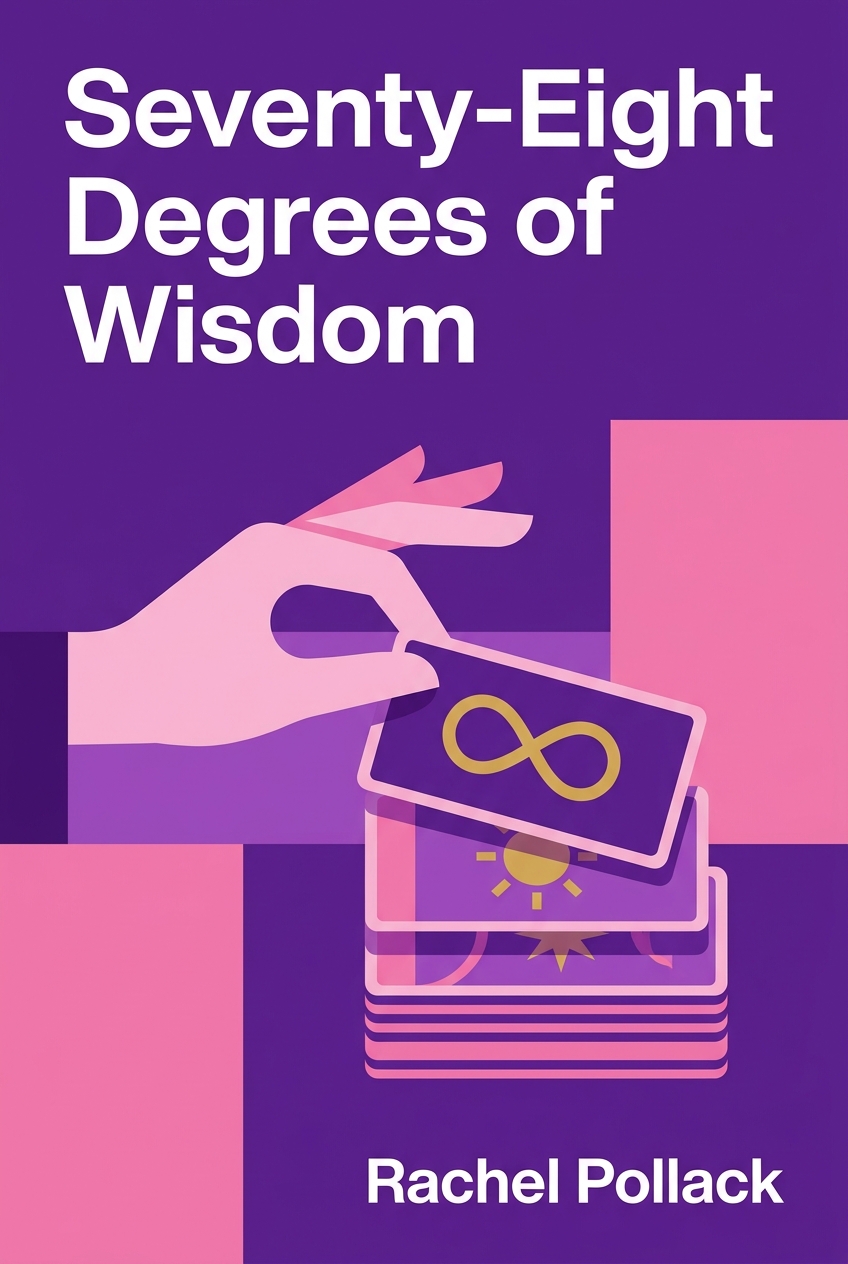
Seventy-Eight Degrees of Wisdom book cover

The Script

Two people are given a box of seventy-eight cards, each printed with a strange and evocative image: a figure hanging upside down, a chariot pulled by mismatched sphinxes, a woman calmly petting a lion. The first person spreads the cards out, memorizing charts and prescribed meanings, trying to learn the 'right' answer for what each card predicts. For them, the cards are a fixed code, a set of answers to be learned and recited. The second person does something different. They don't ask what the cards mean, but what they do. They lay out a few cards and begin to tell a story, watching how the Hanged Man's stillness speaks to the Chariot's frantic motion, or how the woman's gentle strength reframes the meaning of the lion. For this person, the cards are a deck of questions—a visual alphabet for a language the soul already knows.

This second approach, seeing the Tarot as a dynamic journey rather than a static dictionary, lies at the heart of Seventy-Eight Degrees of Wisdom. In the 1970s, as the counterculture movement sparked new interest in esoteric systems, a young science-fiction author named Rachel Pollack found herself drawn to the Tarot. But she was frustrated by books that treated the cards as a simple fortune-telling gimmick. Drawing on her expertise in literature and myth, she saw something deeper: a complete, cohesive system that mirrored the path of human consciousness. She wrote this book to hand readers a key, showing them how the seventy-eight cards form a pictorial narrative of enlightenment that anyone could learn to read for themselves.

Module 1: The Tarot as a Psychological Operating System

The central argument of the book is a radical reframing of the Tarot. It’s about mapping the deep structures of the human psyche. Pollack presents the 78 cards as a visual vocabulary for the journey of self-awareness.

Think of the Tarot as a collection of archetypes. These are universal patterns of human experience. They are the building blocks of myths, stories, and even our own personalities. The Major Arcana cards depict a complete psychological journey toward wholeness. It’s a sequential story of maturation, from innocent potential to integrated wisdom. The journey begins with a fundamental split in human consciousness, the experience of duality. We feel a gap between our inner vision and outer reality. We sense a division between our mind and body, or our masculine and feminine energies.

So how does the Tarot illustrate this? It starts with four key cards that form a foundational pattern. The Fool, card zero, represents a state of pure, undivided potential. He is innocence and freedom, existing before the split. Then come The Magician and The High Priestess, cards one and two. They are the archetypal opposites. The Magician is the active, conscious, masculine principle that shapes the world. The High Priestess is the passive, unconscious, feminine principle of deep, intuitive wisdom. They represent the core duality we all experience. The goal of the journey is to unify these opposing forces. This is the entire purpose of occult disciplines, including the Tarot. They begin by isolating life’s core elements so we can see them clearly. Then, they provide a path to blend them back together.

This journey reaches its destination in The World card, number 21. The World dancer holds symbols of both The Magician and The High Priestess, but holds them lightly. She has integrated these opposites. She has moved from the simple innocence of The Fool to the earned wisdom of The World. This is about achieving a higher, more conscious freedom. And here's the thing: this framework isn’t just theoretical. You can consciously use the Tarot's structure to diagnose and integrate your own psychological splits. By identifying which archetypes are dominant or suppressed in your life, you can begin the work of bringing them into balance. Are you all Magician, constantly doing and achieving but disconnected from your intuition? Or are you all High Priestess, full of deep feelings but unable to manifest them in the world? The Tarot gives you the images and the language to start that work.

Read More